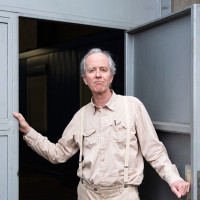
My name is Jussi Parikka – would you like to see my playlist?
Music involves a mix of noise, of existing or fabricated instruments, of alternative worlds that the sounds and voices assemble.
Use " " to search for an exact phrase. Use AND, OR, and NOT (in caps) to refine your search.
Music involves a mix of noise, of existing or fabricated instruments, of alternative worlds that the sounds and voices assemble.
What a strange release, nostalgically so in its way. And how creative.
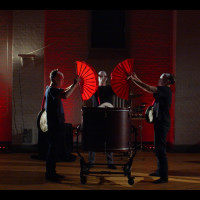
It is saturated, direct, and seemingly made for a grippingly intense choreography. A powerful partnership on the grand stage.
»Music is a full bodied, raw and physical exchange. It’s an absorption that is overwhelming, that sometimes grants you relief.«
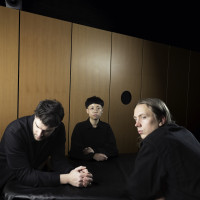
With »Music for Lovers«, the Swiss drummer and electronic musician Samuel Rohrer gets many things right. But the songwriting, unfortunately, falls short.
There was no affected distance or feigned coolness – only pure, unadulterated musical beauty.
For me music is an irregular yet life-long event that requires constant attention in the form of private preparation, rehearsals with others, and performances to audiences.
Heaven, hell, love and country – life’s biggest mysteries were studied at the Polish festival Sacrum Profanum. And it ended well for two Danes.
Emotionally potent, and filled with pleasing, warm synth tones that recall 1970s German Kosmische Musik.
Music to me is a hyperdimensional portal.
It is through knowledge of the art-form and skilful weaving of networks of symbols, that creatives can dictate the terms of storytelling and thus exert their power over the audience.
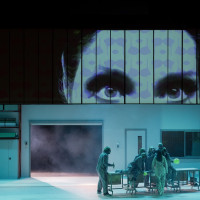
In the musical theater performance »Calls to this number are being diverted« Matthew Grouse puts the absurd working life of late modernity under the microscope.
The essay probes poetics and the politics of a life-affirming operation in which Ukrainians have been self-engaged to resist subjugation and assimilation under Russian colonialism.
I like when it's impossible to tell at first if something is black or white, or country or blues, or whatever
This audio paper narrates through the experiences and ambiences of Russian aggression to which Ukrainians relate a long history of Russia’s imperial statehood.
Democratic conversation and collectively improvised music have such pronounced similarities that improvisations can be discussed in terms of their democratic potentiality.
The sound of the slogans at the demonstrations touches the body, it is impossible to hide from. The vulnerability revealed through this touch creates immediate affective responses pointing at the limitations of sonic support and solidarization.
This article researches the role of the Human body in the production of sound art in the exhibition space. It focuses on the spatial path between body and sound in the exhibition space of sound art.
Operating rooms are typically noise filled environments, where polyrhythms and polyphonics of human and non-human sounds collide. In this paper the operating room soundscape is used for relational ethnographic exploration, framed in critical affect theory, and brings together insights from medical sociology and sound studies.
In the audio-paper »Fear of Weakness: Songs to Agitate the Man«, artist Morten Poulsen builds on his project »Boys Will Be…« (2022), in which he met with young cis-men to have conversations about vulnerability, intimacy and masculine norms
Following Ruiz and Vourloumis, this audio paper performance sounds a formless formation, exploring integrity and wholeness among Black and Indigenous collectives that organize via radical forms of togetherness outside state-sponsored institution
This audio paper explores the »acoustic territory« (Labelle, 2010) of Peckham Rye Lane through my sonic journey as a Peckham resident, practitioner, and researcher.
I went on an artist residency in Tokyo in 2018/19 for three months and ended up spending most of my time in karaoke boxes. I don’t remember what my actual project was but in the birthplace of karaoke, amateur singing of pop songs was all I could think of.
For over 4000 years, the Inuit in Kalaallit Nunaat, as Greenland is called in Greenlandic, have been living in an intimate relationship with nature in the Arctic. Their knowledge of how to survive under such harsh conditions has been preserved and passed on via sound through the millennia.
The article analyses the genre of listening scores – texts written in a natural language that provide the readers with instructions to listen in a certain way or to a certain kind of sounds.