






Samsø Finds a New Sound
»Folly and fun«, a good, innocent and joyful time: this is how Alison Statton characterizes the proverbial salad days in the song of the same title from the groundbreaking album Colossal Youth of the Welsh post-punk band Young Marble Giants. It is hard to describe better the experience of the second edition of the Salad Days festival, which took place on the Danish island of Samsø on August 14 and 15, 2026 – and it proves the organizers' decision for the title right: in a thoroughly DIY manner, Johann Kauth and his partner Hannah Giese went through their record collection looking for titles that would make a good festival name. »We love the song anyway, so it was a perfect fit,« Kauth recalls, and adds how the name kept resonating since the first Salad Days festival in 2024: »a mixed salad of artistic contributions, the reference to Samsø as the vegetable island, and the curious, somewhat green-behind-the-ears approach of the programme – freshness, not least.«
Salad Days is kept small on purpose and open to people from all walks of life
The idea, however, grew out of their previous lives in Amsterdam and Antwerp, where Kauth and Giese already organised concerts, exhibitions and small festivals, often combining music and sound art with visual art, before they moved to Samsø in 2020 and founded the association Terraform in 2021 together with friends. It serves as a framework for connecting local, national and international artists to create a dialogue with the island’s community, work in solidarity, produce art locally and organize events and workshops, in particular for children and their families. The first Salad Days festival two years ago was the first bigger event Terraform organized with the support of a multitude of volunteers.
For its second edition the festival again brought to Sambiosen, the island's sports and cultural centre in Tranebjerg, sound art and indie culture from all over Denmark and the rest of the world – from Japan via Colombia to the United States: 31 acts on two days, with Jonas Olesen's presentation of his book Pionerer & Outsidere. Dansk Elektronisk Musik 1928–1980 at Samsø library as a warm-up the evening before. Throughout the two festival days, the sound and short film AKVAREL by Knud Viktor was on show. All of this gave the Seismograf critic a lot to listen to and think about. Put in a wider perspective, one quickly realizes that this wild mix of experimental and electronic music, sound art, rap, dub, free jazz and noise is exactly the sound that has been lacking on Samsø, and that it holds considerable potential – for the scene it connects to and for the island itself.
When the Machine Answers Back
This year's combination of live concerts in the cultural centre and on the skate park in front of it, with its DJ sets, art performances, installations and sound walks, resembled a testing ground for improvisation, for experiments with new languages and modes of communication, for artistic research in real time, performed in front of an interested, even enthusiastic audience of approximately 200 visitors over two days. Explicit artistic research – in Henk Borgdorff's sense of generating insight in and through creative practice itself – was on display on day one of the festival in the performance by Carolyn Goodwin, founder of the Copenhagen Clarinet Choir, and Michael Mørkholt, composer and member of the Copenhagen-based group År & Dag. For thirty minutes, the duo pursued a single question: can you improvise with a listening machine?
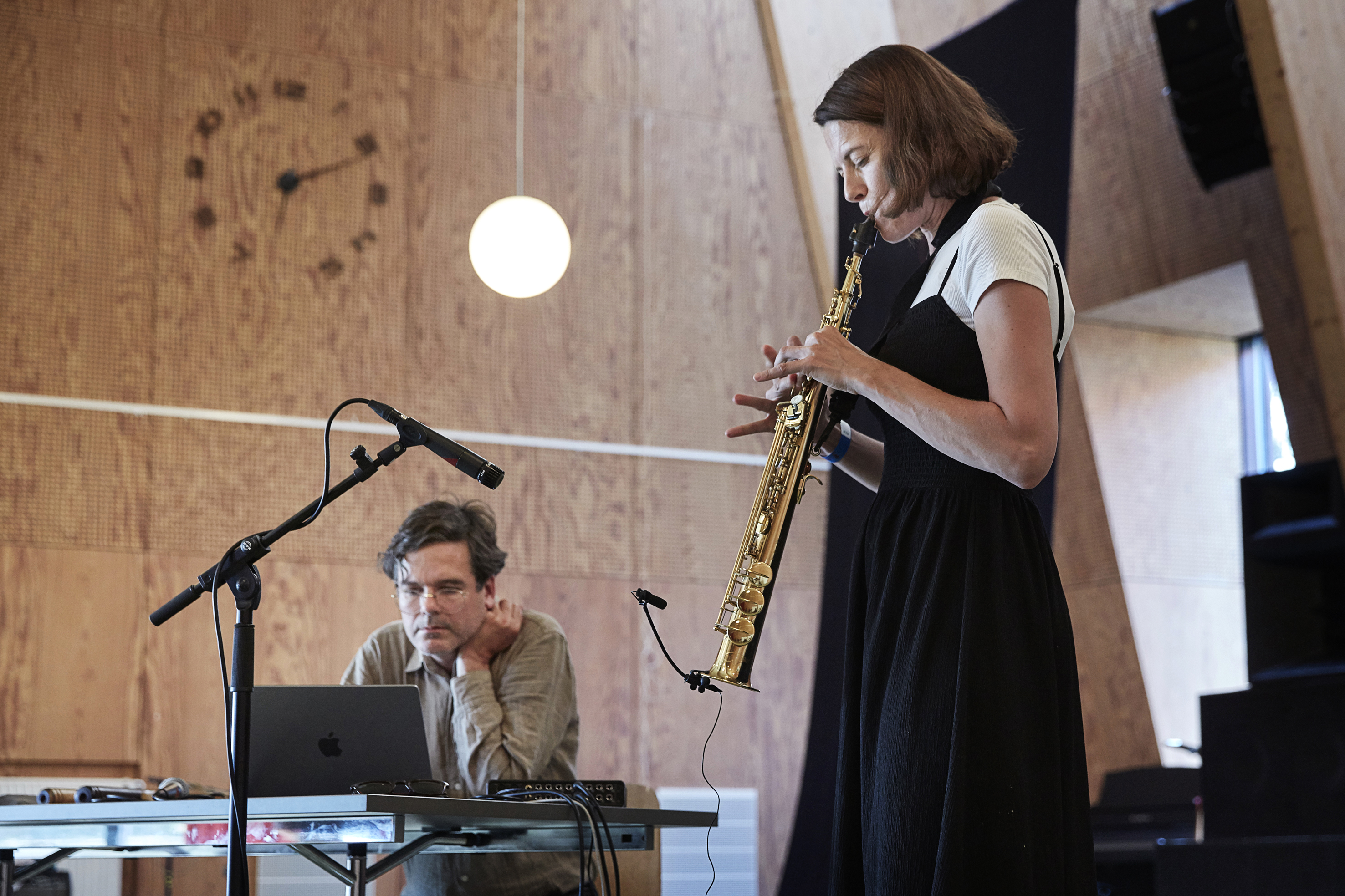
Mørkholt's system, which he calls the Answering Machine, responds instantly to acoustic input, mirroring what it hears or conjuring new forms from it. He describes his interest not as a binary between human and machine, but as a form of cross-pollination, with the system acting as a co-performer within its own cybernetic logic – listening, interpreting, intervening. While Goodwin played soprano saxophone, Mørkholt operated the system, and what emerged was a continuous feedback loop in which both agents modulated each other, the machine answering her lines with flickering and chirping textures. In contrast to this cybernetic setting, experimental filmmaker and sound artist Floris Vanhoof from Antwerp focuses on media archaeology and favours analogue technology for its richness. His performance on the first evening paired a 16mm film – flickering projections of nature footage racing past at a speed that outran recognition – with live modular synthesis to test the limits of perception.
The idea came to him in the darkroom, he explained in conversation: he had noticed that developing photographs while listening to music produced different results. Artists, he concludes from this, should not think in separate categories. At Salad Days Vanhoof also showed Talking Gongs: two large discs suspended in cubic frames among the trees along Pillemarksvej, on the way to Sambiosen. They work as speaker membranes, translating vibrations from small electronic circuits into sound – and into a dialogue with the surrounding habitat and its inhabitants.
Listening to the Landscape
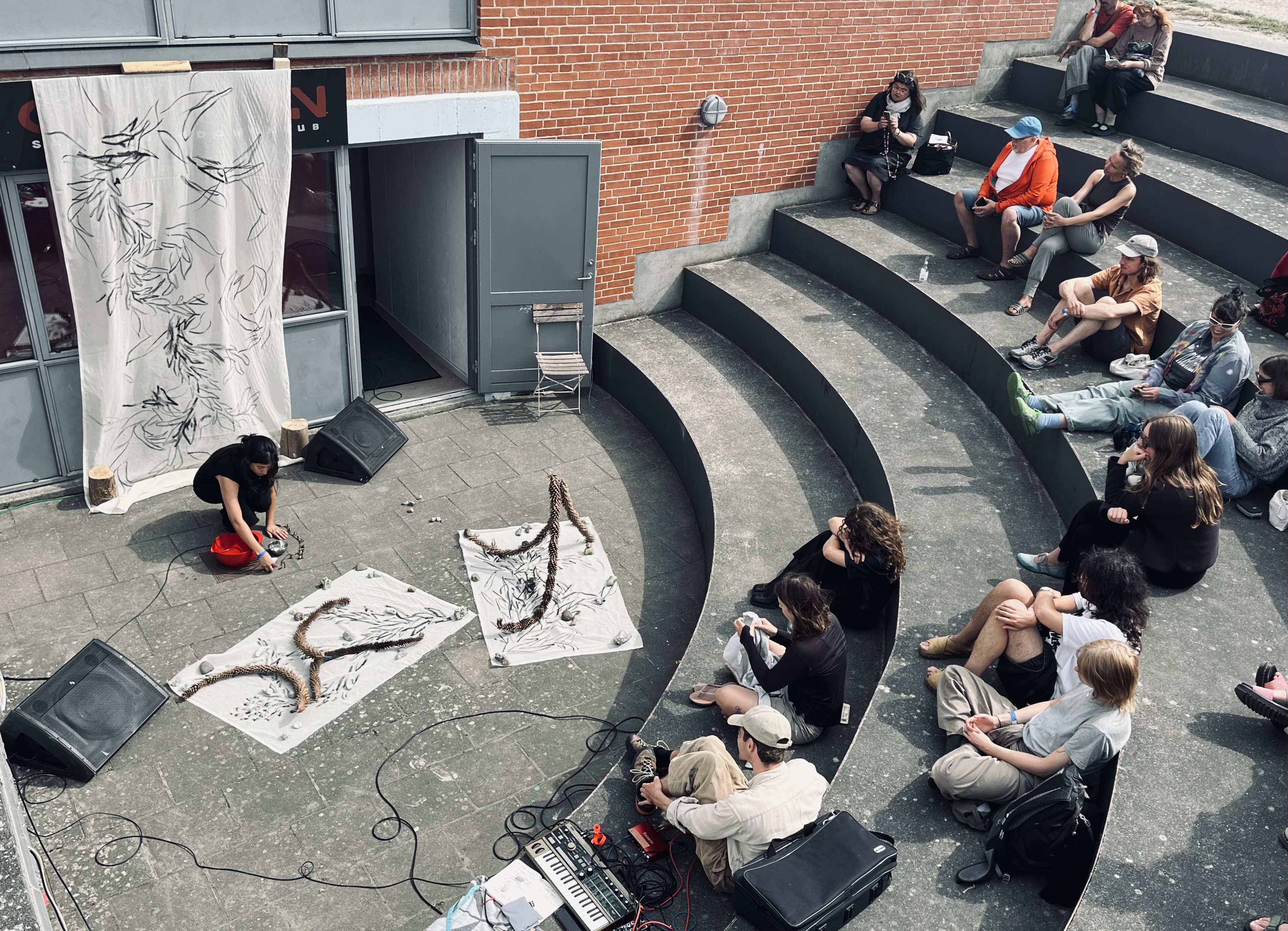
This dialogue between instrument and environment became an acoustic interplay between human and nature in the performances of Valeria Oggioni and Nele Möller. The Cologne-based Colombian musician, artist and sound designer Oggioni performed her ambient piece in the open-air amphitheatre in front of the local youth club Grotten: a meditative dialogue between wood, stone, water, textiles and sound, using branches of the monkey puzzle tree, a species that dates back some 200 million years — a living fossil from the age of the dinosaurs that has survived many of this planet's ecological transitions.
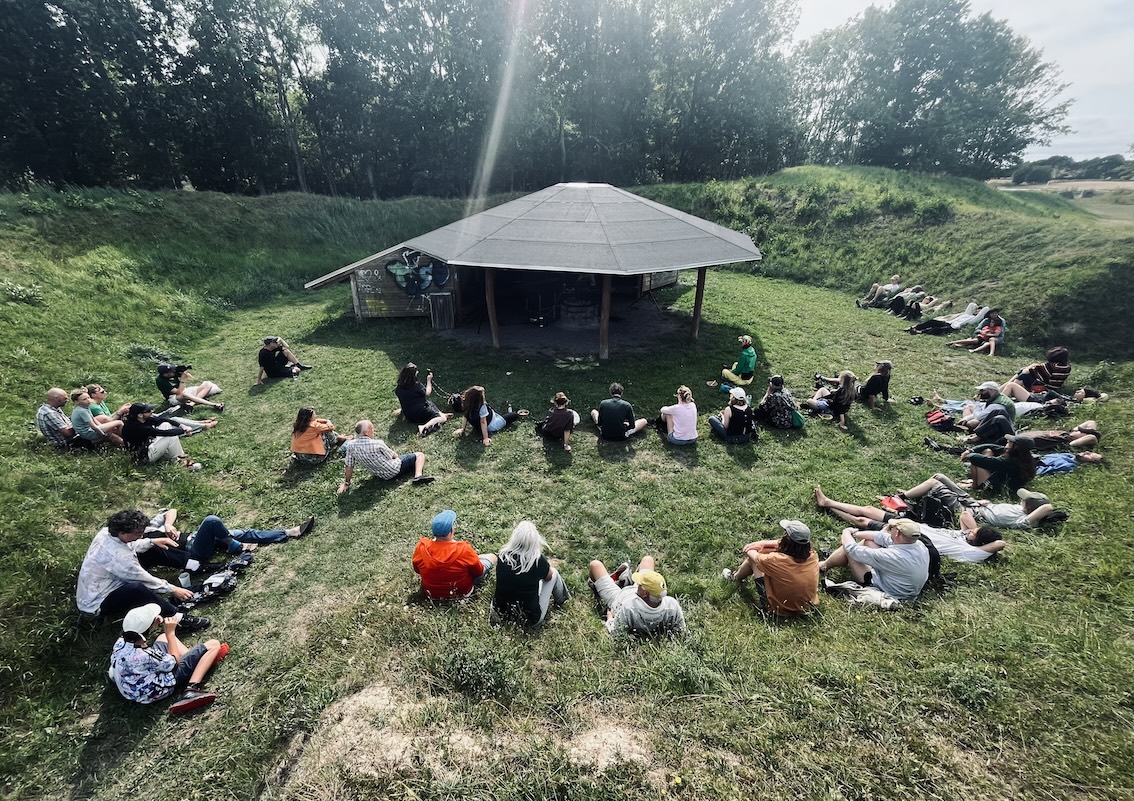
Nele Möller's performance focused on the human–animal relationship by questioning and interrupting traditional orders and hierarchies. The Brussels-based German artist performed at the cave-like Shelter in the park next to Sambiosen, where she presented her large collection of hunting calls. Instead of using them to lure deer or ducks in order to kill them, Möller took the calls out of their context and played them as instruments.
Both performances have a prehistory on the island: the Grøn Musik festival in 2025, initiated by Terraform, and the exhibition Læg Øret til Jorden (2023) on the Danish eco-music pioneer Knud Viktor, produced by Kauth for the island's Billedkunstråd (art council). Both aimed at altering the human–nature relationship in times of climate change through listening.
What a small festival without the professional apparatus of the Samsø Festival gains in openness, it risks in durability
Music to Make Together
The second day opened with Folk på Samsø, and in a sense the band embodies the principle of the whole festival: a meeting of very different people in one sound. Their two-hour jam in the tradition of free jazz ran in two parts – the band alone for the first hour, the audience invited to join in for the second, so that people between seven months and sixty-nine years old ended up making music together.
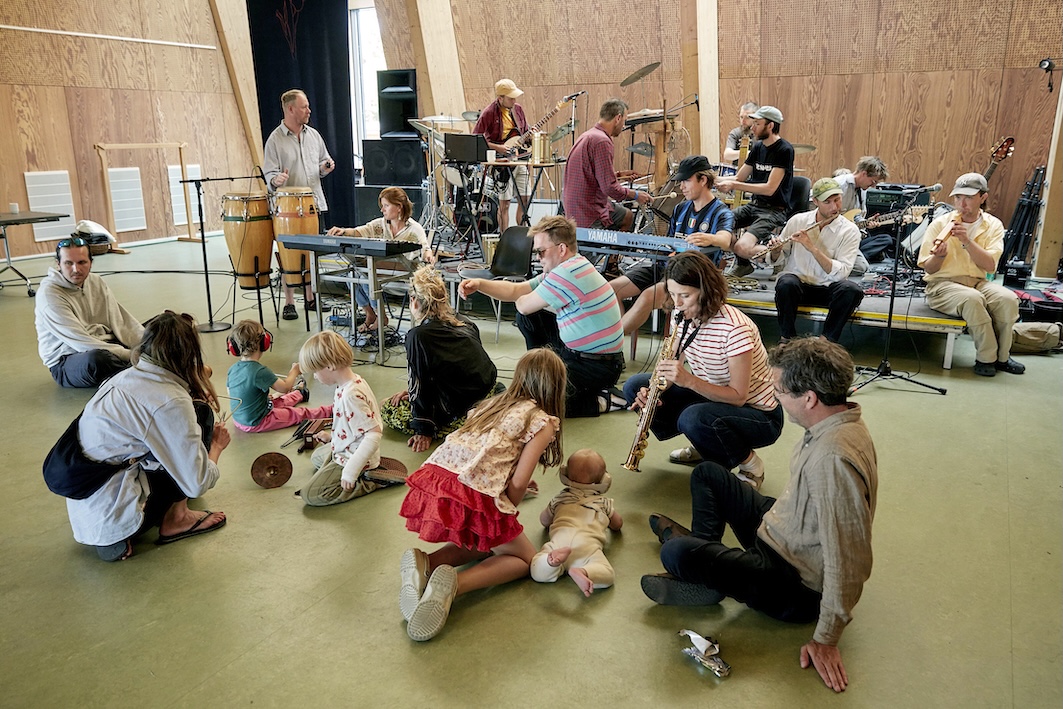
It was one of the clearest illustrations of what Jacques Attali called composition, the fourth stage of music, in which people make music for themselves rather than consume it. The other illustration of this idea, in a different key, was the audiovisual duo of Jenny Gräf and Stephanie Barber, both born and raised in the United States, on their first joint European tour. Barber, an experimental filmmaker and video artist, worked with an early mini DV camcorder, filming photographs of ornate gardens from the 1970s on a table at which she sat and projecting them onto a screen, while constantly shifting the relation between surface, lens and light. Gräf answered with small synthesizer, loops, samples, voice, chimes and a self-built bowed instrument, working extensively with uncanny noise. What made it more than an accompaniment was the mutual conditioning. »I'm changing the images based on what I am hearing from Jenny, and Jenny is changing the sound based on the image I am making,« Barber explains — »an infinite loop of response.« Where Goodwin and Mørkholt improvised with a machine apparently harmoniously, here two artists improvised across media, each influencing the other's material and creating at times an atmosphere that stood in sharp contrast to the festival's generally warm, communal vibe.
An Ecosystem with Fragile Roots
Salad Days is kept small on purpose and open to people from all walks of life, as Kauth describes Terraform’s vision: the anchoring of a network of independent musicians and artists, meant to foster exchange among them, inspiration through new perspectives, and collaboration on a local, Danish and international level – »small enough for people to get to know each other, share experiences and make new contacts.« Organizing such a festival of friends, however, requires a great deal of work from the organizers and their around thirty volunteers.
What a small festival without the professional apparatus of the Samsø Festival gains in openness, it risks in durability: it rests on individuals. That is its quality and its fragility at once. Whether Salad Days becomes the island's third register – alongside the pop of the Samsø Festival and the classical canon of the Søholm Opera – will depend on whether the network it anchors grows roots strong enough in the Samsø soil to carry it.
Salad Days, Samsø, August 14-15 2026