






When the World Trembles, Kirkenes Listens
It nearly happened that the opening had to begin without its keynote speakers. Norway’s Minister of Local Government and Regional Development and several of the festival’s artists circled for hours above Eastern Finnmark while a thick fog hung over Kirkenes. Only after a diversion to Lakselv and several hours of waiting did the sky finally clear. An Arctic prelude of uncertainty.
My own flight was delayed by a full day. I had to give up the opening show and the concert with the Lapland Chamber Orchestra.
Seismic data from Kharkiv and Kherson, cities marked by war, were transformed into sound: low-frequency waves, dense drones, metallic overtones
Kirkenes lies 15 kilometres from the Russian border – a white edge zone facing east. Snow falls in minus 21 degrees Celsius, the fjord heavy and grey. It looks like a remote periphery. Yet beneath the surface the landscape vibrates. At this year’s Barents Spektakel (19–22 February), it was precisely these vibrations that took centre stage.
Down in a cave in the middle of town, two electronic musicians from opposite parts of the world – American Mark Bain and Ukrainian Khrystyna Kirik – performed The Core. Seismic data from Kharkiv and Kherson, cities marked by war, were transformed into sound: low-frequency waves, dense drones, metallic overtones and trembling high-frequency textures.
Bain, who previously recorded the tremors in New York during 9/11, works with the hidden frequencies of buildings and the earth itself. In Kirkenes, the vibrations travelled through the rock walls; the bass pressed heavily against the chest. The body became a resonance chamber for distant explosions and subterranean shifts.
Meanwhile Kirik sang through a throat microphone. The filtered voice slid in and out of the pressure of the drone – a human frequency within the geological darkness.
After an hour we climbed out of the cave again. Snow was still falling. The silence above the town was almost deafening.
When Barents was a buzzword
The festival Barents Spektakel, created by the organisation Pikene på Broen, has since the 1990s operated at the intersection of art and geopolitics. Here, 400 kilometres north of the Arctic Circle, geopolitics is not merely analysis but an atmosphere – something felt in infrastructure, language and everyday life.
Quoting Hegel, she noted that history teaches us that we learn nothing from history. It repeats itself
Many languages are spoken in Kirkenes. Signs appear in Norwegian, Sámi, Finnish and Russian. At the Transborder Café – built for the festival – with dried fish on the menu, discussions revolved around security policy and possible futures.
This year’s theme was The Border Crossed Us. The northern border between Finland, Russia and Norway turns 200 years old this year. The festival therefore asked how the region might look if the line had never been drawn – and how it might appear 200 years from now.
At the Transborder Café, Gøril Johansen spoke with a diplomat’s mixture of sobriety and doubt. She openly asked whether what is happening in Ukraine could also happen here. She referred to Davos and the Munich Security Conference, where Europeans have had to acknowledge that old security guarantees no longer apply. Quoting Hegel, she noted that history teaches us that we learn nothing from history. It repeats itself. The question is what one does here in Kirkenes.
Writer Aslak Bjørn recalled the optimism of the 1990s, when Barents was a buzzword – a promise of cross-border community. »Barents is over,« stated Sør-Varanger’s mayor Magnus Mæland. The war has changed everything. Yet he insists on the importance of everyday life. One in five residents in the municipality is not Norwegian, and Russians have always lived in the region.
Peace researcher Marcela Douglas spoke about »deep peace« – a peace that still exists in the region, but which has become thinner. »When the war ends one day, we will need institutions that can rebuild trust. Deep peace is not sexy. It sounds naïve. But it should be.«
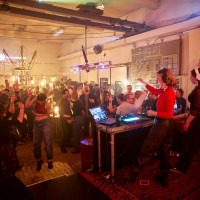
The evening continued with deep house from Tjukk & Bart and Charlotte Bendiks, described in the programme as »DJ, producer, and a positive thinker – the northern ambassador of distant intimacy.«
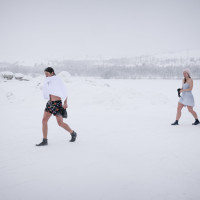
The festival also featured electronically distorted microtonal folk by Naaljos Ljom and morning raves where participants danced before jumping into a sauna and lowering themselves into a hole in the ice.
Listening to the frequencies of war
Sound was a central axis of this year’s festival. At a discursive programme in a former hospital in Kirkenes – under the title Attack. Release. Resist. – conversations revolved around vibrations, drones and seismic data: sound as weapon, witness and resistance.
Steve Goodman – also known as Kode9 – opened with a performative lecture based on his forthcoming book Notes of the Third Ear. As he spoke, drones hummed in the background like a constant alarm signal.
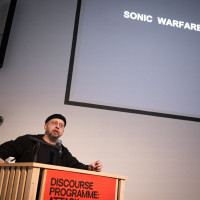
He described a world in which certain sounds promise safety while others signal threat. In Lebanese airspace, the buzzing of drones has become an acoustic memory: a bodily state of permanent vigilance.
Goodman spoke of sonic terrorism, atmospheric terror – »atmoterror« – and of a predatory ambience in Israel, where ambient music and perfume with top and base notes enter into dirty alliances.
Georgian curator Mariam Otarashvili presented the radio platform Mutant Radio, a community-driven project based in Berlin and Tbilisi. Community radio has become popular, she said, because it archives culture – voices, moods and resistance – in real time before they disappear. In fragile democracies the archive can function as a form of protection.
Later Khrystyna Kirik and Mark Bain discussed the project Disturbed Ground with curator Mariana Berezovska. The initiative investigates the ecological footprint of war. News from Ukraine focuses on weapons and death tolls, Berezovska said. But we forget the landscapes. Russia and Ukraine share soil, rivers and underground layers. Missile strikes and explosions leave not only political traces but physical ones in the ground.
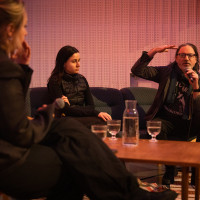
In the small conference room we listened to Bain’s recordings of the vibrations from the World Trade Center. »So this is the sound of the tower collapsing.« A deep frequency filled the room.
When we stepped outside into the white landscape again, everything – once more – was completely silent.
From Swan Lake to exile
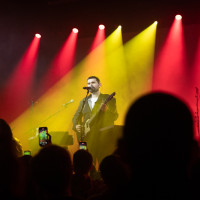
»I would prefer not to be an activist or political. I’d rather just make noise.« With these words the Russian musician Noize MC – born Ivan Alekseyev and now living in exile – opened his concert at the packed Samfundshuset. His music moved restlessly between grunge guitar, hip-hop beats and Eurodance. On stage he taught the audience how to dance the swan dance from Tchaikovsky’s Swan Lake. The ballet, long a symbol of the Russian cultural canon, has today become politicised. »Three men who danced it in the street as a protest were arrested,« Noize MC said from the stage, before singing a song inspired by the poet Osip Mandelstam. Today’s dissidents mirror themselves in those of the past. Another song drew connections to Joseph Brodsky and the poem In the Dark – the poetics of exile. When the concert ended, the backing singers stood behind him dressed in white.
Later that evening Edvard Valberg from the punk-rock band Honningbarna climbed out over the audience – many wearing thick wool sweaters – and also performed psychedelic cello.
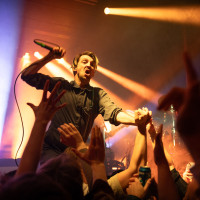
Later that evening Edvard Valberg from the punk-rock band Honningbarna climbed out over the audience – many wearing thick wool sweaters – and also performed psychedelic cello
Words that refuse to die
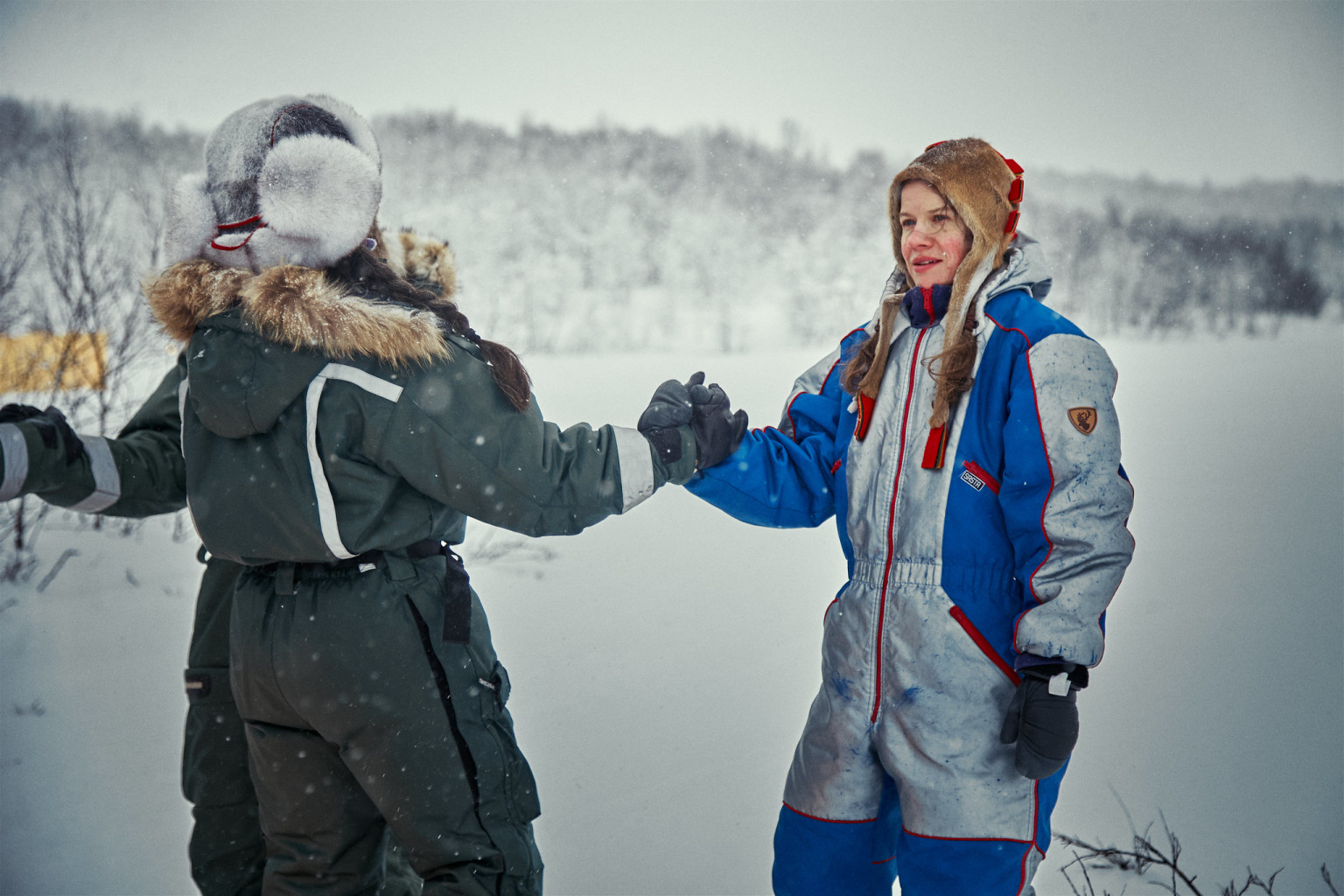
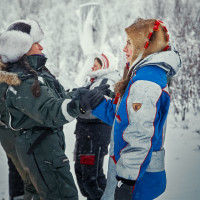
This year’s festival had a strong focus on Sámi culture. Article 3 performed their own distinctive blend of joik, beats and throat singing. And on a frozen lake a Finnish theatre group transformed trauma into a child-friendly performance titled Áávu. The darkness was broken by dance, joik and voices in several Sámi languages as well as Greenlandic. We did not understand a single word – but we danced anyway. Áávu means »joy« in Inari Sámi, and joy can also be an artistic and political gesture.
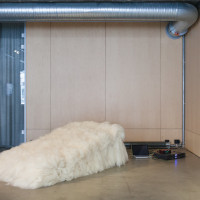
At the art space Terminal B, the sound installation Roaring Silence – with a wool-covered lounge chair at its centre – by Brith Hennie Halvorsen and Nils P. Johansen allowed natural sounds and the deep hum of hydroelectric turbines to meet the Skolt Sámi singing tradition.
On the final day we drove through snow-covered mountains to the Ä’vv Skolt Sámi Museum outside Kirkenes. Here composer Espen Sommer Eide presented the performance Dead Language Poetry. On each side of him sat a grandmother and her grandchild reading words aloud, one by one, while electronic sounds formed a subtle layer beneath.
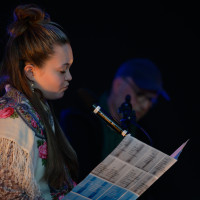
Today Skolt Sámi is spoken by around 300 people in Finland, a few in Russia – and none in Norway. During a fourteen-day expedition Eide had the entire Skolt Sámi dictionary read aloud by local speakers, documenting it on video and audio. Dead Language Poetry did not sound like an elegy. Rather like an archive of words in danger of disappearing. It was captivating.
»Maybe not yet dead language poetry,« someone suggested during the discussion afterwards. Heini Wesslin from the Finnish Sámi Parliament reminded the audience that not everything can be described with words. »Western thinking insists that everything must be articulated. But we do not always use words. Silence is important.« Then she said, with a moved voice: »We have lost the language. And now we are taking it back.«
On the way back through the mountains, the radio played worn-out pop.
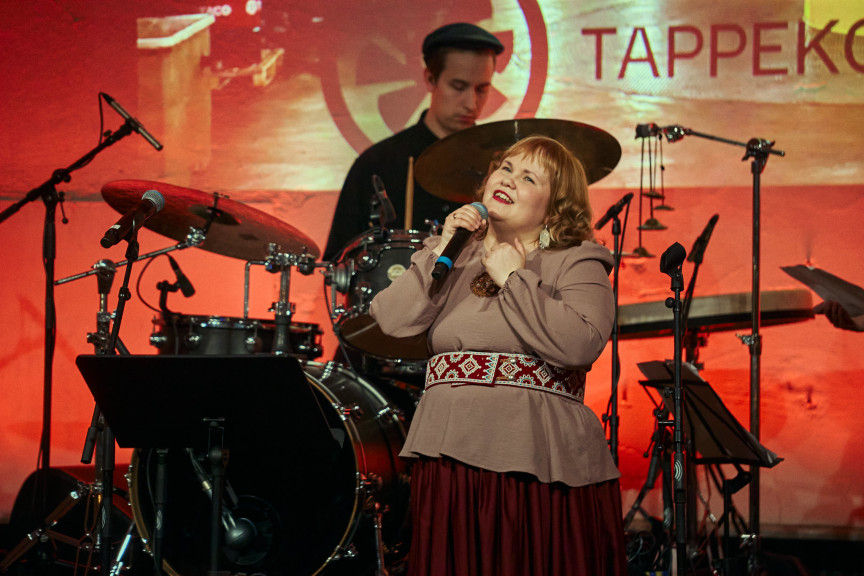
Later that evening, Suõmmkar performed Skolt Sámi narrative songs – leuʹdd – wrapped in pop and rock. Anna Lumikivi-Lemmetty and Hanna-Maaria Kiprianoff took turns singing about forced relocations, language loss and political oppression.
The frequencies of silence
The contrast with the tremors of the world could hardly have been greater than inside the former Customs House in Kirkenes. Here silence lay like an extra layer of insulation around the festival’s most subdued work: Behind The Lidless Eyes by Erja Taskinen and Tuuli Malla.
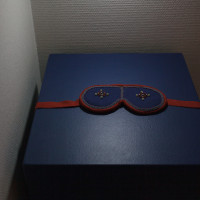
In the video, a pair of hands embroider a sleep mask in which small fish spirals form pearl eyes. The sound is almost ASMR-like: beads against fabric, a faint rustle. The sleep mask can be read as protection against the colonial gaze – a choice to regulate what is seen and what remains hidden.
In a time of predators, relationships, symbols and cultural sensitivity become an important safeguard
Outside the customs building hung Marie Skeie’s textile work If We Go Back There Are No Colours. The fabric is dyed with plants from Gaza – eucalyptus, hibiscus and olive – whose colours have slowly settled into wool and silk. Over time they will fade again: a mourning flag for a landscape in ruins – and a fragile hope that Gaza’s colours may one day emerge again.
In a time of predators, relationships, symbols and cultural sensitivity become an important safeguard. Earlier this year, the Munich Security Conference declared that the world order is dissolving.
In Kirkenes those words feel less like rhetoric than a statement of fact. Russia lies just behind the mountains, and the war in Ukraine is felt not only as a news stream but as a tremor in everyday life.
The Arctic snow can make the place appear like a peripheral stage set. Yet Barents Spektakel functions almost like a seismographic instrument: a festival that detects the tremors of a world in motion – and translates them into sound, conversation and art. When the world trembles, Kirkenes listens.
Barents Spektakel, Kirkenes, Norway, 19-22.02