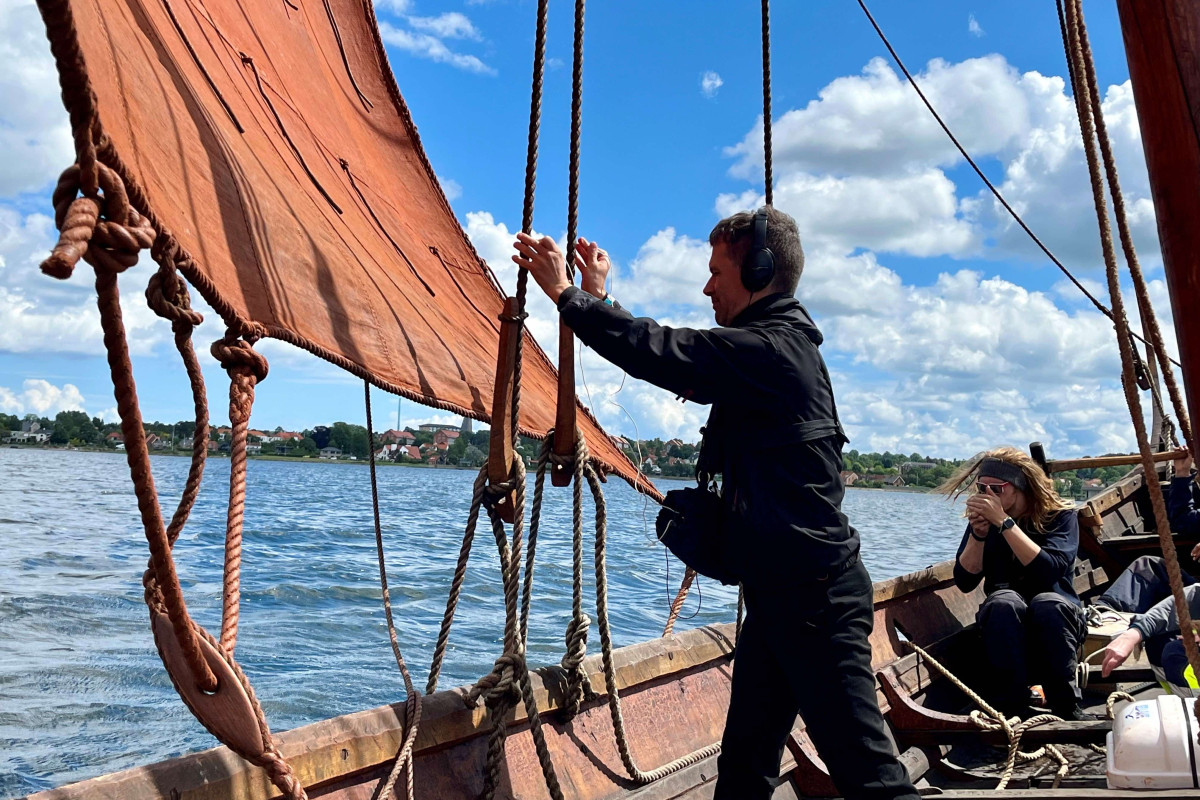
© Vikingeskibsmuseet i Roskilde

Sound artist Jacob Kirkegaard records sounds to connect with the world – to endure what is happening. This time, it's a commissioned work for the Museum of Copenhagen, created to accompany the exhibition of an excavated shipwreck from the harbor. The result is Naufragium (Latin for shipwreck) – gently lapping, quiveringly simple, and almost self-effacingly discreet. And in this way, everything aligns: the story of life in the harbor during the late Middle Ages is only known through rare, major events, while the bustling everyday life, connecting it to the larger world, has drowned in anonymous oblivion.

The shipwreck itself is barely recognizable. A series of ship planks – up to 14 meters in length – suspended on mirrors and supplemented by 11 crossbeams. That’s it. The light in the museum’s narrow room is dimmed, and the windows are covered with film. We are submerged into the depths of the water.

The sound loop lasts 39 minutes if one wishes to listen to it in full. Small sounds are distributed across seven speakers – four in the ceiling, three beneath the wreck. Carefully placed, the gentle lapping, dripping inserts, a trembling rustling like a nerve pathway above, and muffled sounds of wood shifting in water are heard. A kind of foghorn also makes an appearance. All of it is subtly arranged as a soundscape for a silent protagonist, staged through sound. There were likely very few storms, cannons, or other forms of grand drama in the ship’s perhaps 300 years as a cargo vessel in the Copenhagen Harbor before it sank in the 18th century. But if one looks closely – and opens their ears – it bears tangible and truthful witness to the kind of history most of us inherit: the ordinary one.

© Peter Gannushkin

»Music for me is a world full of sound that you can explore, juggle with, systematize, be inspired by and form a starting point for meetings between people across cultures and generations.«  

Håkon Berre (b. 1980) has made his mark as a central figure on the Danish improvised music scene. His practice is characterized by an expanded approach to percussion, where both traditional instruments and everyday objects – such as doorbells, tin plates, chains and kitchen utensils – are included in a nuanced and often unpredictable sonic expression. He has performed at clubs and festivals internationally and collaborated with a wide range of notable musicians, including Peter Brötzmann, Phil Minton, Axel Dörner, John Tchicai, Jamie Branch and Otomo Yoshihide. Berre contributes to an extensive discography with more than 40 releases, many of which on the artist-run label Barefoot Records, which he co-founded. He has also composed and arranged music for theatre and exhibitions, and worked on interactive sound installations shown in museums in Denmark and Germany. He is active in a number of ensembles and collaborations, including Ytterlandet, TEETH, VÍÍK and Mirror Matter, as well as in various duo and quartet constellations.

© Niklas Ottander

»Music is a deep, but not serious, spiritual practice, in which creator, collaborator, and consumer alike are their own personal pope.«

James Black (b. 1990) is a composer, performer, and artistic director of Klang Festival – Copenhagen Experimental Music. Originally from Bristol, England, they moved to Copenhagen in 2013. Black's works have attracted a large amount of attention both nationally and internationally for their signature combination of artistic courage and vulnerability, described by the Danish Arts Council as »a universe of real madness where everything goes«. Their work is a deep and personal exploration of topics such as religion, loss, and queer identity, that is unafraid to be stupid or serious in any direction.

© Christian Klintholm

»Music is just something for me.«

Christian Juncker is a Danish musician and songwriter who has released a number of Danish-language albums. He debuted in 1995 with the band Bloom. Together with his friend Jakob Groth Bastiansen, he formed the duo Juncker in 2002. He is also behind the Christmas carol »Luk julefreden ind« from 2024.

© Guy Wasserman

»Music, for me, reveals the emptiness of boundaries and definitions – in consciousness, in space, and in music itself.«

Idan Elmalem is an oud player and composer working across world and popular music, now presenting his debut instrumental EP and live performance project. Following years of collaboration within the Israeli music scene, he turns toward a more personal and intimate musical voice, blending traditional oud with a contemporary sensibility. Influenced by his studies with master Nissim Dakwar, Elmalem’s music explores the space between tradition and innovation. His debut EP, Time, features three live-recorded pieces that move between past, present, and future, combining classical Arabic and Persian elements with jazz, minimalism, and cinematic sound. Based in Tel Aviv, Elmalem draws on his Moroccan-Danish heritage in his work. He is a graduate of the Jerusalem Academy of Music and Dance and is currently pursuing a Master’s degree in Ethnomusicology at the University of Haifa, alongside his work as a player and composer.

© PR

On May 29, the Aalborg-based collective Datahaven9000 takes over the venue Skråen, transforming its main hall into a concentrated one-day festival of electronic music. The event is part of the concert series Bystanders #3, where the stage is handed over to local scenes rather than the venue’s in-house programming.