






Cello Among Cows and a Love of Music
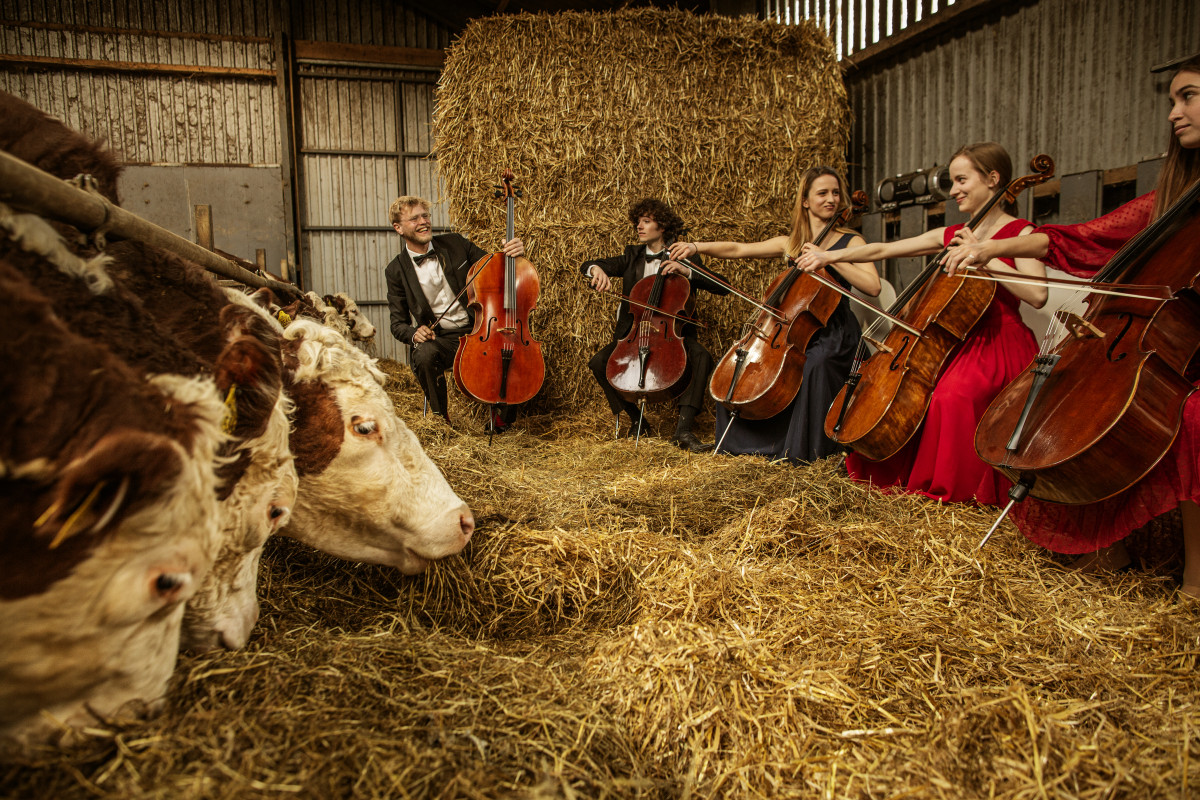

A farm near Rødvig on the Stevns peninsula, home to both pigs and cows, also houses an elite music school for cellists, the Scandinavian Cello School. The school was founded by the British cellist and professor Jacob Shaw, who is also a farmer and lives here with his family. It is a place where the young people in residence are expected to take part in the work on the farm as in a collective, when they are not working on their musical projects.
According to Shaw, this is very much an innovation. In one of the many scenes featuring the thoughtful, idealistic and selfless mentor, he remarks that the classical music world places great emphasis on competition and perhaps on musical development, but only rarely concerns itself with something as essential as well-being.
It is fascinating to follow not only the teaching and competitions on Stevns and elsewhere, but also to listen to the young musicians’ accounts of playing, alongside the many uncommented sequences in which large amounts of music – especially from the classical cello repertoire – are performed. Among them is an outdoor scene where the musicians have attracted a group of cows, who appear to be listening when they are not mooing.
This is a film about self-realisation through discipline, but also about discipline through self-realisation. The film continually circles around the human effort to become better at something, and it does so in a way that consistently places the participants’ love of music at the centre. This also applies to Shaw himself, whose previous serious illness, briefly referred to, forms a kind of counterpoint to the lightness that otherwise characterises the film.
Katrine Philp’s documentary A Classical Life is therefore warmly recommended – not only to parents of musically inclined children, but to anyone interested in music. Classical music? No. Music.
CPH:DOX, 14, 17 and 21 March
Gintė Preisaitė Turns Doubt into Music
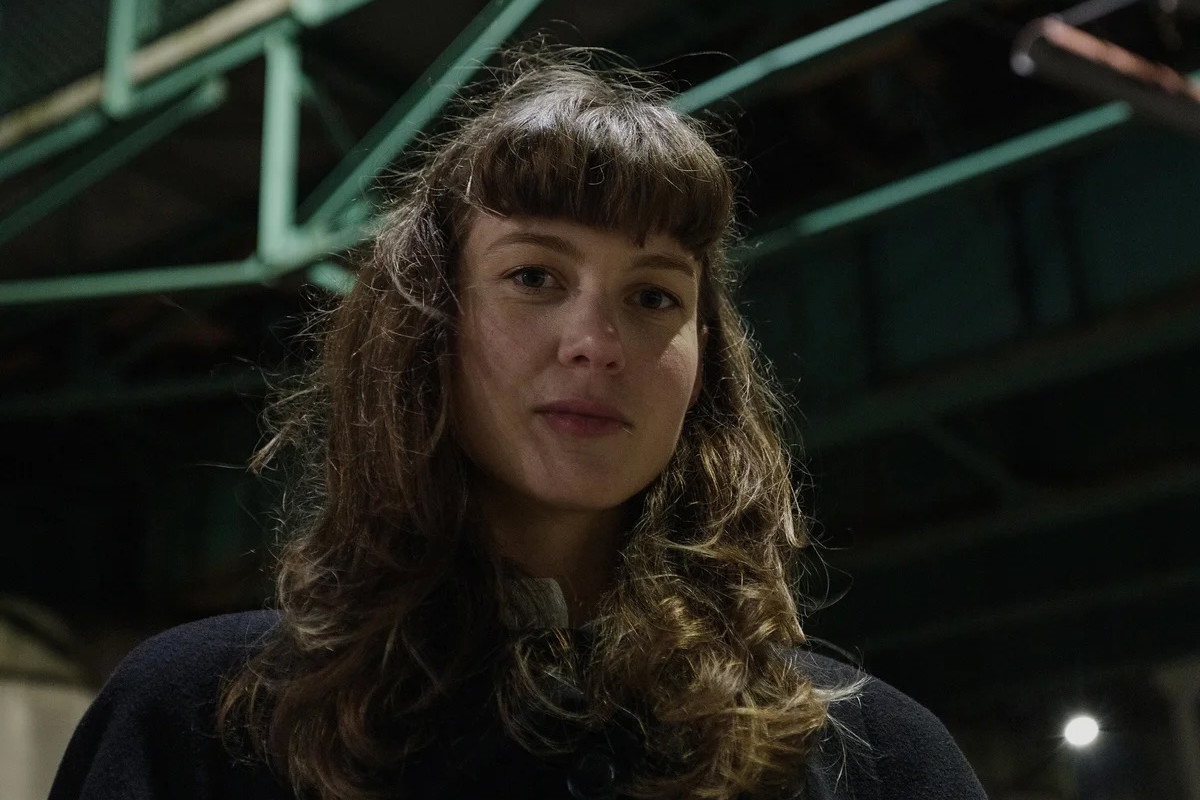

You increasingly encounter Gintė Preisaitė in different contexts and under different names – solo as Baraboro and as part of the trio Treen. With Instruments of Forgetting and the Singing Bone, the Lithuanian-Danish composer releases her first album under her own name, and it certainly feels like her most personal work to date.
Above all, this is because Preisaitė sings on seven of the album’s eight tracks. She treats her voice as an instrument equal to all the others, and although the singing is lyrical, she primarily uses it to create texture, depth, and contrast. On »Summary Saint Mary«, for instance, layers of vocals in different registers intermingle with scraping background noise, rapid pulses, resonant bass, and a multitude of sounds of both digital and analog origin. It feels refreshingly fragmentary – a willingness to play with uncertainty. Not everything coheres, yet it is precisely this lack of cohesion that makes the music feel alive and compelling.
Only on »Nippon Dreams« – a dense collage of percussion, samples, and field recordings of Japanese voices – is Preisaitė’s vocal absent. And it is only then that one realizes how essential it has been as a point of orientation throughout the album. Its absence leaves a void that underscores the duality Preisaitė works with: the music feels both intimate and cool, present and distant.
Instruments of Forgetting and the Singing Bone does not provide many answers. Instead, it becomes yet another fascinating piece in the puzzle of Preisaitė’s singular oeuvre.
A Violinist with Fire in His Bow
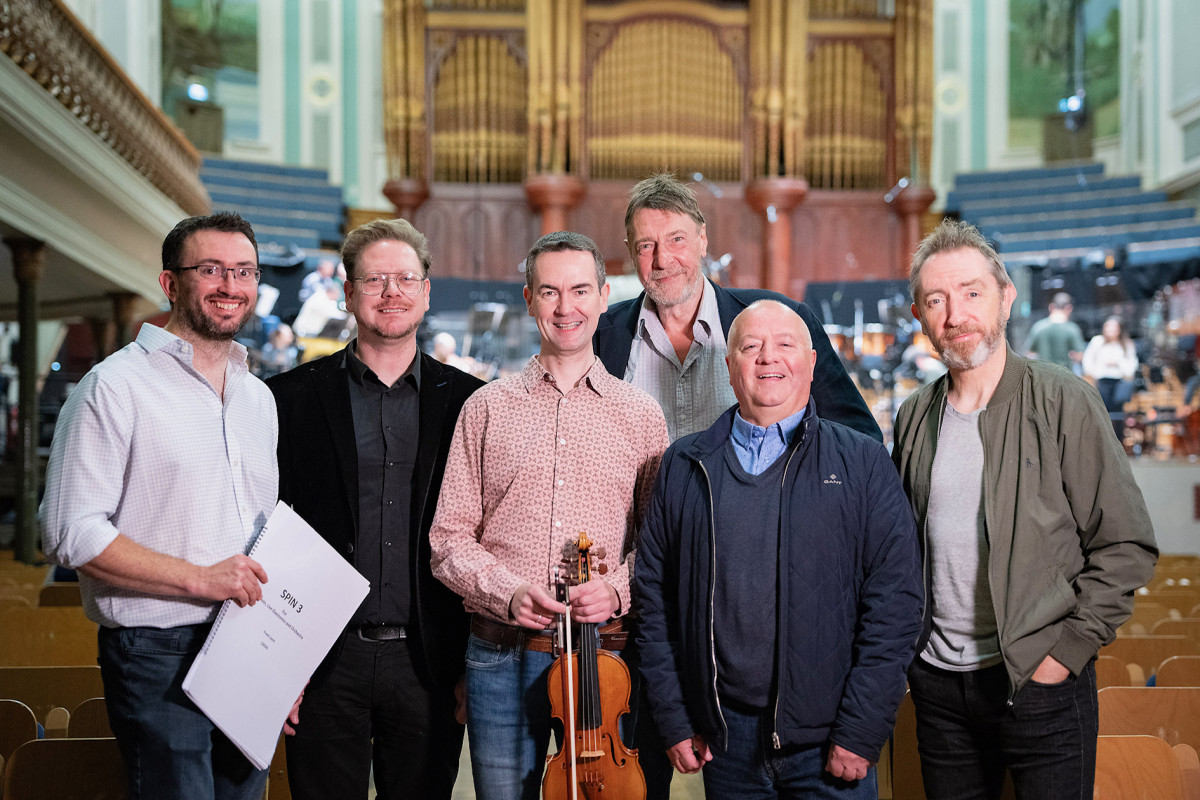
There is nothing quite like true enthusiasts. They champion composers and works that might otherwise have remained dormant. Here we have the exuberant violinist Darragh Morgan, who since the age of fifteen (!) has promoted and performed contemporary music. He knows what works and has a keen instinct for new pieces and composers – especially on this album with the not exactly catchy title Spin – New Music for Violin & Orchestra from Northern Ireland. Four relatively recent violin concertos, all centred around Morgan as soloist. Two of them are dedicated to the musical firebrand himself.
There is fire in Brian Irvine’s violin concerto À mon seul désir from the very beginning, where sparkling motifs and riffs erupt everywhere. Almost too much energy and activity – but it works, and all the fierce gestures are carefully balanced. The movement is titled »With a big life embracing energy«. Concrete and descriptive – the Irish leave the grand spheres of abstraction to the contemporary music scene in Central Europe. I have replayed the dramatic climax of the second movement several times out of sheer enthusiasm, and the entire concerto (which lasts only fifteen minutes) ends with angelic beauty on Morgan’s highest, finest strings.
Ryan Molloy’s three-movement violin concerto, stretching beyond twenty minutes, by contrast tends to drift somewhat aimlessly, although the final movement reaches a strong level. Bill Campbell’s Swim is unmistakably Irish in tone throughout, conjuring images of rolling fields and the proud Irish landscape. Midway through the quarter-hour work, Darragh Morgan delivers a heartfelt and expansive solo cadenza.
Fortunately, Frank Lyons’s Spin 3 is also a small gem, leaving the listener uplifted by this new Northern Irish music performed by the Ulster Orchestra and the fascinating Darragh Morgan, whose deep personal dedication gives so much to the music.
English translation: Andreo Michaelo Mielczarek
Ecstasy After the Party

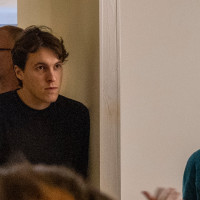
With the debut album Loud Bloom, Olof Dreijer – best known from The Knife – comes across as someone who never quite realised the party was over. Or perhaps realised it before everyone else did.
For years, club music has been absorbed into popular culture and its aesthetic vocabulary – imported into the pop song as energy, irony, and texture through artists like Charli XCX, PC Music, and the entire hyperpop complex. On Loud Bloom, the opposite happens. This is not club music disguised as pop, but pop music subjected to the temporality of the club: circular, lingering, and uninterested in quick release.
Dreijer understands something essential about repetition – the melodies are catchy without being insistent. »Rosa Rugosa«, »Plastic Camelia«, and »Cassia« are instantly memorable, yet the melodies never harden into slogans. The sonic palette is airy and almost devoid of chordal surfaces. Steel drums, gleaming synth figures, pitched tom-toms, and sub-bass drift lyrically through the music, while castanets and cowbells flicker at the edges. Even the vocals function more as texture than as centre.
The album feels constantly in motion, as though its melodies are being refracted through prisms that continuously produce new luminous surfaces. On »Lantana«, tones drift away from their point of departure like blurred watercolours – not quite microtonal, but with a sense of intonation as something fluid. Precisely for that reason, one occasionally misses an element of estrangement. In The Knife, Karin Dreijer’s voice functioned as a disturbing counterforce – androgynous, childlike, threatening. On Loud Bloom, the sonic world is more homogeneous and smoothed out.
Still, the album feels like an heir to the half-clubbed, half-pop kaleidoscopic computer music of the mid-2010s – albums such as Our Love by Caribou and In Colour by Jamie xx – music that dared to be melodic without the safety net of irony. Dreijer’s music believes in ecstasy as a gentle experience. It is music meant for dancing, yet somehow shy at the very thought of celebration.
English translation: Andreo Michaelo Mielczarek
Artificial Intelligence on Autoplay
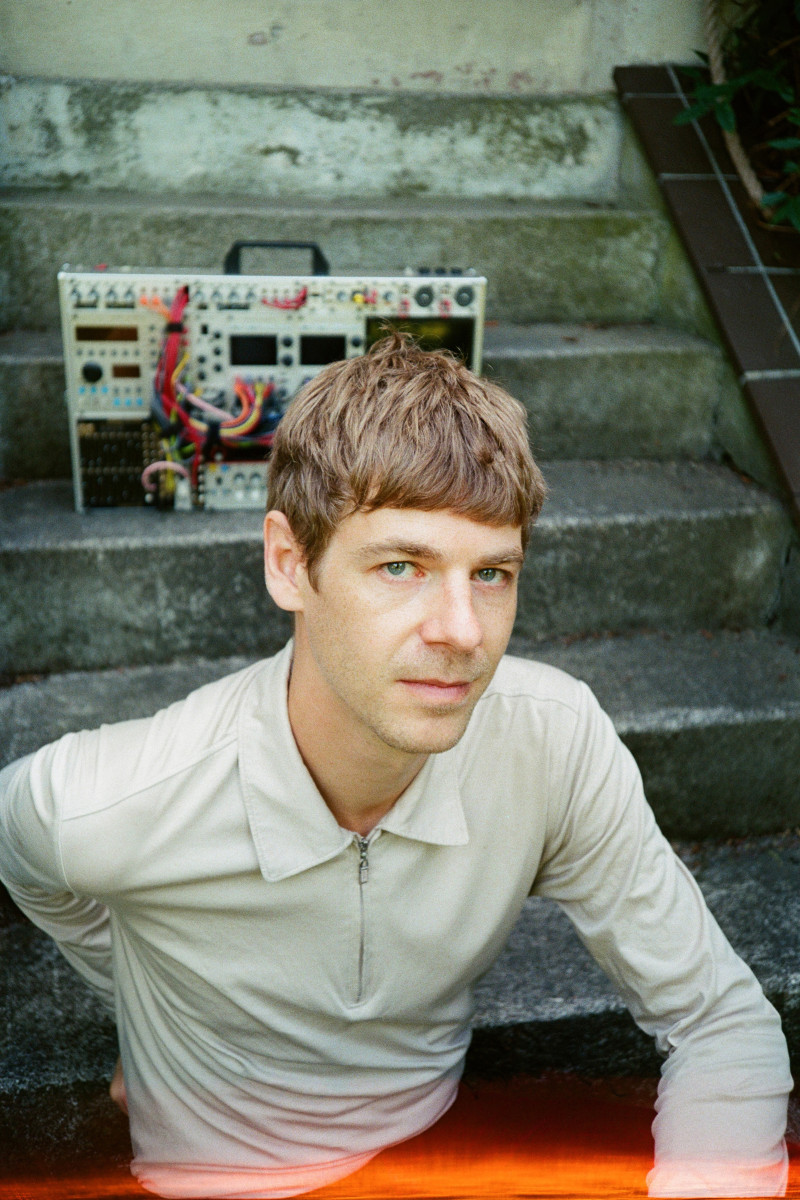
The logic of automation has long been part of modern music production. But what happens when it no longer merely assists, but takes over the creative process and artistic execution itself? Simon Littauer’s Slopcore is one of the latest attempts to answer that question. The sound of the AI-driven project is not radical as such, but it is interesting because Slopcore is several things at once: both a concrete take on an artistic practice shaped by recent developments in AI, and a symptom of the all-encompassing data models currently being debated so intensely.
Slopcore mimics the logic of a familiar streaming platform, except that the music here is generated in real time, with the audio stream continuously adapting to the listener’s behaviour, allowing users to proactively like the output or skip ahead whenever they want. The simple interface – featuring play, pause, and a heart icon – is accompanied by a pointillistic waveform that visually emphasises how Slopcore’s aesthetic winds its way through recognisable electronic terrains of house, 2000s electronica, IDM, techno, drum’n’bass, ambient synth textures, etc. etc. Most of it is rhythmically, harmonically, and melodically coherent, without being overly experimental.
As an AI-boosted extension of Littauer’s broader musical practice – which already contains strong aleatoric and algorithmic elements – the whole thing makes perfect sense. AI is not disappearing as a technology, and the parallels to Spotify’s growing AI ambitions or platforms like Suno are obvious enough. Littauer’s position as an established electronic musician becomes entangled in a deeply commercial and opaque data architecture (read: Google’s). And the title clearly references – perhaps ironically – the concept of »AI slop«, the term used to describe the generic, soulless overproduction of images and sound flooding digital platforms. Beyond being an entertaining listening experience, Slopcore can also be seen as a relevant – perhaps, in the current climate, even courageous – contribution to an ongoing and confusing debate about artistic integrity and authenticity in a cultural world that cannot decide whether it wants to resist or simply log in.
English translation: Andreo Michaelo Mielczarek
Somewhere Between an Acid Dream and a Sound Garden
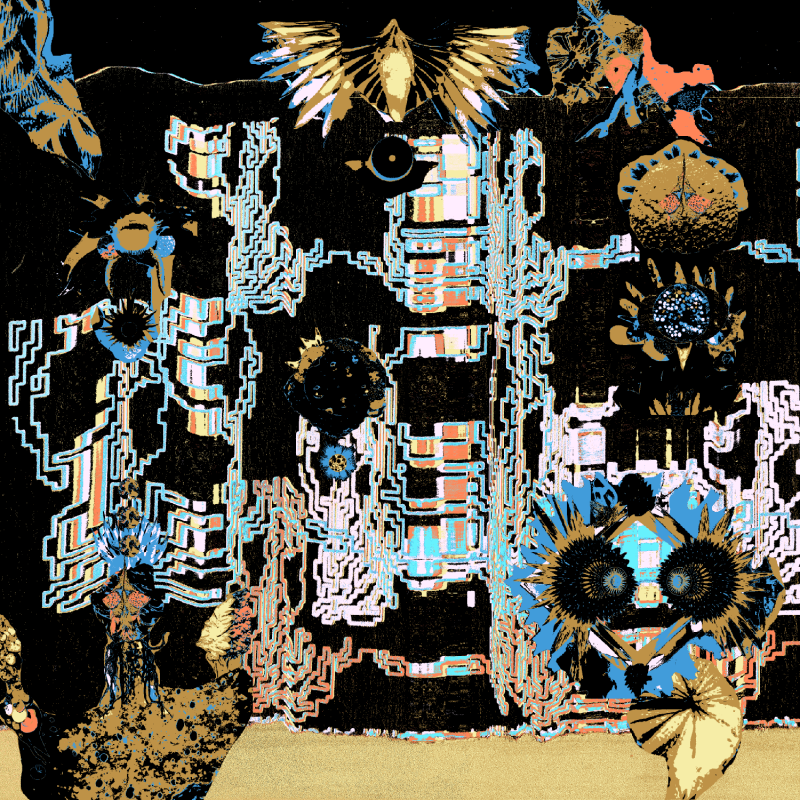
On A Body of Water, you step directly into the singular sonic universe of Finnish multimedia artist Jan Anderzén(Tomutonttu, Kemialliset Ystävät). The album unfolds as a collage of whimsical melodies created in collaboration with British musician Paul Wilson (f.ampism, Yayoba), whose contributions subtly enrich the colorful patchwork of sonic threads. Subtle, perhaps, but unmistakable. The soundscape is densely detailed: beneath the constantly shifting melodies, countless tiny sonic shoots stretch eagerly toward the eardrum. It feels like an acid dream in which everything around you – from roadside flowers to airplanes crossing the sky – has suddenly begun to sing.
Paradoxically, this flood of chaotic and rapidly changing impressions gives the music an almost ambient quality. There is great pleasure in listening closely to the miniature details bubbling beneath the surface, occasionally bursting through to dominate the frequencies for a brief moment.
Yet strong, recurring melodies capable of anchoring the listening experience remain absent in favor of mood and texture. Importantly, this is not a flaw. Heard through an ambient lens, the album – which at first can seem slightly directionless – suddenly reveals its logic. Its playful depth and lack of rigid structure encourage endless free association. It is wonderful music for drifting thought: a multicolored universe where the imagination continually discovers new pathways through a dense undergrowth of details.
English translation: Andreo Michaelo Mielczarek