in brieflive
29.09.2025

Composition for Stone Walls

Bjarke Mogensen – concert in the exhibition »Psychosphere«
© David Stjernholm
© David Stjernholm

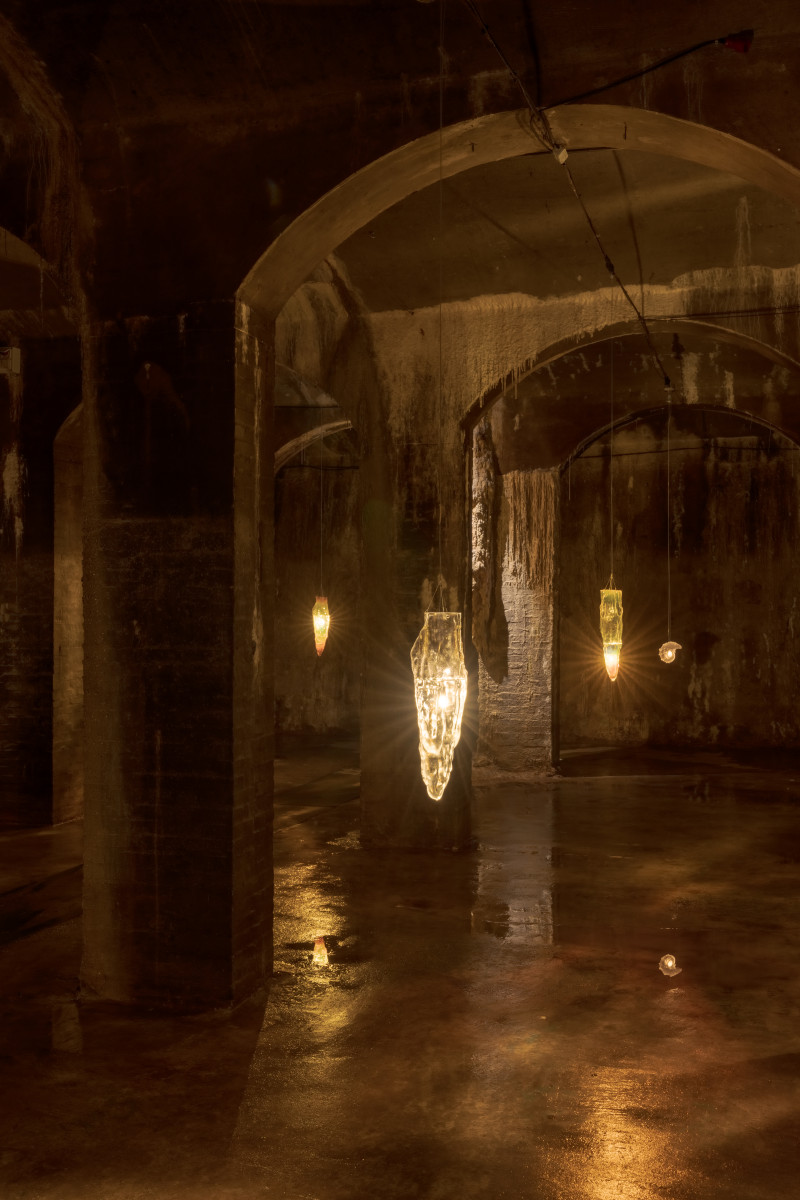
The contrast is striking when, on the hottest day of the year, you step down from the green lawns of Søndermarken into the underground world of the Cisterns, Copenhagen’s old water reservoir. The humidity is high, the light sparse, and stalactites hang from the vaulted ceilings, casting shadows in the puddles on the floor. And then there is the sound: in the empty columned halls, the reverberation can last up to 17 seconds. Even the slightest scrape echoes down here.

Since 2016, the Cisterns have functioned as an exhibition space, and this year Jakob Kudsk Steensen has transformed the halls into an underwater landscape of video projections, sculptural objects, and a soundscape created by Lugh O’Neill featuring Bjarke Mogensen on accordion. Mogensen, who is performing this evening, has a versatile taste. Perhaps a bit too versatile, I think to myself as I read the evening’s program, which spans from Bach to folk melodies from Bornholm. It turns out to hold together better than one might expect. These are compositions that seem to stretch time itself, where long tones – amplified and extended by the reverberation – form a murky foundation for short, pearling attacks, like marble balls ricocheting off a stone wall.

A shimmering, sorrowful composition by Nick Martin, inspired by Michelangelo’s Pietà – marble again – is followed by a meditation on echo among the cliffs of Bornholm by Frederiksberg-based composer Martin Lohse. Another piece rises slender and sacred like high vaults, while Mogensen’s own Passage crackles, snaps, and crunches like stones being broken. Mogensen’s accordion is in constant dialogue with the space; he calls, and the dark colonnades answer back – or is it the other way around?

The audience sits petrified, completely absorbed in the sound, as Mogensen masterfully makes his instrument sound like everything from a rapid breath to a thunderclap. When we finally emerge, heavy clouds hang over Søndermarken, and the heat is gone. The park feels transformed. The contrast is tangible.

English translation: Andreo Michaelo Mielczarek

© PR

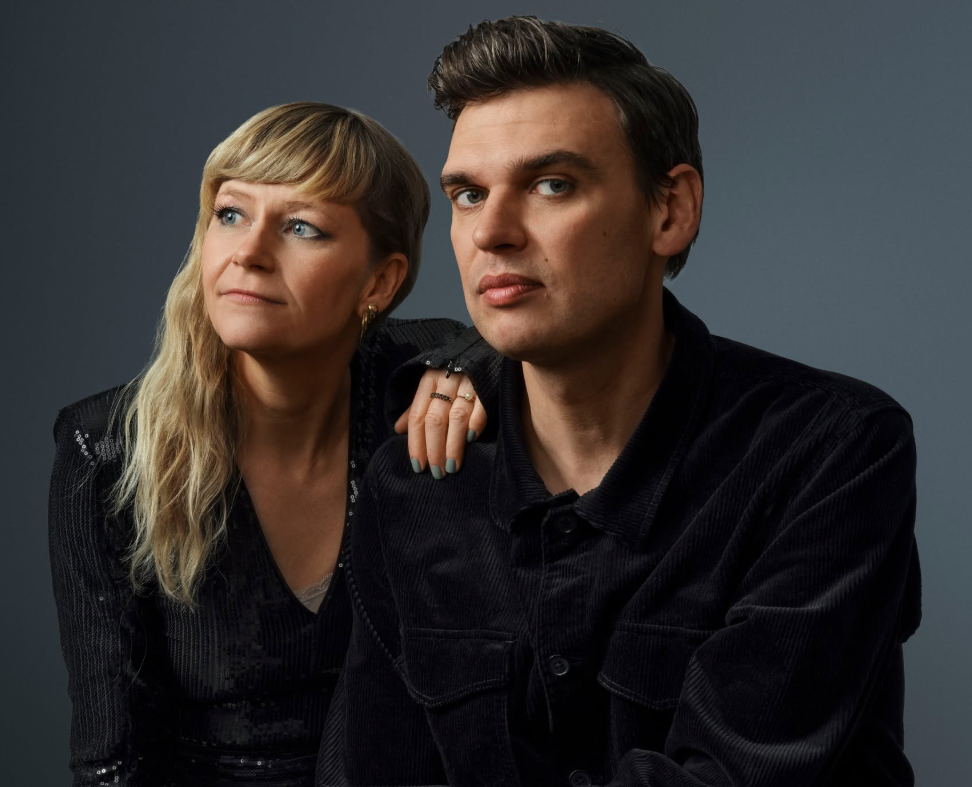
»For us, music is... magic? Aside from the fact that we are huge fans of silence, the closing line of one of our upcoming singles perfectly captures our relationship with music: 

'Music feels like magic to me / A superior art form in a marketplace / Trying to find an empty space'. 

That is what it can feel like as a songwriter and performing musician. We try to hold onto an almost childlike infatuation with music, yet the art form we work in – alternative-leaning pop-rock – was created and has evolved 'in a marketplace' driven by powerful economic forces. As a romantic, that can sometimes be a bit disheartening...«

Late Runner consists of Asger Tarpgaard and Tanja Forsberg Simonsen, both formerly of the bands Superheroes and Private.

© PR
© PR

It was officially confirmed only recently that Icelandic avant-garde star Björk is visiting Bielsko-Biała today. After keeping it under wraps until the last moment, the organizers of the Wędrujący Festiwal (Wandering Festival) have revealed that Björk is the artist closing out the festival's grand finale.

© Kåre Viemose

»Recently, I discovered that when a couple of thousand people clap their thick gloves in minus 30 degrees, it sounds like the softest techno – a freezing space where the cold air turns into a wave of warmth, and we, in a moment of collective devotion, become one with the rhythm, one with the invisible bond that connects us in the warmth of silence. Music is not just sounds, but a vain attempt to capture the infinite, which has always been and always will be.«

Andreo Michaelo Mielczarek has been the editor-in-chief of Seismograf since 2021. He is also a music critic and cultural journalist at Kristeligt Dagblad and Århus Stiftstidende/Avisen Danmark and has over the years written to publications such as Kunsten.nu, Glissando (Poland), Neural (Italy), Raw Vision (UK), Nutida Musik (Sweden), Kunstkritikk (DK/Sweden), Iscene.dk, B.T., and Jazz Special. He is the author (together with Lars Muhl) of the book HVA' SAA! En guidet rutsjebanetur gennem Aarhus – før, nu og i fremtiden (2024) and has also contributed to the anthology on music criticism Man skal høre meget (ed. Thomas Michelsen and Claus Røllum-Larsen, 2024). He is a founder and partner in the Polish-Danish cultural organization Kultur(a), and wherever there is a piano, he will be there, eager to coax a melody from it.

© Aria Leth Schütze

»For me, music is an opportunity for transformation.«

Aria Leth Schütze is based in Copenhagen and is the creative force behind the music projects Alto Aria and Samler På Dig. They are a co-founder of the record label Rhizome and a co-editor of the music magazine Passive/Aggressive. Their practice brings together electronic and acoustic music in an exploration of transformation.
 

© PR

»For me, music is the art form that – if measured in hours and minutes – occupies by far the greatest part of my life. I cannot sing, nor can I play an instrument, but I can listen – as a happy amateur – while cycling, on the dance floor, and, above all, at the office. I almost always work – that is, write – to music.« 

Mikkel Krause Frantzen (b. 1983) is an associate professor at the Department of Arts and Cultural Studies, a literary critic for Politiken, and the author of several books in English and Danish, such as En fremtid uden Fremtid (2018), Klodens Fald (2021), and Slutspil (2024).