in brieflive
24.02.2025

Dido and Doom

Vinterjazz: Alice: Slim0
© Slim0

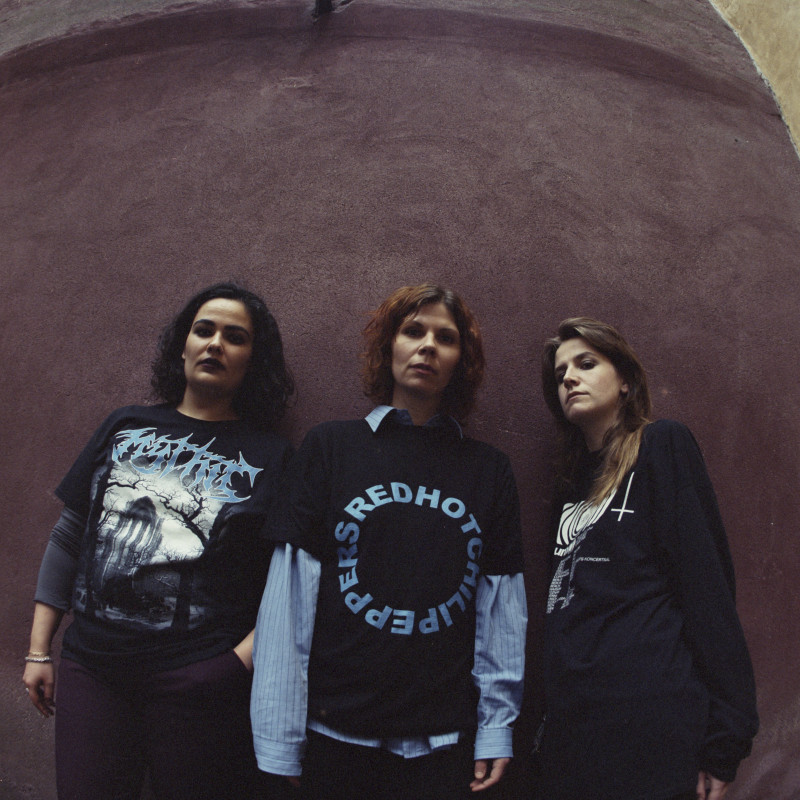
Doom was in the air when Slim0 took the stage on Saturday night at a sold-out Alice. In October, the band released the 17-track album FORGIVENESS—an album that takes a slow step into the riff-laden terrain of stoner rock. For this evening’s occasion, the Slim0 trio had been expanded with a lineup featuring Agnete Hannibal on cello, Aase Nielsen on saxophone, and Johan Polder on bass.

The sound exists somewhere between the English singer Dido, the drone-metal band Earth, and the drill trio Shooter Gang from Trillegården – an abstract comparison that hardly does justice to the uniqueness of the songs, as Slim0’s long referential tentacles stretch far beyond the music’s sharp contrasts. With its sacral-sounding choir and heavy drum passages, the single »Trenches« fit perfectly into the live setting. The darkness and the shifts between the three vocalists – from shared harmonies to growl – intensified the theatrical metal expression.

In a similar way, a nostalgic sigh arose when Dido’s catchy vocal lines from the hit »Thank You« emerged in the double cover »I Have But One Heart.« The perhaps lesser-known instrumental part, consisting of Earth’s »Coda Maestro in F Flat Minor«, turned the piece into a prime example of Slim0’s referential swamp brew. Although the many contrasts made for a rather epic concert, they also left me feeling somewhat conflicted. Conflicted because I genuinely enjoy Slim0’s heavy and fragmented universe, yet the lack of voluminous weight left me craving a more bone-rattling sound that could carve the sharp contrasts even more deeply. Hunger for more doom is certainly not a bad feeling, and I look forward to hearing the epic expression grow louder and even heavier.

in briefrelease
29.09

Treen In Free Fall – And In Common Flow

Treen: »Kaikō«
© PR
© PR

On Kaikō – the trio Treen’s second release – saxophonist Amalie Dahl, pianist Gintė Preisaitė, and percussionist Jan Philipp demonstrate confidence, mutual trust, and a distinct musical adventurousness. The opening track »Hylē« unfolds with rattling percussion and strikes seemingly aimed directly at the piano strings, stumbling forward over an underlying drone. The saxophone cuts in with phrases that sound at once admonishing and bewildered. Nothing feels meticulously calculated; instead, the music is carried by a keen awareness of the three musicians’ individual voices within the shared soundscape.

The same basic formula unfolds across the album’s three other pieces, yet always in new variations. On »Kinetic«, Dahl’s saxophone emerges with much greater weight, its slowly growing crescendo mirrored and challenged by Preisaitė’s piano. Improvised music can often slip into polite holding patterns, with the musicians taking turns in the spotlight – but not here. Dahl, Preisaitė, and Philipp appear as three drifting islands without anchors, propelled by their own currents yet inexorably drawn in the same direction. The result is both sudden shifts and an organic flow that can pull the listener into a trance, if one surrenders and simply lets the sound wash over.

It is precisely the trust between them that allows the three to play freely, without fear of leaving or losing each other. In doing so, they create a momentum that is hard to resist – whether one chooses to let the islands drift past or to float along in their current.

English translation: Andreo Michaelo Mielczarek

in brieflive
28.09

Steel Forks and Silken Script

George Benjamin & Martin Crimp: »Written on Skin«
© Miklos Szabo
© Miklos Szabo

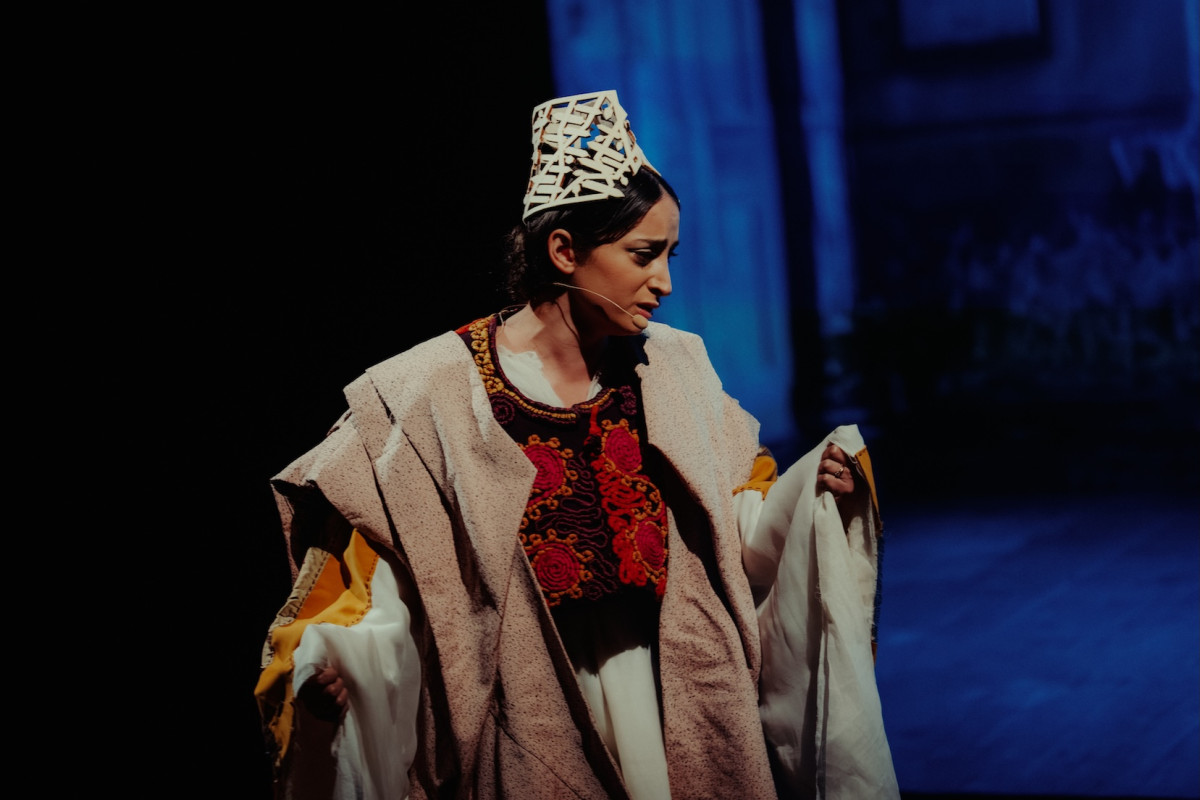
The first time I heard the title of this opera, I was reminded of Franz Kafka’s grotesque short story In the Penal Colony (1914–19), in which a prisoner is sentenced to have his punishment – a moral admonition – engraved into his skin, after which he is meant to feel what it says. In Written on Skin, which premiered in 2012 and has quickly become something of a modern classic in opera houses around the world, the writing on the skin is instead the caress of a young illustrator, who in reality (!) is an angel. The story is set in the 13th century and appeared in Boccaccio’s collective narrative The Decameron in the following century, but it could just as well take place in a dystopian future.

In a land ravaged by war, violence, and terror, the illustrator is hired to create a book for a tyrannical and ultra-violent lord who, among other things, regards his wife’s body as his own private property. The illustrator/angel, however, enters into a passionate relationship with this wife, and all hell breaks loose. Naturally, they both die, and the lord is left alone with his bitter, useless victory, while the angel is resurrected and thus becomes the true victor – and perhaps a queer figure, as the voice type (countertenor) might suggest.

The Royal Danish Theatre’s production is highly convincing. Benjamin’s music roars and crashes, yet is at the same time curiously hushed in its markedly economical use of means. It is as hard as steel forks magically bent again and again, while the often very powerful volume inscribes itself onto the skin of the eardrums in silken script.

English translation: Andreo Michaelo Mielczarek

© PR

»Music for me is a universal tool for opening myself for feelings. It may be anger. It may be happiness or sadness. Music may make you wanna dance or cry. But it never leaves you indifferent to the emotional load it brings. Good music, at least. Music may tell stories. It may as well be a background, or a soundtrack for the moment, for the day, for life. That being said, music for me is a company for everyday. And I’m quite lucky that it’s my company at work as well, I guess.«

Jan Janczy is a Polish journalist and radio host at Radio Nowy Świat. His main fields of professional interest are Northern Europe, international affairs and music. He interviewed among others 3x Grammy Awards winner Fantastic Negrito, Röyksopp, Alabaster DePlume, Archive, Trentemøller and Mogwai. In 2024 together with JazzDanmark, Kultur(a) and Radio Nowy Świat he released a podcast series devoted to the history of Polish-Danish jazz connections. He is a Swedish philologist by education.

© Carlos H. Juica

»Music is inseparable from listening: a close, attentive act. It’s not about beauty, truth or even intelligibility, but connection. This intense, focused intimacy is where meaning and everything else begins.«

Simon Cummings is a composer, writer, and researcher based in England. His music centres on two areas, both of which blur abstract and emotional impulses. The first, explored in instrumental work, involves highly intricate algorithmic processes rooted in carefully-defined behaviours, in a bespoke approach that combines stochastic and intuitive methods to realise large-scale behavioural transformations. His electronic music typically begins with visual stimuli, used to sculpt time-frequency structures investigating the boundary between noise and pitch, reappraising what defines each and their boundaries. He is currently working on a song cycle for voice and electronics for Icelandic soprano Heiða Árnadóttir, to be premièred in 2026. His research is primarily long-form critical writing on contemporary music, published on his website 5:4, as well as in assorted online and print publications.