

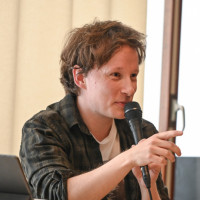
James Black
28










The French electronic musician Rone finds it difficult to express emotions verbally. In Valentin Paoli’s rather touching documentary The Musician and The Whale, he reflects on music’s ability to create connections and convey moods to an audience – whether human or interspecies.
One day, Rone receives a video from a sailor who is playing his music at sea. Whales gather around the boat, seemingly drawn to the sounds, and this becomes the starting point for an exploration of whether the musician might be able to communicate with the animals through sound. Rone seeks out an expert in whale vocalizations, who points to certain high-pitched synth elements in his EDM compositions that resemble whale song. He then has a girls’ choir record the whale sounds with human voices and travels to Réunion to play the sounds back to the whales.
At first, the attempt proves futile: the whales appear indifferent to the girls’ choir. Quoting Johann Wolfgang von Goethe, Rone realizes that if one wishes to move others, one must begin with what moves oneself. It is a Disney-like insight in a slightly sentimental film that speaks to the human desire to communicate with animals.
But are we actually sure that animals want to communicate with us? As the film’s central figure, Rone briefly reflects on a few ethical questions concerning animals, yet his infectious enthusiasm for the sounds of whales prevents him from asking the most fundamental questions about the relationship between humans and animals. Instead, we get a portrait of the musician that is almost as polished and warm-hearted as his music. The whale, wisely, remains beneath the surface of the sea.
»The Musician and The Whale« / »La Baleine et le Musicien« (83 min.)
Valentin Paoli (FR), 2026. Screening at CPH:DOX, March 11, 12 and 20
What does Britain sound like now? Like a country longing for ideals and meaning following its abandonment of any sort of common cause or experience. The catastrophe of Brexit looms large.
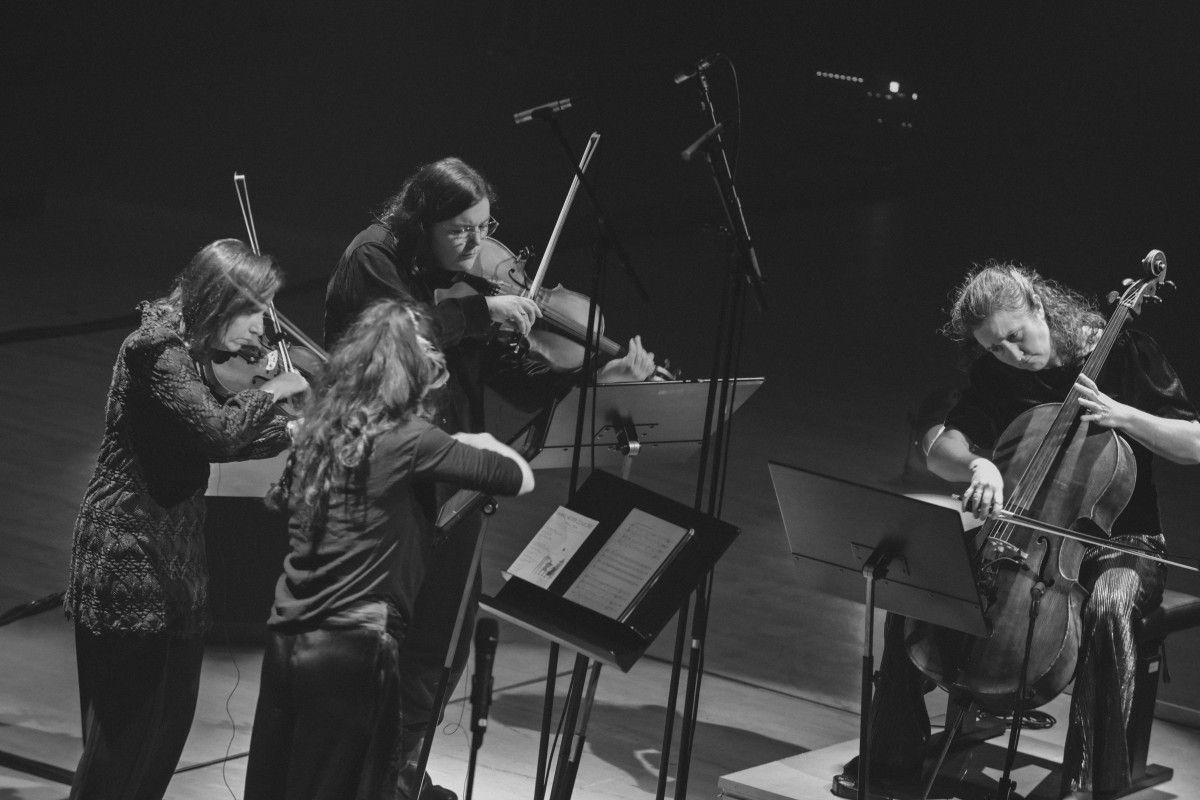
At least Britain still has talent. Manchester Collective is one of the nimble ensembles that have emerged from a British artistic landscape in which old infrastructural certainties no longer rule. It is a flexible, string-based group that plays with heart, soul and extraordinary technical finesse. Its ear for detail, sense of floating lightness and good taste in composers caught the attention of the Danish String Quartet, which presented the ensemble’s exploration of contemporary Britishness as part of its Series of Four festival.
All the composers featured see beyond thinking of innovation in terms of tonality. The wild hockets and reels of »Muttos« from Christian Mason’s Sardinian Songbook tap a typically English handling of folk material, as do Dobrinka Tabakova’s Insight and Jonathan Dove’s Out of Time. Those pieces, and Andrew Hamilton’s absurdist musical jigsaw puzzle In beautiful May, speak of loss as much as Anna Meredith’s Tuggemo shrieks a sort of plastic optimism.
The highlights were the half-lit remembrances of Jocelyn Campbell’s 3AM and Edmund Finnis’s String Quartet No 2. Finnis’s piece extends a salient, introspective form of British minimalism. The third movement, played without vibrato, seems to express a longing to exist beyond the confines it has prescribed for itself. Very British. Just as much so was the particular charm that flowed all night from MC-founder Rakhi Singh, who with her colleagues, played everything with astonishing, tender beauty.
James Black and Connor McLean, the two composers behind the tongue-in-cheek outfit The Ensemble That Loves You, are, as newcomers, not yet eligible to vote in Tuesday’s general election. They can, however, intervene – and that is precisely what they did on Saturday with a good old-fashioned podwalk.
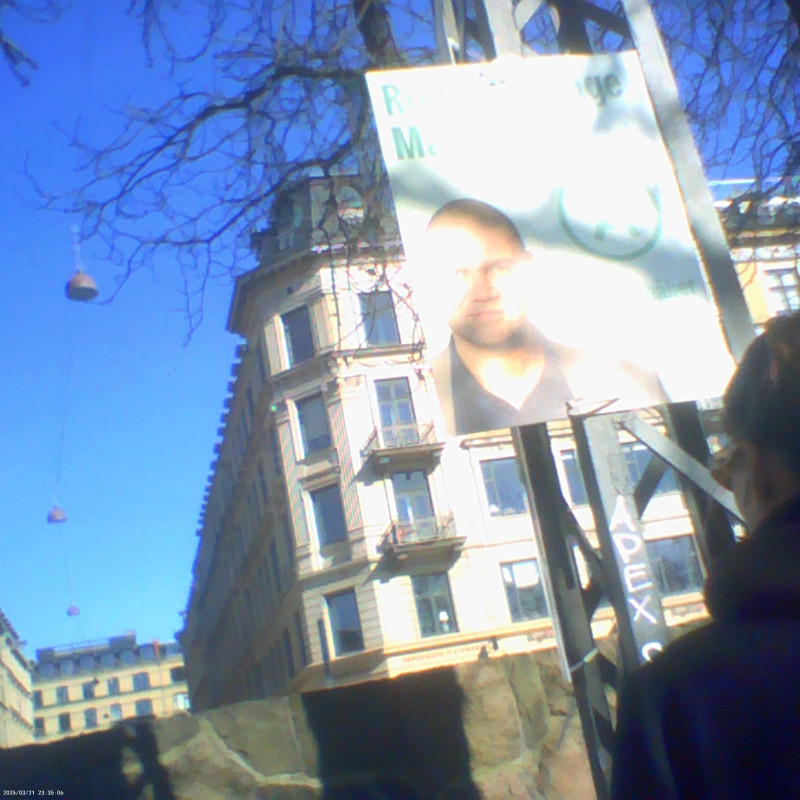
Over the course of three hours, you could stop by the pair, who had set up camp on the northern bank of Sortedams Sø in Copenhagen. There, you were handed a QR code, guided to the nearest campaign poster, and left with a SoundCloud link. »Alright, see you in 16 minutes,« Black said, and suddenly I was standing in front of political scientist Thomas Rohden of the Danish Social Liberal Party, confronted with his peculiar, toothless plastic smile.
»It’s important to connect with the election, so look the candidate straight in the eyes,« a synthetic female voice instructed as I pressed play. So I did. Stood still, listened, stared. Became a kind of artwork myself, I suppose – certainly looked like an idiot. And while the voiceover sent me onward to new posters, Black and McLean worked to complete the sense of alienation with brief sonic interventions.
The voice first took on a slight echo, then locked into a groove – »vote-for-me-vote-for-me-vote-for« – before dissolving into short-circuited 8-bit electronics, a faltering barrel organ, and flickering monologues over live jazz, mimicking an absurd media reality.
Gradually, the glossy, guileless eyes of the posters came to express just how artificial the election really is. »The person you are looking at is not real,« the synthetic voice concluded – remarkably agitated for a computer. »The party will replace you with a robot.«
Alright, alright. From the voiceless, one must hear the truth – wrapped in British political sarcasm and MIDI jingles: a light – and perhaps somewhat cheap – dish, but who has the energy for more after four weeks of campaigning? On my way back to Black and McLean, I saw a woman point at a poster of 26-year-old Maria Georgi Sloth, also from list B: »She gave me a piece of chewing gum down at the station.« And just like that, the election was decided.
English translation: Andreo Michaelo Mielczarek
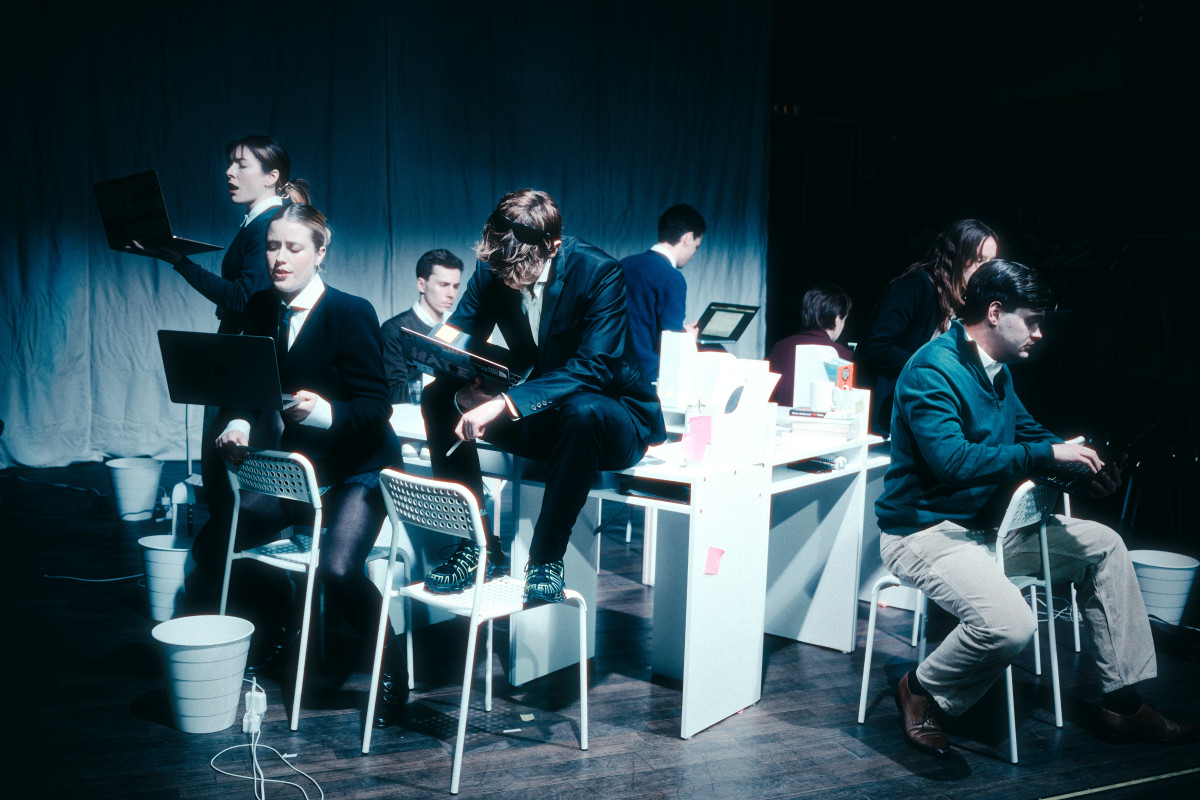
Eight people sit at their own office desks. One raises an elbow to their mouth and lets out a muffled groan into it; another starts lazily slapping their forearm; a third suddenly creaks like a worn-out spring mattress. But the young singers of ÆTLA don’t crack a smile – their deadpan is the main comic ingredient in Matias Vestergård’s Apollonian sketch show SEX in Concert.
They quickly move from a whore’s chorus to a Renaissance madrigal, the transition seamless, with the humor tagging along: an Italian word that sounds like »aquamarine« becomes »ah! kvamarin«, and in this way, 400-year-old works by Gesualdo and his like-minded peers are sprinkled with Vestergård’s salon-style wit. But the movement also goes the other way: Vestergård’s newly composed pieces are tastefully ornamented with moving voices and flirt with strict church modality.
The desks are constantly rearranged, the office workers shifting from tableau to tableau, while the task of writing lyrics into a Google Doc projected on a screen rotates among the singers: Amalie Smith, Marvin Gaye, outraged anti-capitalist critique, and cheerful chat language – everything tinged with desire, but above all with ambivalence toward desire. Everything flows, including Vestergård’s compositions, which in one moment test icy echo techniques, and in the next turn up the heat with perfectly crafted barbershop.
SEX in Concert is clearly an exercise, and as director, Johan Klint Sandberg has had a field day with the office comedy. But the exercise succeeds (even if the hands stay above the covers): before you know it, an hour has passed in which Vestergård, Sandberg, and ÆTLA have slipped poetry, madrigals, and new vocal music down the throat of a young audience. It can actually be quite fun!
Christianshavns Beboerhus, March 18–22
English translation: Andreo Michaelo Mielczarek

»Music for me can do something very special. It brings people together in shared experiences, but it can also be a very personal mental tool. Personally, I use music all the time – to create energy on a run, to create concentration for work tasks, or to find peace in stressful situations, such as in the dentist's chair. And of course to create joy and a good mood. Music is always an essential ingredient in good memories.«
Rikke Andersen has been at the helm of SPOT Festival since January 2024. With a background as a venue manager and booker at Fermaten in Herning, she has solid experience from both the creative and organizational side of the music industry. She has previously worked in the record industry, been deeply involved in marketing and communication, and has had a hand in several cultural projects.
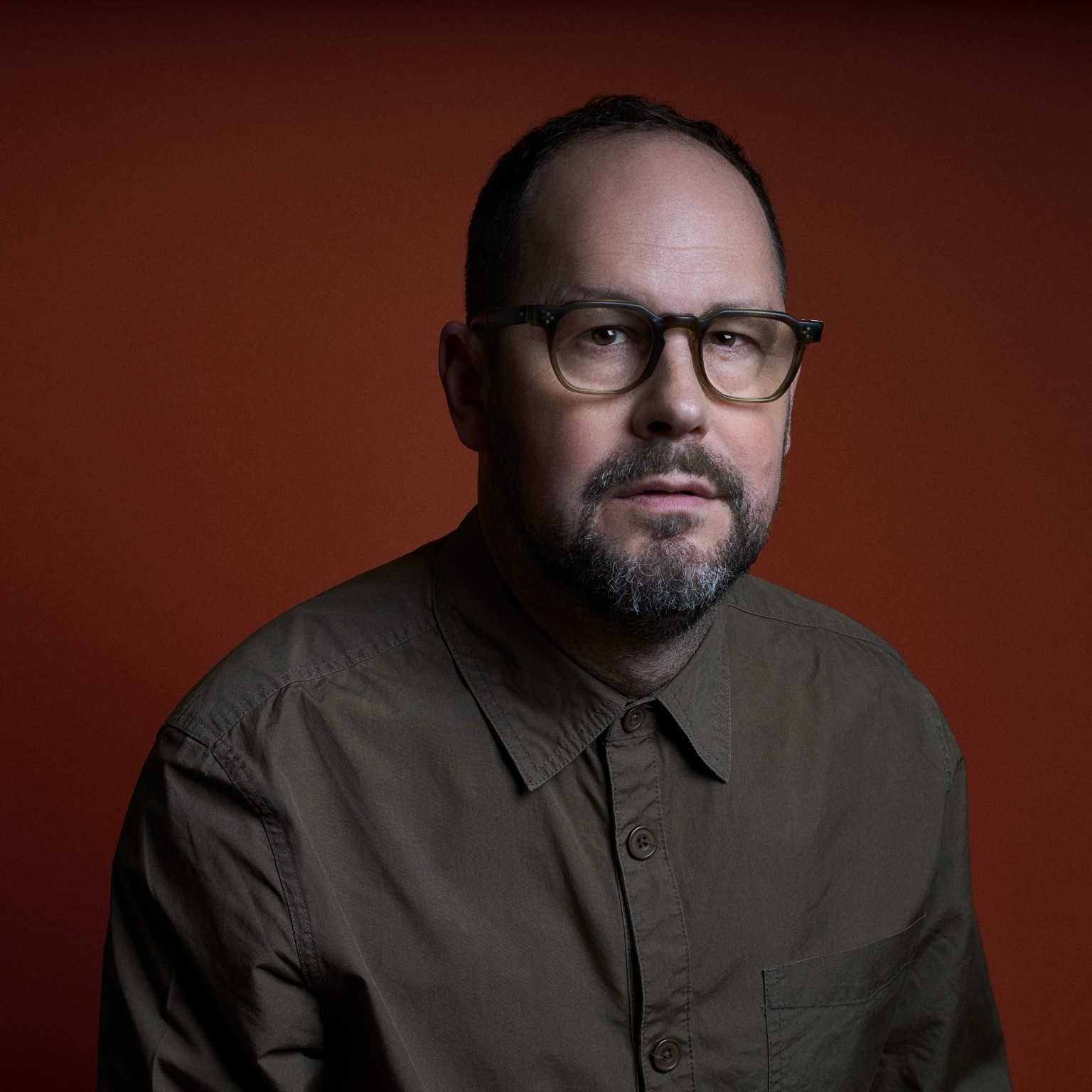
»Music, to me, is an open road to adventure, where anything can happen. Music, to me, is a freedom that holds all emotions. Music, to me, is the most private thing and something many can share. Music, to me, is incomprehensible, enlightening, entertaining, religious, philosophical, vibrating, magical, and the strongest force I know. Music, to me, is something that makes me aware of life. Music, to me, is a free bird.«
Gustaf Ljunggren is a Swedish musician and composer based in Copenhagen. His works are often driven by a desire for introspection and immersion in a noisy world. In 2026, Gustaf Ljunggren releases the album Along The Low Road, created in collaboration with the Icelandic musician Skúli Sverrisson. Ljunggren has contributed to hundreds of releases as an instrumentalist and arranger, and over the years he has worked closely with Emil de Waal, CV Jørgensen, Steffen Brandt, Sofia Karlsson, DR Pigekoret, Eddi Reader, Anders Matthesen, and many more. For the broader Danish public, Gustaf became a familiar face when he served as bandleader on Det nye talkshow on DR1, hosted by Anders Lund Madsen. Since 2011, Gustaf Ljunggren has been the driving force behind SPOT Festival’s concert series Naked.