in brieflive
17.04

The Kids Are Alright

Ligeti Quartet: »Workshop concert«
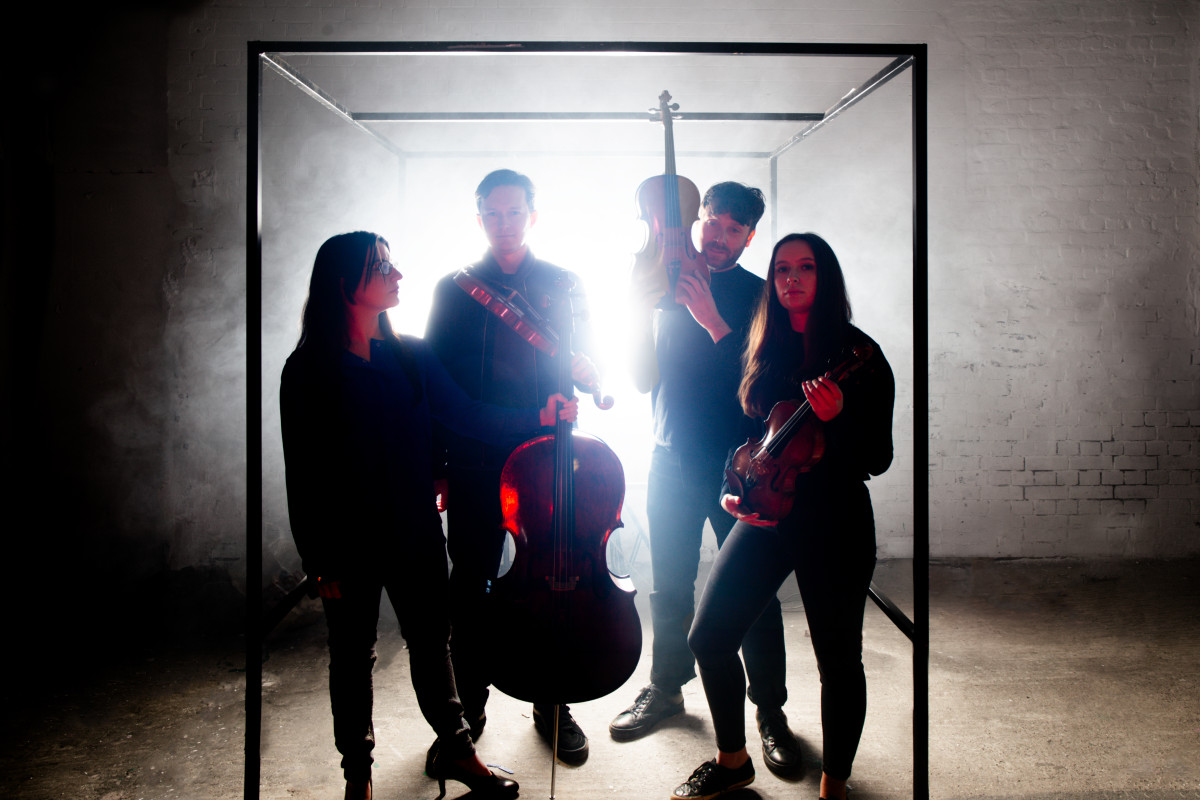
Ligeti Quartet. © Louise Mason

I know, I know. A workshop concert at the conservatory: yawn. And no, hardly anyone showed up – apart from Bent Sørensen. Fair enough. But yes, you missed out. Especially on young Albert Laubel, who did exactly what you hope someone will do at this kind of concert: suddenly step forward, make a mark, and promise something for the future.

It was the English Ligeti Quartet visiting the Royal Danish Academy of Music for the seventh time to work with the students. And they did so with both commitment and precision. (Someone should really give them a prize one day – say, someone sitting on a fortune they clearly don’t know what to do with.)

Lucas Fagervik’s Bells & Canons set up stark oppositions, as composers tend to do in exercises of style: a bright, slightly fractured minor chord set against gentle baroque pastiche in increasingly rapid alternations. Then a movement with brutal – almost banal – glissandi, another with heavy bow strokes, and a final one in which the strings took turns trying to keep a single tone alive. A beautiful, constructive, and Jürg Frey–porous landing.

A different kind of circus instinct drove Yifan Shao’s ultra-short Dreams Evaporated Too Soon, which sounded like abused sounds dragged across a floor. The ending was ultra-theatrical: the quartet froze mid-air for a moment before scraping the last traces of life out of the strings.

»I can make this even more mannered,« Jonas Wiinblad must have thought, opening his String Trio with Viola – not a quartet, of course! – with silent playing. But cliché turned into quiet poetry as small, innocent intervals slowly emerged in tight patterns. When the viola was finally allowed to join, it went against the grain: a virtuosic solo cadenza with falling bow strokes, shimmering overtones, and temperament. Boom! A striking contrast. Less convincing was the piece’s apparent need for a final, unnecessary layer of electronic distortion. Still, points for mannerism.

What remained was Albert Laubel’s String Quartet as the most fully realized work of the concert. Not overthought, just a seamless movement between dynamic extremes. Distinctive trills were elegantly disarmed by inserted snaps, glissandi sounded like part of an internal logic rather than mere effect, and the sound world shifted with calm dramatic overview. Substance and maturity in 2026 – well, well.

English translation: Andreo Michaelo Mielczarek

in briefrelease
09.03

Everything a Snare Drum Can Do

Ryan Scott: »21th-Century Canadian Snare Drum«
© PR
© PR

Let’s be honest: when you think of composed music for solo instruments, the snare drum is probably not the first thing that comes to mind. It may be the noisiest member of the percussion family and has been setting the volume level in everything from classical music to pop for decades. That’s why I pricked up my ears when the Canadian percussionist Ryan Scott announced an entire album of works for snare drum – written by 14 different composers. A full hour and a half of music, no less. And yes, that sounds like a lot for a record that mainly consists of a single drum. But there is definitely something to discover here.

The opening, Andrew Staniland's »ANTIGRAVITYDRUM«, blends free jazz with inspired use of percussive vibraphone, while Beka Shapps’ »Skinscape IV« sends the drum strokes through ring modulation and extensive sound processing, bringing us close to musique concrète. Christina Volpini’s »only ghost« slips into horror territory with march-drum-inspired bursts and ghostly use of the snare drum’s high register, while Amy Brandon’s »Time and Effort« almost becomes a demonstration of the instrument’s technical possibilities.

Fourteen works over ninety minutes is a substantial mouthful. The snare drum’s limited tonal vocabulary means that you occasionally lose focus, even after several listens, and the contrast between drum strokes and silence is repeated a little too often. That said, Ryan Scott and the composers get just about as much out of what is essentially a glorified marching drum as one could hope for. I was both entertained and intrigued along the way. As an experiment, the idea is strong – but in the long run also a bit too insistent for me to return to often. Still, one should not underestimate the versatility of a good old-fashioned snare drum.

English translation: Andreo Michaelo Mielczarek


in brieflive
09.03

Beauty in Decay

Thure Lindhardt, Ensemble Hermes, Sophie Haagen & Mikkel B. Grevsen: »Helvedesblomsterne«
© Anders Hede, Musikhuset

We sat in slow decay for an evening in the vestibule of Hell. It was during an ambitious, multisensory interpretation of Charles Baudelaire’s poetry collection Les Fleurs du mal (1857) – Helvedesblomsterne (The Flowers of Evil). Director Anna Schulin-Zeuthen and composer Mikkel B. Grevsen brought together mezzo-soprano Sophie Haagen and actor Thure Lindhardt with the six string players of Ensemble Hermes, adding electronic music to the mix. This Frankenstein-like staging transported modernist poetry into 2026, where the motifs stretching between beauty and decay still – despite many scientific advances – remain a fundamental condition.

In Musikhuset Aarhus, the stage was decorated with lush and withered flowers as vanitas symbols. Lindhardt opened with a recitation that shattered the fourth wall: with both humour and intensity he addressed us directly in the audience – hypocrites and future corpses.

In contrast to the almost seamless sonic unity of Haagen’s dark voice, the string players’ sustained textures and the ghostly distortions of the electronics, Lindhardt’s reading appeared as a strange but necessary disturbance. He prowled about with a folder tucked under his arm like an awkward outsider – the poet as eternal observer.

For my part, I dutifully tried to follow the printed programme sheet, but soon gave up and instead – quite in the spirit of the work – allowed myself, hypocritically, to be intoxicated and seduced. Helvedesblomsterne succeeds as a bold and grand project. Yet the performance also balances a little too cautiously between harmonic beauty and the nineteenth-century uncanniness that in Baudelaire crawls with death all the way into the bones.

English translation: Andreo Michaelo Mielczarek

© Diana Aud

»For me, music is both the beat that gets me through my run, sets the mood for everyday life, but not least my personal soundtrack that evokes past events and moods throughout my life.« 

Lasse Andersson is the museum director of Kunsten Museum of Modern Art and Utzon Center, as well as the chairman of the board of Krabbesholm Højskole and the Packness Foundation. Before museums took up all his time, he wrote his PhD thesis The City and the Creative Entrepreneurs, co-founded the art and technology house Platform4, and was behind both the LasseVegas office and the technology project Nulkommafem. He has also headed the Urban Design department at Aalborg University. Today, he works purposefully to develop cultural institutions as modern spaces for learning: places where people meet and connect through aesthetic experiences that move, challenge, and open new perspectives on the society we share. For Lasse Andersson, art and architecture are not just mirrors of the world – they help shape it. With that ambition, he has curated exhibitions such as Fatamorgana – Utzon møder Jorn (2016) I Arkitektens Verden – Reiulf Ramstad (2019), Pierre Huyghe – Offspring (2022), Tal R & Mamma Andersson – omkring Hill (2023) og Michael Kvium – Knudepunkt (2025).

in brieflive
07.03

Sound Crusts in Slow Motion

Abul Mogard
© Claudia Gschwend
© Claudia Gschwend

It has become common to describe a strain of ambient music as »cinematic«, thereby – perhaps unintentionally – dismissing it as mood-setting functional music rather than an art form in its own right. Yet the exploration of static sound fields and atmospheric drone structures long predates their use as a cinematic device. Within this tradition, stretching from Morton Feldman to Éliane Radigue and Phill Niblock, the Italian composer Guido Zen has, for the past fifteen years or so, inscribed himself under the pseudonym Abul Mogard. In the late 1990s he moved through London’s electronic underground with the duo Gamers In Exile and has since collaborated with, among others, the Danish composer Goodiepal.

At the concert at Alice, Mogard’s broad synth textures emerged like banks of fog. Behind a table densely packed with drum machines, mixers and patch cables – tendrils of wires curling between the machines – the black-clad Mogard stood illuminated by small clip lamps attached to the edges of his equipment. The tones were elongated, almost motionless. Time was not measured in bars but in intensity: bass resonating in the chest; a subtle adjustment of atmospheric pressure. Undramatic, yet unstoppable. The textures shifted so gradually that one often registered the changes only after they had passed. Harmonic modulations rarely felt like traditional chord changes, but rather like shadows moving across a surface.

Synth layers slid into one another with near-geological slowness, settling like accumulated sediment – gentle and colossal at once. Mogard lingered on the single tone long enough for it to begin revealing its inner life: tiny trembling vibrations, almost microscopic irregularities in the crust of sound. The sound pulsed from within, crossed by undulating patterns of interference.

English translation: Andreo Michaelo Mielczarek


in brieflive
06.03

Labour of Birth

Katinka Fogh Vindelev, Sankt Annæ Pigekor, Kind of Opera et al.: »Elegier over jorden«
© PR

»This pain is not only yours,« chants a choir standing in a circle around the woman in labour. »This pain is not only yours,« comes the enveloping echo from the rest of the choir, positioned along the walls of the ceremonial hall, forming a circle around the audience and inscribing us into the labour of female fertility.

Elegier over Jorden (Elegies over the Earth) is based on Sofie Isager Ahl’s reworking of the myth of Persephone, daughter of the goddess of agriculture and queen of the underworld. The Greek myth is one of those that explains the barrenness of winter by Persephone’s descent into the underworld, but in this reinterpretation she returns to earth to give birth. We follow her labour over nine months while members of the choir work in the fields, struggling for crops under pressure from the current climate collapse. Here, the regeneration of nature is not a matter for higher powers but a struggle that begins in the body and in the soil – much like that of the woman giving birth.

The ecofeminist interconnectedness of the female body and nature has been a hot topic for several years now, and I am unsure what Elegies over the Earth adds to it. My hesitation stems mainly from the harsh acoustics of the ceremonial hall at Ny Carlsberg Glyptotek which, combined with Marie Topp’s choreography – often positioning singers with their backs turned to parts of the audience – makes it difficult to hear Ahl’s words.

When Elegies over the Earth works best, it is in the dialogue and timing between the choir, the soprano and composer Katinka Fogh Vindelev in the role of the labouring Persephone, and the minimal ensemble of two violins and a cello. When the voices of Sankt Annæ Girls’ Choir curl around the cello’s dark timbre, and when the primordial woman Persephone’s lament is allowed to hang in the room for a moment before the choir resumes, the performance touches on something real. Yet the experience never quite settles in the body, and the painful struggle of birth – despite the choir’s insistent chanting – never truly becomes mine.

Performances on 5, 7 and 8 March

English translation: Andreo Michaelo Mielczarek