in brieflive
06.03

Labour of Birth

Katinka Fogh Vindelev, Sankt Annæ Pigekor, Kind of Opera et al.: »Elegier over jorden«
© PR

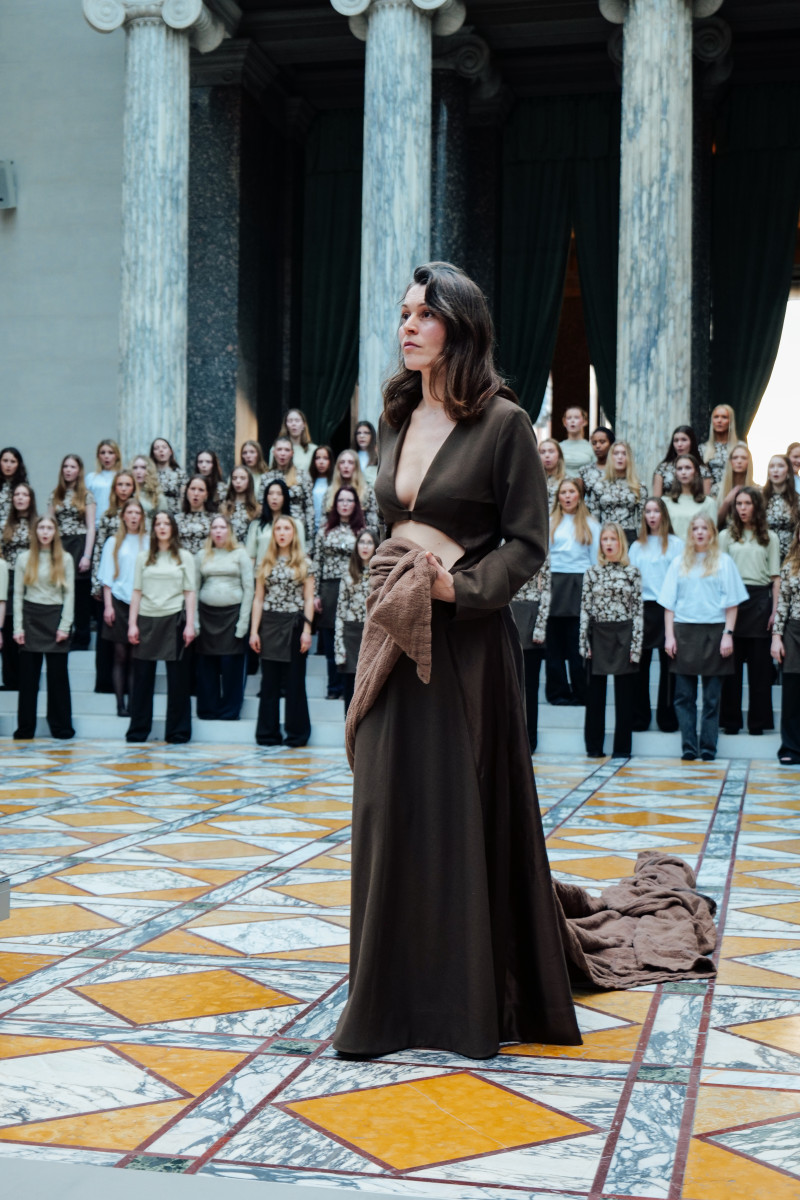
»This pain is not only yours,« chants a choir standing in a circle around the woman in labour. »This pain is not only yours,« comes the enveloping echo from the rest of the choir, positioned along the walls of the ceremonial hall, forming a circle around the audience and inscribing us into the labour of female fertility.

Elegier over Jorden (Elegies over the Earth) is based on Sofie Isager Ahl’s reworking of the myth of Persephone, daughter of the goddess of agriculture and queen of the underworld. The Greek myth is one of those that explains the barrenness of winter by Persephone’s descent into the underworld, but in this reinterpretation she returns to earth to give birth. We follow her labour over nine months while members of the choir work in the fields, struggling for crops under pressure from the current climate collapse. Here, the regeneration of nature is not a matter for higher powers but a struggle that begins in the body and in the soil – much like that of the woman giving birth.

The ecofeminist interconnectedness of the female body and nature has been a hot topic for several years now, and I am unsure what Elegies over the Earth adds to it. My hesitation stems mainly from the harsh acoustics of the ceremonial hall at Ny Carlsberg Glyptotek which, combined with Marie Topp’s choreography – often positioning singers with their backs turned to parts of the audience – makes it difficult to hear Ahl’s words.

When Elegies over the Earth works best, it is in the dialogue and timing between the choir, the soprano and composer Katinka Fogh Vindelev in the role of the labouring Persephone, and the minimal ensemble of two violins and a cello. When the voices of Sankt Annæ Girls’ Choir curl around the cello’s dark timbre, and when the primordial woman Persephone’s lament is allowed to hang in the room for a moment before the choir resumes, the performance touches on something real. Yet the experience never quite settles in the body, and the painful struggle of birth – despite the choir’s insistent chanting – never truly becomes mine.

Performances on 5, 7 and 8 March

English translation: Andreo Michaelo Mielczarek

© Aske Jørgensen

»Music for us is the perfect language that we love to speak. A language where it is the individual's feelings and imagination that determine what is right and wrong. Everyone can speak the language. You don't have to be able to write or understand, but just listen. Some music requires that you listen carefully and maybe hear it several times. A bit like when you talk to someone from Norway or Sweden, you also have to listen a little extra.«

DØGNKIOSK is a Danish punk band consisting of four middle-aged musicians with roots in the Central Jutland underground. The band plays a raw and energetic form of punk, where a naked and explosive sound is accompanied by lyrics that are significantly prominent in the soundscape. Their expression is inspired by 1980s punk and characterized by a punk poetic approach, delivered with a clear dialect. In April, DØGNKIOSK will release the album Tæt på kanten. The band's music generally revolves around challenging fixed patterns and insisting on personal freedom.

in brieflive
07.04

PowerPoint Against the Dark

Laurie Anderson with Sexmob: »Republic of Love«
© Ebru Yildiz
© Ebru Yildiz

With her characteristic curiosity, Laurie Anderson opened Sunday’s concert in DR’s concert hall with a political statement and the remark, »Thank you for your attention to this matter.« The theme of the evening was a heavy political climate, to which Anderson – like a professor emerita of the avant-garde – offered a musical framing narrative of music, slideshow, and quotes from thinkers and artists who, each in their own way, nuance an increasingly dark world. A framework in which every piece of music had a clear purpose: to evaporate any residue of convention.

Slide by slide, the audience was guided through curious glimpses of the totalitarian and the conventional. The long list of words deleted from government documents by the Trump administration, for instance, served as an introduction to »Language Is a Virus«, inspired by writer William Burroughs, who also appeared on the screen behind Anderson and the band Sexmob. So did Lou Reed, Anderson’s late husband. Dressed in a glittering jacket that, like a kind of magical Kraftwerk, triggered sounds of drums, foghorns, and cash registers, Anderson shared the couple’s three life lessons while playfully dancing and narrating.

I don’t think I’ve ever attended a concert where the entire production team – both on and off stage – was credited with rolling end titles. Yet it felt like a completely natural conclusion to Anderson’s slightly dry and remarkably hopeful PowerPoint concert. A performance that, as a delightfully deconstructive reminder, united the experimental and the concrete in a hands-on first aid kit against tyranny and oppression.

© Peter Gannushkin

»Music for me is a world full of sound that you can explore, juggle with, systematize, be inspired by and form a starting point for meetings between people across cultures and generations.«  

Håkon Berre (b. 1980) has made his mark as a central figure on the Danish improvised music scene. His practice is characterized by an expanded approach to percussion, where both traditional instruments and everyday objects – such as doorbells, tin plates, chains and kitchen utensils – are included in a nuanced and often unpredictable sonic expression. He has performed at clubs and festivals internationally and collaborated with a wide range of notable musicians, including Peter Brötzmann, Phil Minton, Axel Dörner, John Tchicai, Jamie Branch and Otomo Yoshihide. Berre contributes to an extensive discography with more than 40 releases, many of which on the artist-run label Barefoot Records, which he co-founded. He has also composed and arranged music for theatre and exhibitions, and worked on interactive sound installations shown in museums in Denmark and Germany. He is active in a number of ensembles and collaborations, including Ytterlandet, TEETH, VÍÍK and Mirror Matter, as well as in various duo and quartet constellations.

© Niklas Ottander

»Music is a deep, but not serious, spiritual practice, in which creator, collaborator, and consumer alike are their own personal pope.«

James Black (b. 1990) is a composer, performer, and artistic director of Klang Festival – Copenhagen Experimental Music. Originally from Bristol, England, they moved to Copenhagen in 2013. Black's works have attracted a large amount of attention both nationally and internationally for their signature combination of artistic courage and vulnerability, described by the Danish Arts Council as »a universe of real madness where everything goes«. Their work is a deep and personal exploration of topics such as religion, loss, and queer identity, that is unafraid to be stupid or serious in any direction.

© Christian Klintholm

»Music is just something for me.«

Christian Juncker is a Danish musician and songwriter who has released a number of Danish-language albums. He debuted in 1995 with the band Bloom. Together with his friend Jakob Groth Bastiansen, he formed the duo Juncker in 2002. He is also behind the Christmas carol »Luk julefreden ind« from 2024.