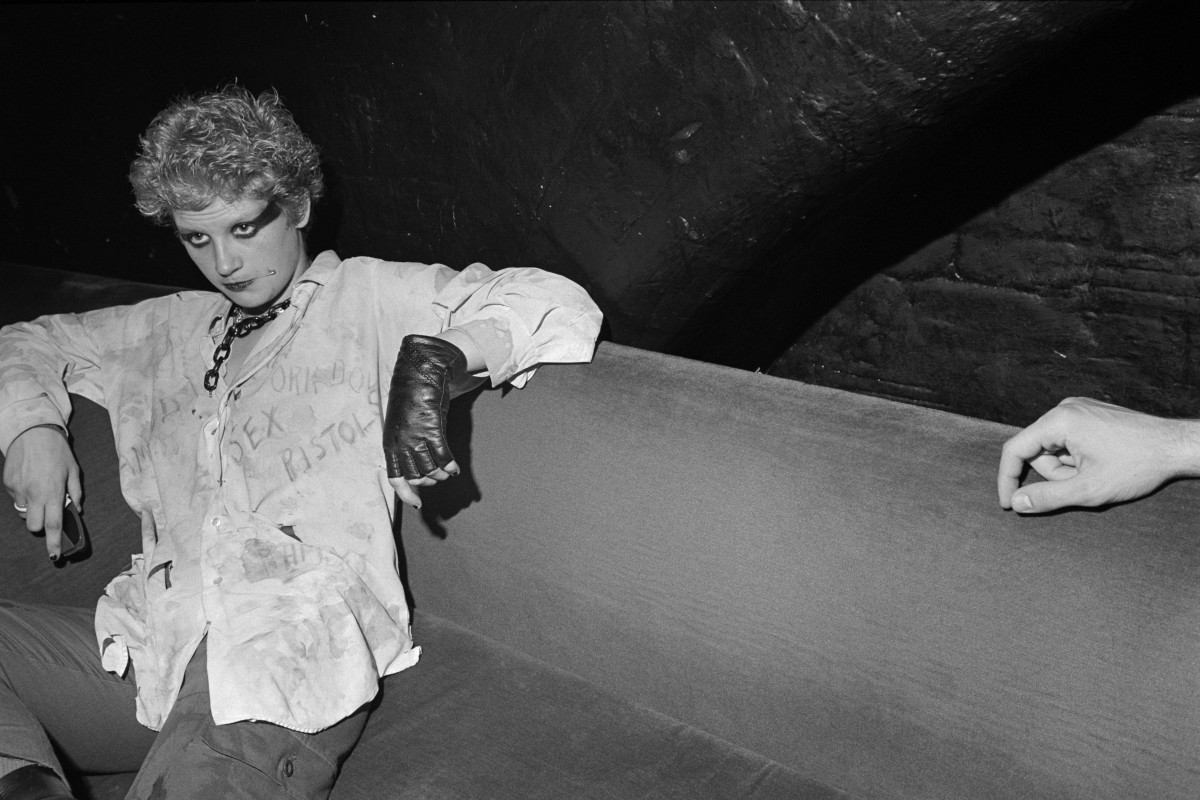


© Karen Knorr & Olivier Richon, Vortex 6 from the Punks series, 1976 - 1977, gelatin silver print on paper,18,7 x 28,2 cm, Tate. Courtesy of the artists.
The first thing that hits you at Aros' Unruly – the Body in Punk isn't dog collars, leather jackets or fishnet stockings. It's the sound. It rumbles through the galleries. After all, what is punk doing in a museum? Punk was never made for museums. It's dirty, loud and ephemeral. It thrives on amateurism, mistakes and resistance. One might fear that the white cube would turn three-chord fury into cultural history and noise into background music. Curator Marie Arleth Skov has created an exhibition in which sound doesn't merely illustrate history – it propels it. Raw guitars, piercing saxophones, flickering Super 8 films and concert footage merge into a rush of noise, images and bodies.
Unruly is not a comprehensive history of punk but a sharply focused snapshot of a culture in which sound and the body were inseparable. Punk's godmothers appear alongside Danish bands such as Lost Kids, Pussy Punk and Sods in previously unseen footage from a legendary punk happening in Copenhagen. A leather drum kit by Käthe Kruse of Die Tödliche Doris stands as a sculpture bearing the dry title In Leder, while Cornelia Schleime's video reveals the vulnerability and poetry that also inhabited punk rebellion. The contrast with Erik Satie's stripped-back piano music is exquisite. Walking through the exhibition feels like stepping inside a three-dimensional fanzine. Everywhere, it celebrates misfits and those who never asked for permission. Leopard-print cushions, raw materials and tactile installations make you feel as if you could almost touch punk itself.
In art museums, sound is often reduced to atmosphere. Here, it becomes a material on equal footing with fabric, video and the body. Noise is treated as an artistic method rather than a soundtrack. Fifty-year-old noise still sounds astonishingly contemporary as it resonates with the exhibition's newer works. You feel it vibrating through your body. Instead of muting the world, the museum becomes an amplifier.
Can rebellion survive inside a museum? Unruly shows that punk's energy does not necessarily disappear when it enters an institution. Only two things are missing: the chance to experience the exhibition at four o'clock in the morning – and a lavish catalogue bound in latex.
English translation: Andreo Michaelo Mielczarek