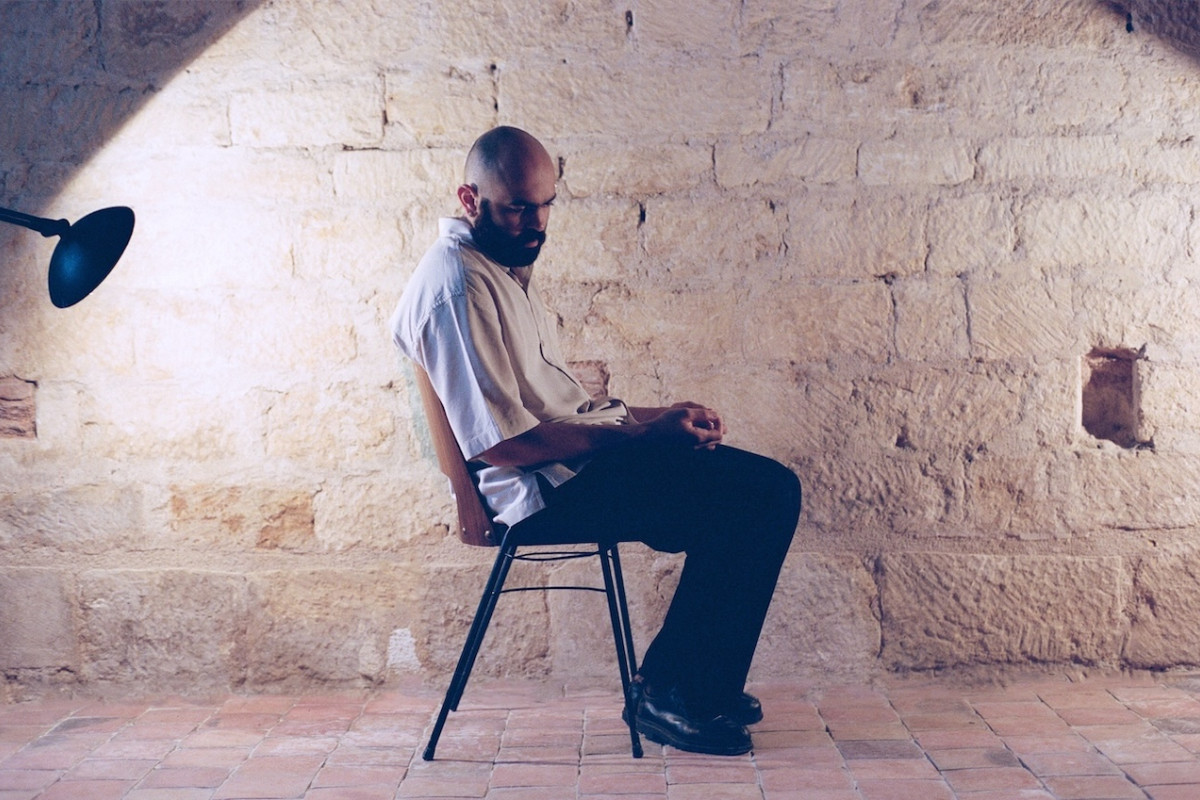
I believe I am not the right person to grapple with all the existential questions of faith and culture that the multidisciplinary artist and political experimentalist Abdullah Miniawy grapples with on his latest album, Nigma Enigma. The record is equal parts Arabic chant, folk music, and sound art, based on modular synths and field recordings. The Egyptian composer uses the album’s eleven abstractions as the soundtrack to what he himself calls »an Arabic opera of doubt and faith«. But as a non-Arab, lifelong atheist, it is difficult for this reviewer to fully engage with the big questions Miniawy poses in his mother tongue, while samples of crackling fires and layers of filtering create an otherwise enigmatic atmosphere that resonates well with the album’s title. As the music also functions as the soundtrack to an immersive video game, we are taken even further from familiar territory, given that the reviewer has not touched such things since Quakein 1992.
If one sets aside the search for meaning and allows oneself to be colored by the music’s immediacy, what emerges is a strongly conceptual, sonically accomplished work, in which Miniawy’s voice – most often chanting Arabic phrases from old folk songs – is interwoven with electronic noise. In particular, the transition from the beautiful two-part chanting on »Jayhano Al Kawahi« – with strong religious undertones – to the deeply anarchic noise vignette »Half a Year II«, featuring filtered sine tones and pounding bursts of bass noise, serves as an apt characterization of a minimalist piece of sound art.
Yet without being able to share Miniawy’s cultural and spiritual context, the album feels like a riddle I cannot solve. Like drinking an Irish coffee without the whiskey: the real praise is withheld. Nigma Enigma will speak to those who can relate to the spiritual and philosophical questions Miniawy raises, while others may experience it as a musical journey without fully understanding its destination.
English translation: Andreo Michaelo Mielczarek