In brieflive
29.09

In a Warm Bed of Darkness

Gintė Preisaitė, Drew McDowall
© Rene Passet
© Rene Passet

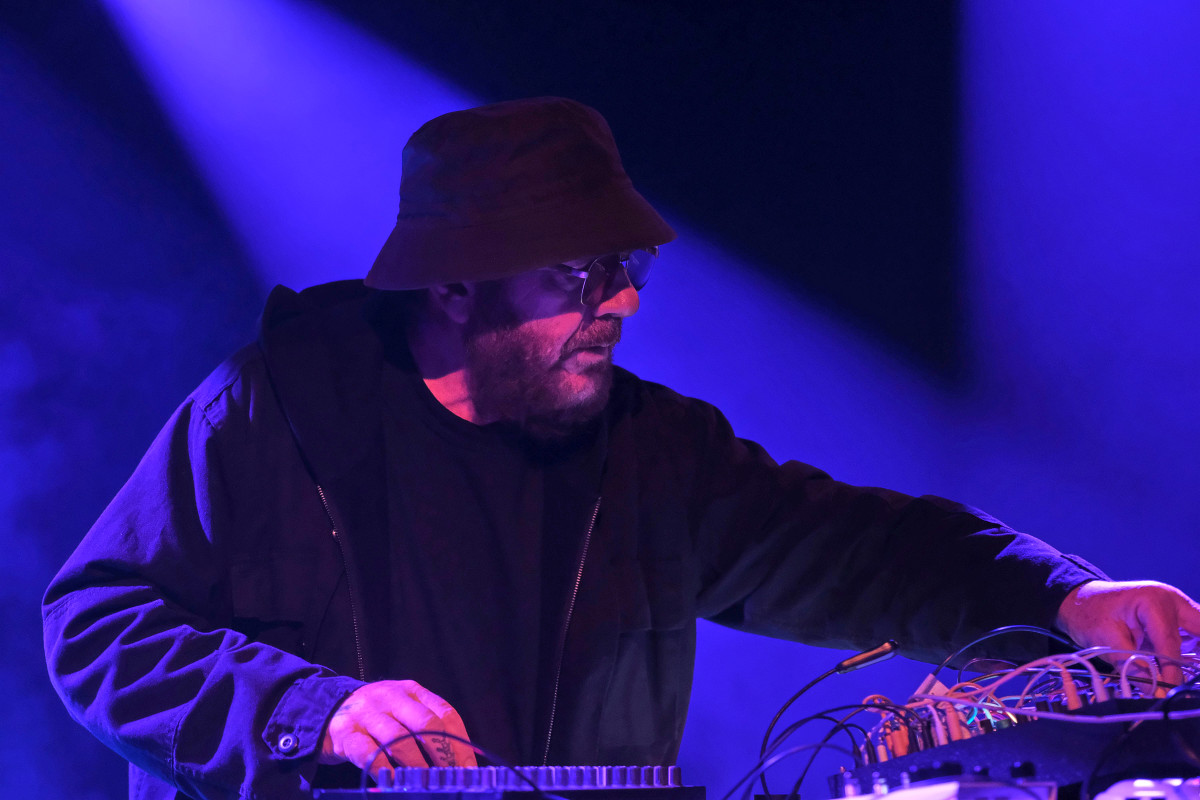
Rumor has it that the now-defunct British electronic band Coil once created a soundtrack for the cult horror film Hellraiser – so disturbing that it was rejected for being too frightening. With that story in the background, it almost felt like a natural opening to autumn’s darkness when Drew McDowall, former member of the mythical band, took the stage at Alice in Copenhagen on Wednesday evening. The Scottish musician is known for entering into striking collaborations – with Danish Puce Mary and, most recently, the American-Swedish composer Kali Malone – and it was precisely for this reason that it made sense for the evening to begin with an intense concert by Gintė Preisaitė. Like McDowall, she has the ability to transform even the simplest sounds into all-encompassing sonic landscapes.

Although both musicians clearly work from an electronic foundation, their sonic universes appeared remarkably organic, as if they were shaping living material. In her all-too-brief concert, Preisaitė created a mosaic of field recordings, voice fragments, and cassette tapes – chaotic one moment, ordered and transparent the next. With the same cool precision, McDowall unfolded his performance as if it were one long harmonium drone, slowly creeping under the skin with the inescapable logic of a horror film. For McDowall, darkness is not an alien force but a familiar companion, which he skillfully reshapes into soundscapes that are at once disturbing and reassuringly enveloping – like lying in a warm bed with the nightmare right beside you.

Both Preisaitė and McDowall moved effortlessly across the border between the acoustic and the electronic. Their music appeared as a contemporary legacy of the musique concrète tradition: an insistence that electronic music remains one of the most experimental art forms – vital, organic, and with the ability to let even the smallest sound open up an entire world in itself.

English translation: Andreo Michaelo Mielczarek

© Beowulf Sheehan

»Music is limitless, and its potential for meaning is infinite. This is neither good nor bad, but simply an acknowledgement that music is one kind of expression of any given culture (with many other inputs, of which I am mostly ignorant). From that perspective, I suppose then that music is just another medium through which I try to understand another human and/or the culture that they exist(ed) in, and more deeply feel the interconnectedness of the world that we live in, that we have inherited, and that we will pass on.«

Currently the only musician ever to receive two Avery Fisher Career Grants – in 2016 as a soloist and in 2019 as a member of the JACK Quartet – cellist Jay Campbell has brought his eclectic artistic interests both as a performer and curator to the New York Philharmonic, Deutsche-Symphonie Orchester, Los Angeles Philharmonic, Seattle Symphony, Ojai Festival, Lucerne Festival and many others. Deeply committed to collaborative music, Jay is a member of the JACK Quartet, as well as the Junction Triowith violinist Stefan Jackiw and composer/pianist Conrad Tao, multidisciplinary artist collective AMOC, and frequently works with composers and performers like Helmut Lachenmann, Patricia Kopatchinskaja, Barbara Hannigan, John Zorn, Tyshawn Sorey, and many more from his own generation. 

In brieflive
05.07.2024

A World of Contrasts – and a Touch of Smurf Vocals

Roskilde Festival: Slauson Malone 1
© PR

The cello is everywhere at this year’s Roskilde Festival. Some use it as just about anything else – hey, now it’s an electric bass, or how about a keyboard drowned in effects – but in American Jasper Marsalis’ Marcela Lucatelli-worthy bomb project Slauson Malone 1, the cello was actually used as, well, a cello.

Marsalis himself handled vocals and electric guitar on the open Platform stage, while Nicholas Wetherell opened the concert with a motor-race assault on his amplified cello, then pivoted into plucked meditations, to which Marsalis contributed overtone playing on guitar. Sensitive jazz guys? Nope – suddenly: synchronized noise sprints, intimacy splintered, and before long Marsalis threw himself into the seated audience with a somersault – and a scream.

Meanwhile, Wetherell played tender vibratos. Because contrasts thrive at Roskilde – and, after all, seem to be driving the world forward these days. And so it was the world itself that came into focus in the music: through violent shifts between 8-bit Smurf vocals, ambient gnawing solo cello, intimate indie layered over a one-second sample of Cher – culminating in a wistful lullaby veiled in digital theremin.

In many ways, it was peak hipster era. But it was also intensely moving – something like following Mahler out on the edge of the abyss as he tried to sketch the whole world into his scores. The only difference: the easel looks a bit different today.

© Pavlos Fysakis

»Music involves a mix of noise, of existing or fabricated instruments, of alternative worlds that the sounds and voices assemble. Some are gentle, some less so. We shift gears with music, it shifts intensity, we shift with it. I listen when I can.«

Jussi Parikka is a Finnish cultural historian and writer who works at Aarhus University as professor of Digital Aesthetics and Culture. After some 15 years in the UK, he continues in Denmark his work on how ecology, digital culture, art and design, and philosophy intersect. He has written on visual culture and history and archaeology of media, including the recent books Operational Images (2023) and Living Surfaces: Images, Plants, and Environments of Media (2024) which is co-authored with the Madrid-based artist Abelardo Gil-Fournier. Besides his writing and work as educator, he has been active as a curator including the recent show Climate Engines at Laboral, in Gijon (Spain) that was co-curated with Daphne Dragona as well as his involvement in the curatorial team of Helsinki Biennial 2023.

In brieflive
09.04.2024

Ballet’s New Power Duo

Josefine Opsahl: »Passengers of Passing Moments« (Koreorama nr. 01)
© Henrik Stenberg
© Henrik Stenberg

Josefine Opsahl herself sits on stage in the Australian-Danish choreographer Tara Schaufuss’s ballet Passengers of Passing Moments, for which Opsahl has composed the music. In fact, she almost steals all the attention from the ten dancers, as it is fascinating to watch the 32-year-old cellist’s theatrical immersion and her very active use of her right leg to control the loop and effects box.

The nearly half-hour ballet score is inspired by Bach, but also conveys a highland-like sense of drama through sampled breathing, stabbing subdivisions, and pronounced reverberation. It begins with delicate, bright major-key tones, but quickly moves into the depths, finding throbbing bass and timpani-like resonance. Emotions rush through every bow stroke.

The theme of the ballet is time. In fleeting moments, the dancers are caught in Opsahl’s small, mechanical loops; later, a dark, melancholic space is established, in which a young woman sinks into a memory. Extended sounds and overtones signal a time put out of joint; a faint wind is heard, a ticking fades in, and suddenly she has dreamed her beloved into being.

The woman moves like a ghost among the other bodies as Opsahl intensifies her playing, shifting between triple and quadruple meter. At one point, it is as if she disappears entirely into the violent temperament of the music; her dramatic flair turns Bach into an Avenger-like hero, and this suits Schaufuss’s focus on the force of emotions remarkably well. It is saturated, direct, and seemingly made for a grippingly intense choreography. A powerful partnership on the grand stage.

© Sebastian Gudmand-Høyer

»Music is a full bodied, raw and physical exchange. It’s an absorption that is overwhelming, that sometimes grants you relief. Music is interactive, and depends on you as a listener.« 

Alexander Tillegreen is a composer and artist who operates both visually, sonically and spatially. He works in a plurality of formats including multichannel sound installations & performances, interactive listening sessions, paintings, prints, light and concerts as well as exhibitions, commissioned works, and releases. In 2023, he presented a cycle of new commissioned sound works for the Darmstädter Internationale Ferienkurse für Neue Musik. Same year, he released his debut album in words on the acclaimed German electronic music label rastermedia. 

Alexander Tillegreen’s work has been the subject of numerous institutional solo and group exhibitions including: A Bruit Secret – Hearing in Art at Museum Tinguely in Basel (2023), O-Overgaden Institute for Contemporary Art in Copenhagen (2022), FuturDome Museum in Milano (2022), Kunstverein Göttingen (2022), Kunstforeningen GL Strand (2023), Museum für Moderne Kunst in Frankfurt (2017), and The National Gallery of Art in Copenhagen (2008). He has presented his music at many festivals and venues including STRØM Festival, Roskilde Festival, and CTM Festival. 

His most recent work investigates the relationship between psychoacoustic sonic phenomena and their potential to reflect and awaken the listener’s own linguistic and cultural embeddedness and co-creative embodied, interaction as a listener. 

He has been conducting artistic research at the Max Planck Institute for Empirical Aesthetics. This research centers on aspects of attention, spatial sound, voice, gender, identity, embodied co-creation, and language perception in relation to the phantom word illusion – a language-based psychoacoustic phenomenon, that triggers the illusory sensation of hearing inner streams of words that are not necessarily acoustically present.

In 2024, Alexander Tillegreen will represent Denmark at the ISCM World New Music Days on the Faroe Islands.