From the Culture Yard in Helsingør, ships glide past Kronborg Castle through the narrow waters of the Øresund – a reminder of the trade routes that, for centuries, have carried goods, people and power between the Nordic region and the wider world. It is an apt point of departure for the Passage Festival, and for Marie Dahl's vocal work Silk. Sugar. Sand, which explores the intertwined histories of three materials.
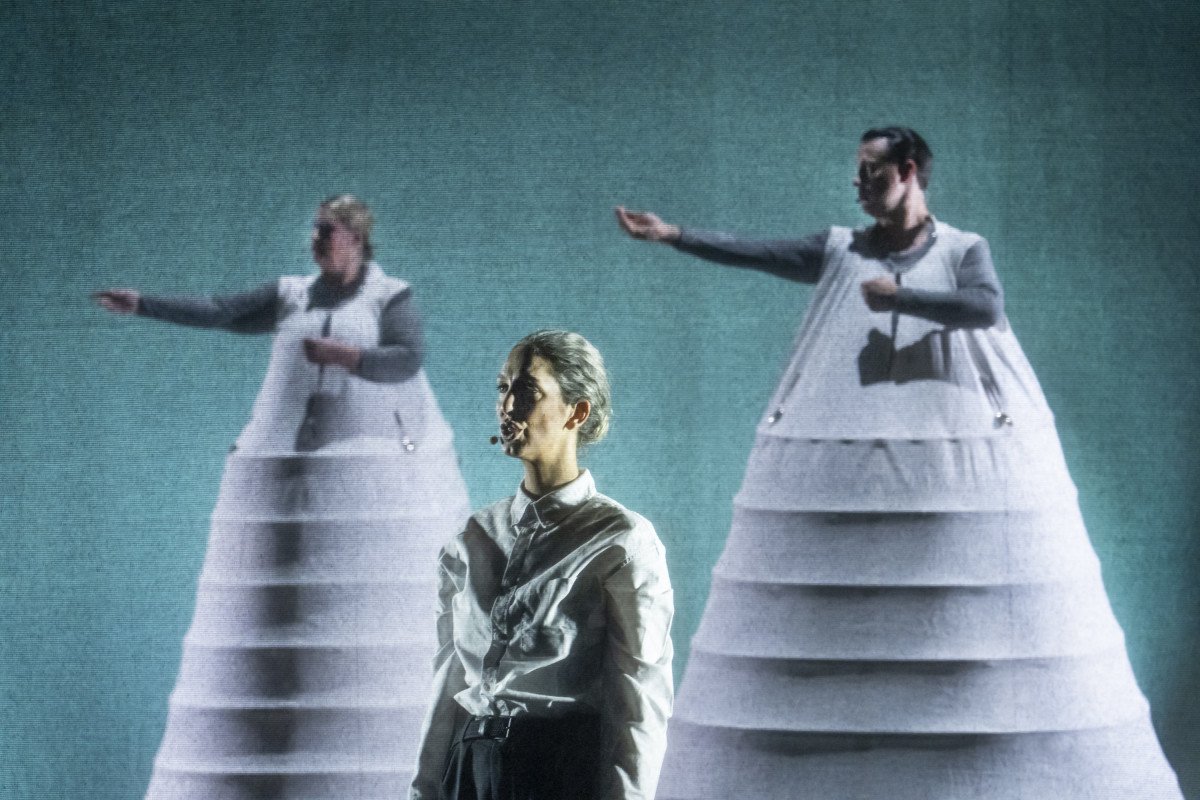
Silk. Sugar. Sand is a vocal performance in three acts tracing the historical journeys of these materials through colonialism, the global economy and geopolitics. Five singers from Ars Nova Copenhagen perform within a minimalist scenography consisting almost entirely of coloured light and three sets of costumes that transform throughout the performance: first silk dresses, then crinoline-like structures evoking sugar loaves, and finally grey stone-like forms suggesting accumulations of sand.
The work's central device is to translate the physical properties of these materials into vocal expression. At one moment, the elasticity of silk becomes soft, flowing polyphony; at the next, a cocoon-like electronic crackle. Sugar's crystalline structure is rendered as sharp vocal attacks – brief, whip-like cracks – as well as sweet, intimate whispers, while sand creaks and rustles, resonating with a libretto about economy and domination, violence and desire.
The performance has no conventional narrative, and the five singers portray no distinct characters, moving somewhat stiffly across the stage, as performers often do when their primary focus is on the voice. Comparisons with Hotel Pro Forma's Flammenwerfer are difficult to avoid. There, the production's rigorous aesthetic was counterbalanced by C.F. Hill's wildly expressive visual universe and Blixa Bargeld's deeply vulnerable stage presence. Those qualities are missing from Marie Dahl's carefully controlled staging, which could have benefited from more of the sensitivity and chaos that also form part of Kirsten Dehlholm's artistic legacy.