in brief
29.09

Injured Swan In a Flooded World

Aaben Dans, Mads Emil Nielsen, Thomas Eisenhardt and Kamilla Wargo Brekling, among others: »Vi fortsætter…«
© Birger Hansen
© Birger Hansen

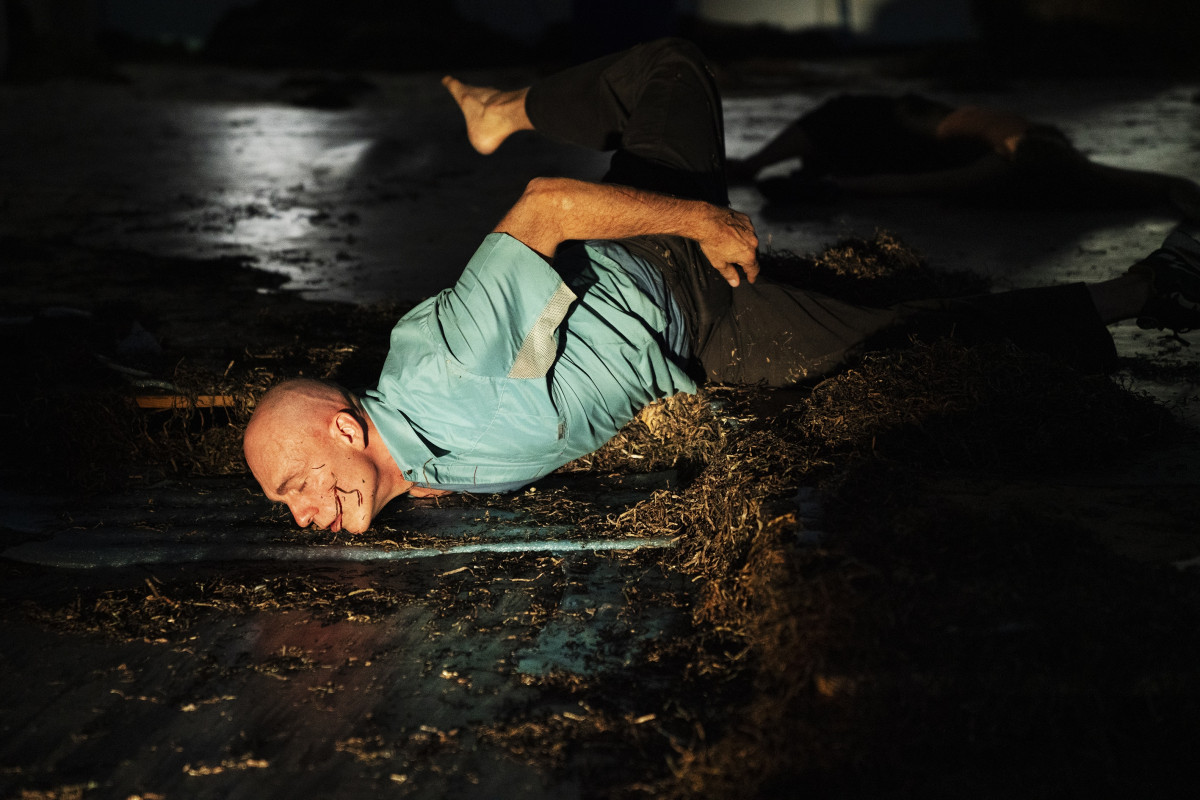
An injured swan lies buried in seaweed in a corner of the hall, while four lifeless bodies are scattered across the floor. More seaweed hangs from the ceiling, and the smell hits us already as we step through a bluish, latex-like curtain. The foyer was filled with heaps of seaweed and leftover plastic, and now we are inside an unfamiliar underwater landscape. The bluish light flickers on the wall, the soundscape murmurs faintly like a distant current of noise. We are underwater.

Slowly, bodies come back to life. They stretch in movements of suffering, stagger, struggle – but they rise. Subtle beats and Mads Emil Nielsen’s restless drones push the scene forward. The question of what has happened is rhetorical: everything points to climate catastrophe. Roskilde Fjord has overflowed its banks. Humans continue – despite a state of emergency, despite the flood – while the swan has succumbed.

The dystopia comes alive as the dancers, with impressively exploratory movements, search for ways to adapt to a new world. Here scenography, light and dance interact powerfully, and the senses are overwhelmed. That is precisely why it is a pity that the sound quality feels flat, when the sonic dimension plays such a role in the storytelling.

Still, Vi fortsætter... (We Continue…) succeeds in creating a universe that is at once absurd and all too recognizable. It recalls a gentler version of Ruben Östlund’s Force Majeure: the comic and tragic traits of human nature set against the inexorable forces of nature.
In the end, the dancers leave the stage and we are left in silence – with the afterthought of why we continue like this, and with the sensation of treading water long after leaving the fjord’s flooded universe.

English translation: Andreo Michaelo Mielczarek 

© Mishael Oladipo Fapohunda

»As Bertolt Brecht once wrote: 'In dark times, will there also be singing? Yes · there will be singing, about the dark times'.«

SLIM0 is a Copenhagen based doom/grunge/punk trio consisting of Mija Milovic (guitar), Lena Milovic (guitar) and Simin Stine Ramezanali (drums). The vocals of all three members can be heard throughout, the voice being a central element to the band's practice. SLIM0 uses minimal, albeit feisty arrangements to convey a strong sense of ominousness. Through crashed cymbals, distorted guitars and voices in unison, they present a full body of work hailing from personal takes on classic punk/rock tropes with SLIM0 as the omniscient narrator. Their debut album FORGIVENESS was released in October 2024 via 15 love. 

© Søren Lynggaard
© Søren Lynggaard

It is difficult not to read a great deal into trumpeter, composer and all-round musical visionary Palle Mikkelborg’s new solo album Light. He has long since passed retirement age, withdrew from touring in 2024, and with this release has presented something that very much feels like a kind of farewell.

The opening track, Per Nørgård’s »At tænde lys« (»To Light a Candle«), is pure Mikkelborg: his lyrical, elevated and elegiac solo trumpet, in both form and expression, speaks directly to the listener’s heart. Elsewhere, he draws on old soundscape recordings, combining them with piano and trumpet. The interplay between the old and the new creates a compelling mystique and casts a subtle, unsettling shadow over the music.

»Capricorn« perhaps stands out most strongly: a tender and romantic reimagining for solo piano of one of his own pieces, like a loving glance back at bygone times and former triumphs. And then, of course, the closing track, Thomas Laub’s »Stille, hjerte, sol går ned« (»Be Still, Heart, the Sun is Setting«), where Mikkelborg’s melancholic trumpet is joined by Jakob Bro’s guitar, Helen Davies’ harp and Thomas Lis’s choral soundscape. Together they create a piece of music that truly feels like a farewell, marked by both uncertainty and sorrow, but also acceptance and gratitude.

All in all, Light is the perfect distillation of Mikkelborg’s musical life – a cavalcade of the qualities that have always defined him as a musician: light, colour, life, mysticism, love. Whether this will be the final release from Mikkelborg’s hand, I do not know, but if it should prove to be the case, few swan songs have ever sounded so beautiful.

© Bjørn Giesenbauer
© Bjørn Giesenbauer

It is difficult to keep pace with Masami Akita. The 69-year-old Japanese noise artist, who since 1979 under the name Merzbow has helped shape the genre, released no fewer than a dozen albums in 2025 alone. On a rare mini-tour with stops in Helsinki, Stockholm and Aarhus, he showed that his energy remains intact. At Radar he gathered an audience that had travelled far to experience the godfather of noise – an artist who has consistently insisted on noise as a physical, almost tactile experience. Wearing a bucket hat, Akita constructed his trajectories with clear architectural precision. Layer upon layer of distortion and feedback took shape and struck like a brush of metal: hard, cutting, physical – uncompromising, yet at the same time remarkably nuanced.

Akita worked not only with electronics, but also with homemade metal instruments – first a banjo-shaped device, then a square musical saw – lending the sound a raw, tangible materiality. Everywhere, microscopic shifts in texture emerged, small fissures of tone within the massive pressure.

The opening set by frã (Francisco Moura) began the evening with a more fragile, yet persistent electronic texture, a precise counterpoint to Merzbow’s compact blocks of sound. Some might have wished for a gentler entry into the musical year 2026, but the concert underscored the ambitions Radar is currently pursuing.

English translation: Andreo Michaelo Mielczarek

in brieflive
14.01

The Excess of Attention

Aar & Dag: »A MAJOR CELEBRATION«
© Emilia Jasmin
© Emilia Jasmin

A steady stream of musicians enters the Xenon stage on Wednesday night at Vinterjazz. No fewer than 33 musicians take part in the mosaic of instruments assembled by the label Aar & Dag to celebrate the release of their cassette A MAJOR CELEBRATION. A release consisting of no less than three concerts, performed according to special composition cards, then mixed on top of one another and now issued on cassette. A major release calls for a major celebration, and rarely have I seen a more ambitious and idiosyncratic release concert.

The concert unfolded at a calm, unhurried pace – patient and attentive, the many musicians gave one another space to open up the broad soundscape. Double bass and electric bass, guitars, saxophones, synthesizers, percussion, cassette tapes, piano, and cello are just a selection of the orchestra’s many voices. Like a kaleidoscope, the ensemble shifted again and again, drifting between crooked, meandering passages and bubbling harmonies that only just brushed against a peculiar sense of tempo.

The word »soundscape« truly comes into its own in this context. For much like Hieronymus Bosch’s surreal monumental paintings or Sven Nordqvist’s Pettson and Findus illustrations, the concert – with its many people on stage – was filled with an impressive level of detail and a multitude of small scenes unfolding across one another. Each time my attention settled on a particular point in the music, I missed a new development elsewhere in the orchestra. An excess of attention, and a fine demonstration of a boundary-disrupting musical expression that one can only hope to encounter more of.

in brieflive
14.01

All Life Has the Right to Live

Lara Tacke, Alexandra Moltke Johansen, Kirstine Fogh Vindelev, Katinka Fogh Vindelev, Freya Sif Hestnes: »Animal«
© PR
© PR

It is this violent and feral line of text that hangs like a monolith in the austere stage space at Sort/Hvid after 80 minutes of a furious, raging monologue in the performance Animal. Actress Signe Egholm Olsen is left standing like an animalistic goddess who has carried out her own ritual of purification. A ritual about motherhood and about morality for animals and humans alike – flanked by the three wordless classical singers Katinka Fogh Vindelev, Nina Smidth-Brewer, and Hávard Magnussen, who function as a chorus in a Greek tragedy. They illustrate and stage the text through precise sonorities.

Animal is based on Alexandra Moltke Johansen’s debut novel from 2022 of the same name and overflows with meaning, hurled into the audience’s face from beginning to end. Worries, anxiety, angry activism, grief, and doubt – tied to being pregnant and becoming a mother to a »useless« child with Down syndrome in a world marked by climate catastrophes, war, inhumane political cynicism, and greed. All of this flows from the mother’s inner dialogue as a long moral reckoning and outpouring, unfolding in a scenic tour de force – from the clinically clean and artificial atmosphere of a wellness spa to a material chaos of soil, branches, and sweat.

Kirstine Fogh Vindelev has composed a soundscape that makes it possible for us to breathe at all. Discreet choral tones, small electronic passages, a touch of barbershop, screams, and a pop song are wedged in between the words. It is simple and straightforward. The music is allowed to comment and converse like a shadow presence alongside the many words, but at no point is it allowed to become the protagonist or truly carve out its own space within the performance. One could easily wish for another form of sensory reflection than that which words and speech alone can provide.