in brief
07.10.2021

Bag brandvæggen ligger utopien

Hôy La: »There’s a Girl Inside My Brain Who Wants to Die«
Hôy La. © Petra Kleis

Når jeg sætter mig og skriver formskemaerne ned på papir, kan jeg jo godt se det. At Ingri Høylands album består af både klangligt og formmæssigt varierede skæringer, der til tider er helt eminent godt og ukonventionelt sat sammen. Tiden bliver strakt helt ud på åbningen »Ego, Bitch« og giver en overlegen baggrund for vokalens insisterende refræn om handlekraft. Som komponist vil hun virkelig noget, og som producer vil hun – sammen med de øvrige fire producere på udgivelsen – virkelig, virkelig noget, ja næsten alt.

Jeg kigger ned på papiret og konstaterer, albummet er noget af det ypperste, der er udkommet i år. At det er sådan, Billie Eilish ville have lydt, hvis hun ligesom Høyland studerede på Rytmekons i København. Her er plads til bløde sirener, skinger solosaxofon, drevne grooves og et virvar af pludselige syntetiske indgreb. Så kigger jeg op fra papiret og spørger mig selv, hvorfor jeg alligevel ikke helt lader mig rive med.

Hovedmistanken retter sig mod den næsten provokativt anonyme vokal, der ofte er lige så druknet i filtre og manipulationer som resten af lydbilledet. Det bliver kontrol med kontrol på, og det er måske lige kontrol nok. Heldigvis er udgivelsen ikke kun en portefølje over teknisk finesse, men vidner altså også om et enormt potentiale, som ligger og gemmer sig bag firewallen. Virus efterlyses.

Viner Khaiitov. © Tatita Zhiliaeva
»Music is the opposite of escape for me right now: it’s where the tension gets held, repeated and turned into rhythm.«
 
Viner is a DJ and producer based between Marseille and Barcelona, where he runs the label and art lab PATAR. Born in Ulyanovsk to an Uzbek, Tatar and Bashkir family, he started making music in Kazan. In 2022 he recorded across Uzbekistan: Navruz in Tashkent, the Stihia festival in Muynak (where he was technical director), and street sound in Khiva, Bukhara and Samarkand. On 2330 (PATAR, November 2026) those recordings are cut into fragments of two seconds or less and set into three-beat loops running against the main pulse, »doira« patterns that take several bars to come round, and bass in blunt, distorted blocks. The sources stay half-legible. What carries is the friction, held for five tracks and never quite released.


© PR

»For me, music is a kind of secret path – a gateway to emotions, thoughts, and ideas that might otherwise be difficult to access. It serves as a shortcut to daydreaming and creativity – to those moments when I feel most connected to my own humanity and that of others. Through music, my own life intertwines with the artist’s, and together we create something entirely new.«

Kristoffer Møllegaard holds an MA in Russian Language and Culture from the University of Copenhagen (2017), with a specialization in future speculation within Russian art and philosophy. He writes regularly about Russian culture and, in his spare time, is active as a visual artist and amateur saxophonist. He has been a contributor to Seismograf since 2020.

© PR

»Music is like a black hole that sucks you in and shoots you out on the other side of the universe.«

Francesco Rista is a guitarist working across classical and electric guitar. His recordings have been reviewed by international music magazines and broadcast on BBC and RAI Radio 3. After studying at the Royal Danish Academy of Music and Lund University, he focused on studio recordings, exploring guitar repertoire from the Baroque and Romantic periods to contemporary music, as well as the instrument’s varied tonal possibilities. Rista is currently based in Iceland, where he teaches guitar, composes music, and collaborates with contemporary composers.


in brieflive
30.10

Only at the End Did the Music Break Free

The Baroque Society: »Remembering«
© Malin Annie Jansson

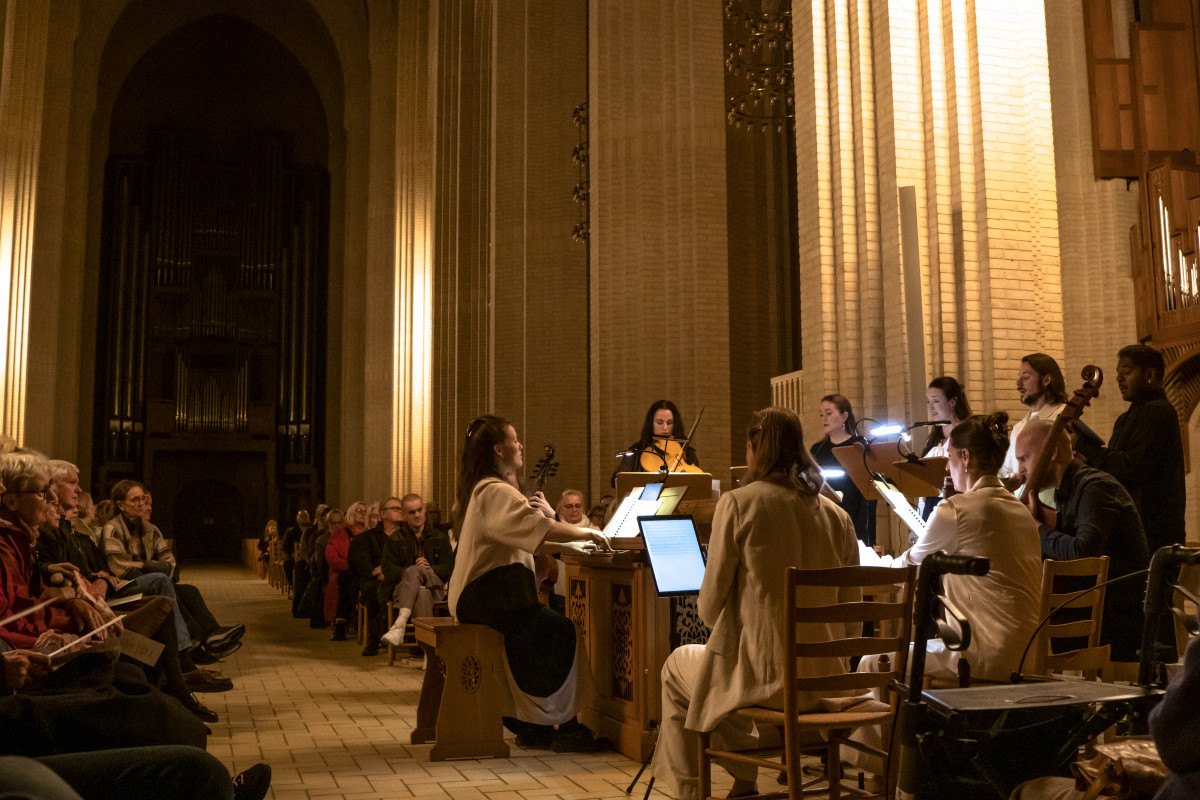
The British composer Nick Martin, who is based in Copenhagen, attempts to give remembrance a sonic form in his brand-new work Remembering, written specifically for The Baroque Society. On Thursday evening at Grundtvig’s Church, he succeeded beautifully in parts of the fifteen-minute work for four singers and a small, intensely focused group of Baroque instruments.

Dense vocal textures lingered over harmonies that unfolded slowly, while allowing the soloists to emerge one by one. The static accompaniment provided a foundation for remembrance, over which the floating voices evoked the lost and departed. The harmonies gradually shifted in colour like clouds in the sky, constantly changing shape – seemingly at random, yet following what felt like a fixed, organic pattern. But the work became too long and passive. Only in its final minutes did the harmonies break apart, making room for welcome rhythmic variation and tantalising silences. Had this shift in form come earlier, Martin might have created a more compelling work. It nevertheless ended with a gem of an open, searching chord which not only demonstrated his gifts as a vocal composer but perhaps also invited us to think of remembrance as something positive and transformative rather than tragic.

Remembering was framed by two works by J.S. Bach (BWV 118 and 106). The latter cantata was later given the title Actus Tragicus, but it was not entirely tragic: for Bach, death primarily offered access to something better. That sense of consolation was harder to find in this performance, where the small orchestra of The Baroque Society lacked energy and momentum. Yngvild Haaland Ruud, seated behind the small organ in the middle of the ensemble, provided insufficient musical direction to bring the players together. The tempo was far too ponderous, and the music lingered too much on the feeling or memory of the sounds just heard. Still, it was refreshing to encounter a new work by Nick Martin – an invitation to remember at All Saints’ Day.

The concert will be repeated in Copenhagen, Helsingør and Gentofte over the coming days

English translation: Andreo Michaelo Mielczarek

© PR

»For me, music is incredibly important. It is music that reveals who I am and who I want to be. Music is my muse, my solace, and my paintbrush. It paints my state of mind, serves as a frequent topic of conversation among my friends, and – along with the lyrics – acts as my preferred form of expression. To me, music represents the colors and shapes of my life. I have a particular fondness for Danish artists such as C.V. Jørgensen, Elisabeth, Olesen-Olesen, Peter Sommer, and Gravens Rand.«

Søren Damm is an award-winning author known for the novels Transit, Melodrama, and Finland. He is also a singer and songwriter, having released, among other works, the album Håbet Er Den Største Last.