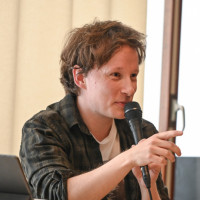

Niels Rønsholdt
51







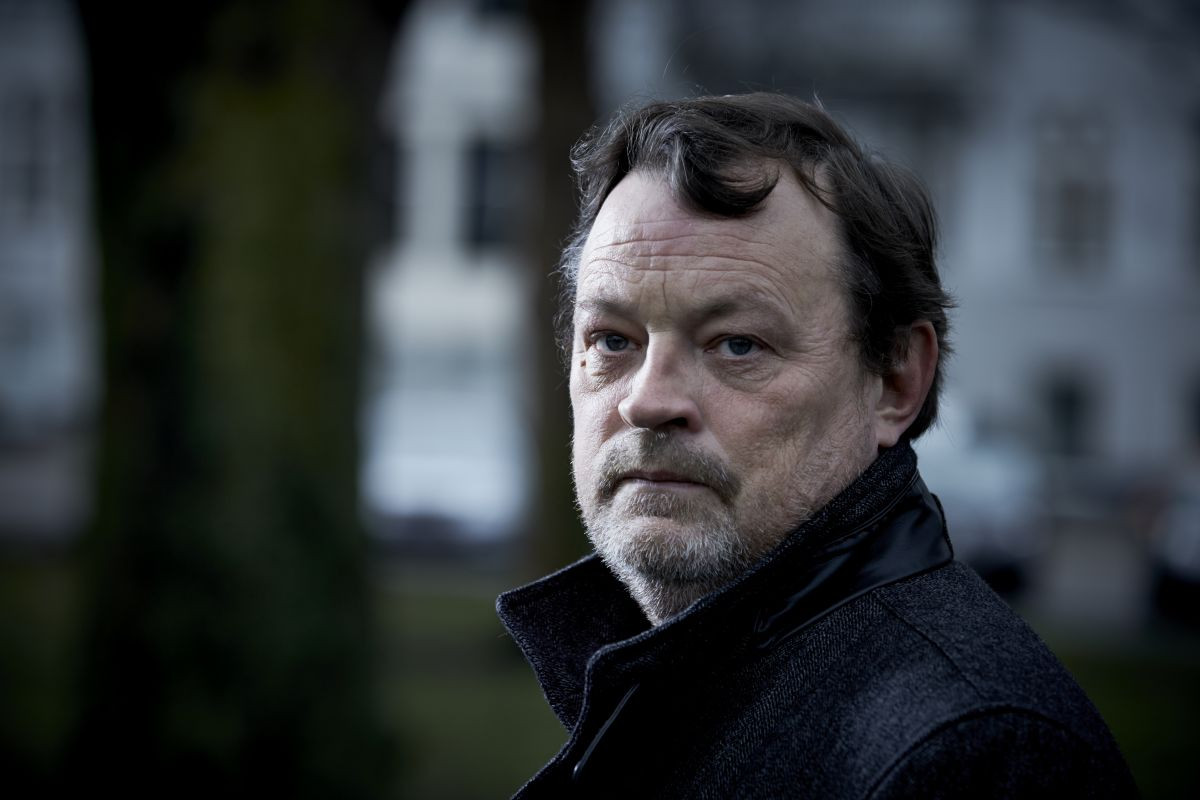
Bestræbelsen er den samme i de to erindringsbilleder, der som en uhørt luksus materialiserer sig her gennem DR Symfoniorkestrets adrætte arbejde. Nemlig at stille et nostalgisk vemod – romantiske strygere, klagende glissandi – op over for moderniteten.
Hvordan lyder nuet? Enten som storbyens susende trafik i L’isola della città med Trio con Brio som fremskudt hovedperson eller som et vedvarende skrig af skiftevis klanglig opfindsomhed og monoton udstrakthed i Second Symphony.
Mest fortællende virker mødet i den raffineret konstruerede trippelkoncert, hvor et spilledåseenkelt klaver klinger af fugal barndomslængsel, men afbrydes af kontrabassernes støjende borebehov: erindringsflugten saboteret af vejarbejde, Bent Sørensen som underspillet – og uventet – humorist.
Hører man værket som et møde mellem nostalgi og nutid, lægger man også mærke til, at de to kombattanter forsones. En stammende, snurrende uro sætter sig i den erindrende, der til sidst indser støjens potentiale og ender med at skabe endnu skønnere klang ved at invitere dissonansen indenfor.
Det er et finurligt og betagende erindringsspil, Sørensen tegner op. Det er også albummets stærkeste værk, for sekundsymfonien føles som indspillet musik mere forceret i sin dualisme, end den gjorde i koncertsalen, der bedre understøttede klangens rumlige vandring og den dramatiske vekselvirkning med slagtøj.
Ikke desto mindre: to fantastiske eksempler på, at Bent Sørensens nostalgiske drift er absolut moderne, ekvilibristisk og foreløbig uden udløbsdato.
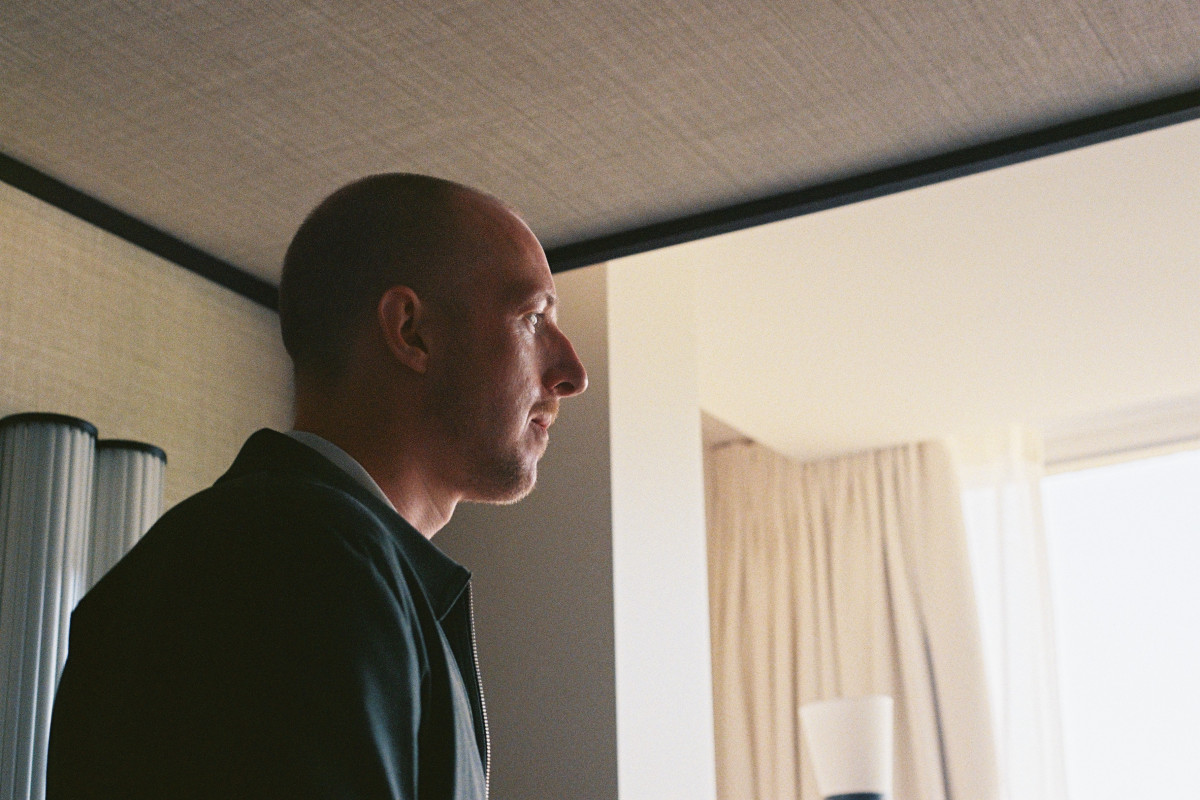
The forest lake is a cradle of life in more than one sense. The forest’s myriad forms of life depend on its waters, but its trickling branches, intense stillness, and soft reflections also hold powerful musical potential. It is precisely this life-giving energy that forms the basis of Swedish composer Filip Leyman’s solo debut album, Soft Light. From the very first track, »Beyond the Sea«, one senses how Leyman manages to create an organic universe where every sound nourishes the soil for the next. It is difficult to find either beginning or end as the many synthesizers and strings grow into and out of one another – you simply have to surrender and sink into this spherical universe of reverberations and deep, steady bass.
Filip Leyman’s work cannot be described without mentioning Swedish artist Anna von Hausswolff. Her music is like a force of nature, carried by long, sacred organ passages – and what is Hausswolff and what is Leyman is never entirely possible to determine. Soft Light gathers together compositions written over decades and appears as a natural extension of the many albums and soundtracks the two have created together. The album contains a strong cinematic dimension: in a track like »Shapes«, the layered sounds culminate in a dazzling climax that feels like slow motion in sound.
Here, Leyman appears as a musical botanist, patiently letting his synthesizers grow, sprout, and bloom. Although Soft Light has developed over many years, it sounds remarkably cohesive – like one long breath. The album seems more cultivated than composed. Let us hope that Soft Light is only the beginning, and that Leyman will allow more solo albums to grow in the same light.
English translation: Andreo Michaelo Mielczarek
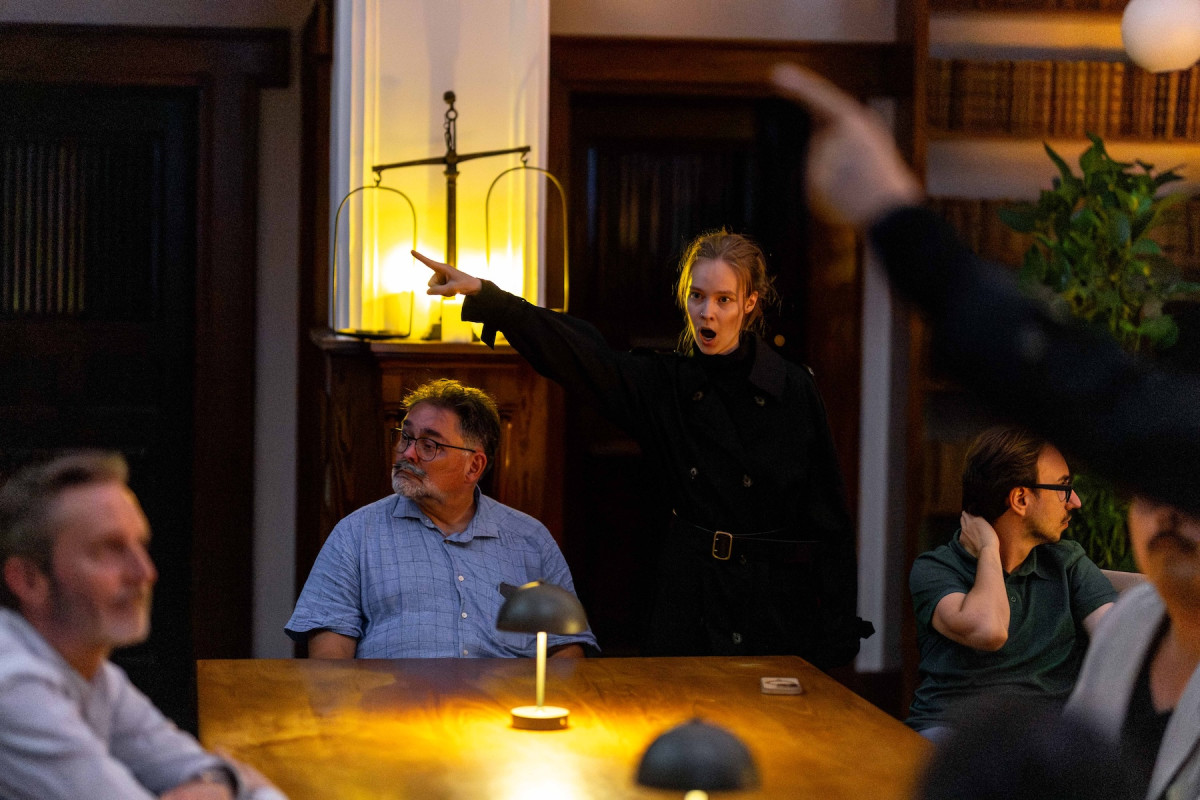
A newly composed opera staged in a courtroom may sound like a banal trick. But as I step into the waiting hall of the Aarhus Courthouse for Niels Rønsholdt and Louise Beck’s Den Stærkes Ret – Den Svages Pligt (The Right of the Strong – The Duty of the Weak), I wonder for a moment if I’ve come to the wrong place. An oblong room, tables scattered about, a balcony above – and then a sheet of music in a glass display case that normally would hold old legal documents. The scenography is discreet, but the legal framework immediately sparks reflections on law, power, and justice.
Soon, nearly 20 singers appear on the balcony. The music is tonal, carried by resonance and repeated phrases that gradually shift like a canon. You sense borrowings from minimalism, but also a near-folklike simplicity that makes the choir both enchanting and unsettling. The plot – a daughter confronting her father’s ghost to claim his weapon – emerges only in fragments. It is the atmosphere that drives the work, and it changes radically when the singers leave the balcony and place themselves among the audience, while three dancers move through the hall.
A pivotal moment comes when the choir suddenly strikes tuning forks and places them on the tables, sending a vibrating »wuu-uu« through the room. Goosebumps arrive instantly. Moments later, the singers address us directly, holding intense eye contact. It feels both intimate and transgressive, like being spoken to in court with no chance to reply. I wanted to look away, but felt compelled to hold their gaze. Here, the title became physical: the duty of the weak to submit.
As the work fades out, all the singers turn against the father and side with the daughter. Books are torn from the shelves, pages ripped out, and as »Listen and learn« is sung, Orwell’s 1984 flickers in the back of my mind. It is both disturbing and uncannily timely in an era where obedience to authority and manipulation again shape public discourse.
Den Stærkes Ret is one of the most intense musical experiences I have had in years. It unites aesthetics, body, and social commentary in a way that makes you shudder. I am already waiting for acts two and three.
English translation: Andreo Michaelo Mielczarek

Rumor has it that the now-defunct British electronic band Coil once created a soundtrack for the cult horror film Hellraiser – so disturbing that it was rejected for being too frightening. With that story in the background, it almost felt like a natural opening to autumn’s darkness when Drew McDowall, former member of the mythical band, took the stage at Alice in Copenhagen on Wednesday evening. The Scottish musician is known for entering into striking collaborations – with Danish Puce Mary and, most recently, the American-Swedish composer Kali Malone – and it was precisely for this reason that it made sense for the evening to begin with an intense concert by Gintė Preisaitė. Like McDowall, she has the ability to transform even the simplest sounds into all-encompassing sonic landscapes.
Although both musicians clearly work from an electronic foundation, their sonic universes appeared remarkably organic, as if they were shaping living material. In her all-too-brief concert, Preisaitė created a mosaic of field recordings, voice fragments, and cassette tapes – chaotic one moment, ordered and transparent the next. With the same cool precision, McDowall unfolded his performance as if it were one long harmonium drone, slowly creeping under the skin with the inescapable logic of a horror film. For McDowall, darkness is not an alien force but a familiar companion, which he skillfully reshapes into soundscapes that are at once disturbing and reassuringly enveloping – like lying in a warm bed with the nightmare right beside you.
Both Preisaitė and McDowall moved effortlessly across the border between the acoustic and the electronic. Their music appeared as a contemporary legacy of the musique concrète tradition: an insistence that electronic music remains one of the most experimental art forms – vital, organic, and with the ability to let even the smallest sound open up an entire world in itself.
English translation: Andreo Michaelo Mielczarek
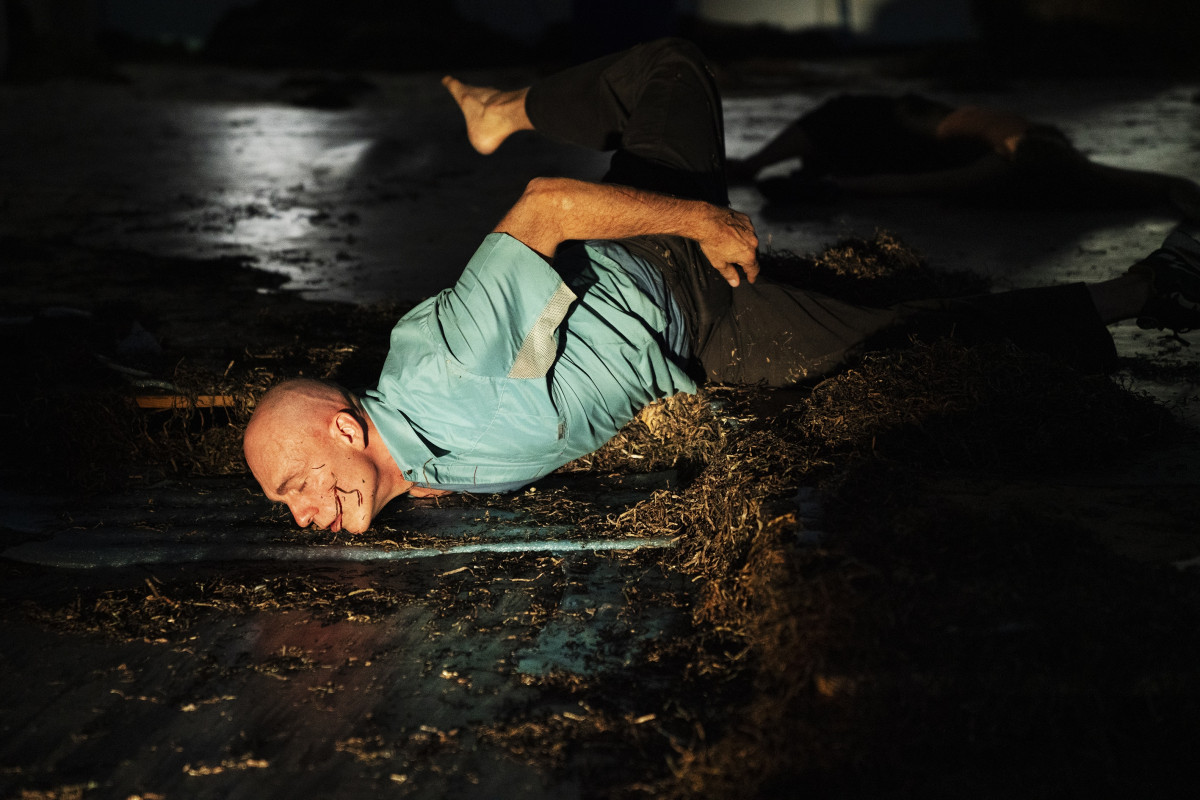
An injured swan lies buried in seaweed in a corner of the hall, while four lifeless bodies are scattered across the floor. More seaweed hangs from the ceiling, and the smell hits us already as we step through a bluish, latex-like curtain. The foyer was filled with heaps of seaweed and leftover plastic, and now we are inside an unfamiliar underwater landscape. The bluish light flickers on the wall, the soundscape murmurs faintly like a distant current of noise. We are underwater.
Slowly, bodies come back to life. They stretch in movements of suffering, stagger, struggle – but they rise. Subtle beats and Mads Emil Nielsen’s restless drones push the scene forward. The question of what has happened is rhetorical: everything points to climate catastrophe. Roskilde Fjord has overflowed its banks. Humans continue – despite a state of emergency, despite the flood – while the swan has succumbed.
The dystopia comes alive as the dancers, with impressively exploratory movements, search for ways to adapt to a new world. Here scenography, light and dance interact powerfully, and the senses are overwhelmed. That is precisely why it is a pity that the sound quality feels flat, when the sonic dimension plays such a role in the storytelling.
Still, Vi fortsætter... (We Continue…) succeeds in creating a universe that is at once absurd and all too recognizable. It recalls a gentler version of Ruben Östlund’s Force Majeure: the comic and tragic traits of human nature set against the inexorable forces of nature.
In the end, the dancers leave the stage and we are left in silence – with the afterthought of why we continue like this, and with the sensation of treading water long after leaving the fjord’s flooded universe.
English translation: Andreo Michaelo Mielczarek
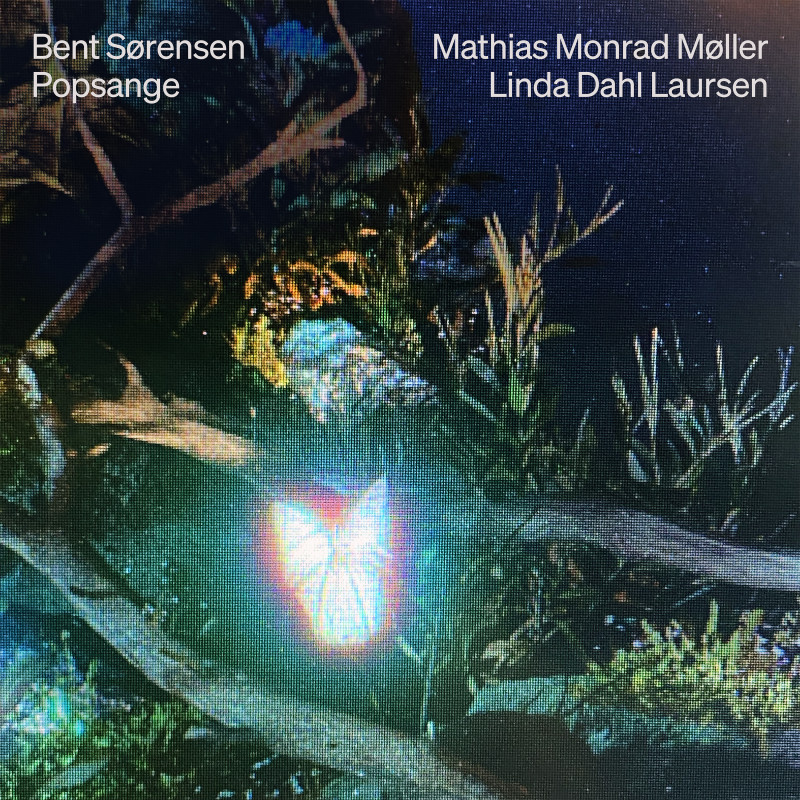
»Your eyes are in reality luminous tunnels to another reality.« So goes one of the key lines in the opening song of Bent Sørensen’s song cycle Popsange, inspired by texts by Michael Strunge. It sets the tone and points toward the recurring lyrical themes: all-consuming love, the shared journey toward another place – and the eyes, always the eyes, appearing in almost every single song.
Mathias Monrad Møller sings with great sensitivity, bringing the text to life, and his interplay with Linda Dahl Laursen is strong. Yet Popsange has much more in common with lieder than with actual songs – not least because of the text’s at times highly poetic language. The tender, almost naïve voice of the lyrics receives its most convincing counterpoint from the piano, as in »Illusion«, where it first follows and supports the words, only to break out into rapid, dissonant chords that interrupt and almost mock the singer.
Still, traces of pop music can be found here and there. »Tid og rum« builds on repetitions with small variations, much like the verses of a pop song. And in »Hjertestrøm«, Møller colors his voice with a timbre that could easily fit on a pop album – not least because the piano here is delicate and playful, giving the voice more freedom.
All in all, Popsange is a pleasant listening experience, but I miss the presence of David Bowie and Lou Reed on the musical front. The work is at its most innovative where it dares to embrace pop. Imagine if the texts had been carried by actual verses, hooks, and choruses – elements that might have turned them into true earworms.
English translation: Andreo Michaelo Mielczarek