

in brief
27.04.2023

And Mary responded

Hugi Guðmundsson: »The Gospel of Mary«
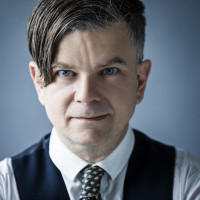
Hugi Guðmundsson © Dagur Sigurðsson

Et nyt oratorie af Hugi Guðmundsson giver Maria Magdalene en klar stemme som apostel med et tæt forhold til Jesus. Med oldgamle apokryfer som tekstligt udgangspunkt består The Gospel of Mary af en række korte satser for sinfonietta, kor og solosopran. Hypnotiske meditationer spilles af blot et enkelt blæserinstrument med strømmende melismer og fungerer som en slags auditiv søjlescenografi, der rammesætter fortællingen i et mellemøstligt univers. Ligesom hovedpersonen selv står de helt alene, og det er smukt og ekstremt nærværende. Fra den første basklarinetmeditation stiger pulserende strygere op til ivrige xylofonstrømme og et svævende lydtæppe af menneskestemmer. Hele satsen bliver mere og mere højtregistreret og dirrende, til musikken næsten splintrer. 

Som en græsk tragedie har koret både en kommenterende og en dramatisk rolle, hvor herrerne agerer Jesu disciple og kvinderne en slags forlængelse af Maria Magdalenes eget væsen. Schola Cantorum Reykjavicensis lægger stemme til og klinger flot over Århus Sinfoniettas flydende teksturer. Maria Magdalene synges af norske Berit Norbakken med en sopranstemme af drømmende vægtløshed og intens skønhed. På en gang stærk og sårbar er Norbakkens stemme omsluttet af kor og instrumenter, først nærende og beskyttende og siden mere voldelig, rå og klaustrofobisk. Hugi Guðmundsson skriver fantastisk for stemmer, og særligt værkets stille momenter er de mest magiske. Den rene menneskelighed eksisterer som et barn i os alle, bliver der proklameret, men Maria Magdalene bliver dog næsten for ren i sin godhed til for alvor at inspirere til radikal humanisme, for hvad er hun mere?

© PR

»Music is the ultimate gateway to presence, a true expression of the moment.«

Praised by DownBeat Magazine as one of Europe’s most versatile and inquisitive musicians, Polish-born, Scandinavian-based trumpeter and composer Tomasz Dąbrowski creates music that whispers before it screams – blending open, lyrical melodies with raw, unconventional trumpet sounds. Dąbrowski has revealed an unceasing curiosity, stretching and expanding his jazz roots in an ever-widening circle of exploration. From the beginning he’s rejected hierarchies, preferring to see creative music as a boundless practice that can accommodate ideas drawn from every spot on the stylistic map. While plenty of musicians pivot toward new directions, sometimes transforming their aesthetic wholesale, Dąbrowski has long revealed a more ruminative and holistic mindset that has allowed him to retain a clear artistic identity through countless projects, whether driven by improvisation or composition. 

© Malthe Ivarsson

»Music is where my heart is. The place where I feel the most freedom and possibility to express myself. It's also the place I seek to when I need to calm down.«

Anna Roemer is a Danish guitarist and composer from South Zealand, now based in Copenhagen. She has performed with artists like Hannah Schneider, Jacob Bellens, and Guldimund. Together with saxophonist Cecilie Strange, she forms the acclaimed duo K A L E II D O, known for music that constantly evolves. The duo has received national and international praise and won the Carl Prize for »Jazz Composer of the Year« for their albums Elements and Places (2024).

in brieflive
02.06

Not the Royal Rock Star We Might Have Wished For

David M. A. P. Palmquist: »King Frederik X’s Honour March«
© Kongehuset
© Kongehuset

Surely, I can’t be the only one who nearly choked on my oyster on New Year’s Eve, when King Frederik X delivered his first New Year’s speech. What a modern take on the old tradition! Instead of sitting solemnly at a desk, he calmly walked into the room – a room demanding attention, where a futuristic mural stole the show. I could barely focus on the speech itself, distracted by the psychedelic imagery behind him: a visual nod to Yellow Submarine by The Beatles. Was this a sign of a rock star ascending the throne?

Wishful thinking, as it turned out. The speech turned into a parade of predictable platitudes. The same can be said about the King’s new Honour March, composed by David M. A. P. Palmquist, former conductor of the Royal Danish Life Guards Music Corps. A traditional and sluggish piece that plays it entirely by the book.

Since H.C. Lumbye gifted a march to Frederik VII in 1861, it has been a tradition for members of the royal family to be granted personal marches. Take the lively and self-ironic Parade March for Queen Margrethe, which includes quotes from both »I Danmark er jeg født« and »Daisy Bell«. Or Crown Prince Frederik’s brisk and quirky Honour March in 6/8 time – written by Fuzzy for the now-King’s 30th birthday – tipping its hat to Carl Nielsen’s »Som en rejselysten flåde«.

But where is the personal character in Palmquist’s march? The composer approaches the task far too conceptually, attempting to give the piece a musical signature with a kind of rebus at the beginning. The first note is an F, followed by one ten steps higher – thus spelling »Frederik the 10th« in musical code. The many references to other military music are just as internal. What’s missing is something that breaks with protocol – just like King Frederik himself has done in his most memorable and beloved moments. In the end, it sounds like a march that has forgotten who it was written for.

English translation: Andreo Michaelo Mielczarek. Proofreading: Seb Doubinsky

© Clement Beauvais

»Music exploration and creation is not limited to notes, timbres and traditional structures, but extends to everything that shapes the listening experience.«

Alexandre Bazin is a French musician, and documentary producer, active in the experimental music scene at the fringes of GRM. His music is published by Important Records, Umor Rex Records, and Constructive. Bazin began his musical journey early, first studying classical piano at the conservatory before exploring jazz and electroacoustic music. The study of other musical languages has opened new perspectives and led him to rethink music beyond its traditional structures. He discovered a world where sound becomes raw material, and where production plays an essential part. This exploration revealed to him that music creation transcends notes and timbres, encompassing all elements that shape the listening experience, with sound engineering playing a pivotal function in this process. Bazin produces monthly documentaries for Radio France and GRM (Groupe de Recherches Musicales), chronicling the history of the experimental scene from its origins to the present.


in brieflive
27.05

When Orpheus Turns His Head

O Future: »Enter Afterlife«
© PR
© PR

Thorvaldsens Museum is a fitting place to unfold a narrative about the soul’s journey to the underworld. Not only are the halls filled with depictions of Greek mythology, the museum itself is a kind of mausoleum, with Bertel Thorvaldsen’s grave situated at the heart of an inner courtyard. Everything should align perfectly when the multimedia duo O Future stages the descent into Hades through sound and animated video projections. But it doesn’t.

Through eight rooms and five sound works, we move from the banks of the River Styx, through the underworld, and finally to Elysium, where the blissful afterlife awaits. Along the way, we are confronted with judgment, choice, and struggle – existential themes played out on the grandest scale. The electronic soundscape, delivered through headphones, begins with a simmering, oppressive digital lament and accelerates through the rooms to a heavy electronic beat layered with symphonic undertones. We hear jazzy saxophones, looped synths, and white noise, before safely arriving in a spherical, almost sacred, digital choir.

There’s an intriguing theme in the collision between digital voices and the idea of death, but it is drowned out by the many loose ends of the exhibition. Why, for instance, is there no synchronicity between sound and visuals? Why are videos consistently projected onto sculptures that bear no relation to Greek mythology? And why the oddly synthetic color palette that evokes 1990s MTV more than it does the vast drama the story seeks to evoke? I hurriedly close my eyes and try to focus on the beat – but it’s too late. Orpheus has turned his head, and Eurydice is lost. So is this exhibition.

English translation: Andreo Michaelo Mielczarek