






In the Shadow of Pärt
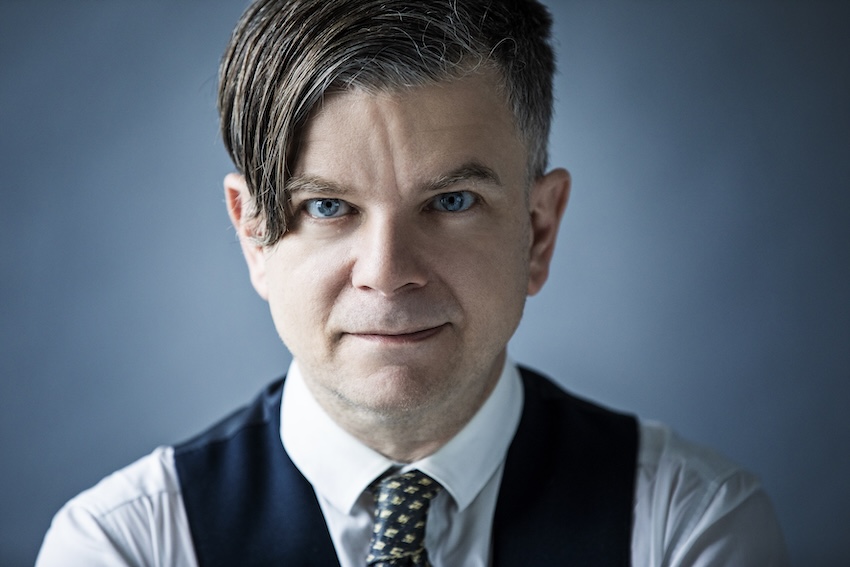
Estonia is an unusually small country with an unusually rich and multifaceted musical life. In the corridor leading passengers out of Tallinn Airport, large posters display photographs and life-philosophical quotes by Arvo Pärt, whose global fame has long since become something the country proudly brands itself with.
I have just landed and am on my way to Estonian Music Days, the contemporary music festival that, under various names, has existed since 1979. Like many others, I was first introduced to Estonian music through the works of the now 90-year-old composer. Yet these posters also draw my attention to the contradiction he, in a sense, embodies.
Estonia is an unusually small country with an unusually rich and multifaceted musical life
On the one hand, he is a mainstream icon who has helped place Estonia on the cultural world map. On the other, he is a massive elephant in the room for the country’s musical life – one that undoubtedly benefits from the attention his reputation has brought, yet must also constantly struggle to free itself from the dominance he inevitably exerts, both internally and externally, as the single most towering institution in Estonian music.
These posters do something else as well: they remind us of the prominent role music – score-based music included – plays in modern Estonia, not only as a bearer of identity, a mechanism of reflection, and a catalyst for immersion and aesthetic contemplation, but also as a tool for strengthening national cohesion. Later, as I wander through Tallinn’s medieval city, I am struck by how it is dominated by entirely different posters advertising concerts with long-canonized composers – names that, from an outside perspective, follow in Pärt’s wake: Erkki-Sven Tüür, Veljo Tormis, and the Latvian Pēteris Vasks – alongside a wealth of other music.
Conservatism with historical resonance
At the concerts I attended during Estonian Music Days, I sensed in the audience a profound support for – and recognition of – the importance of musical life to public discourse. The concerts revealed just how deeply, even radically, Estonian music exists within a field of tension between »the established« and »the new«, between »tradition« and »renewal«, between »simplicity« and »complexity« – to such an extent that I am not even sure these are the right terms to use.
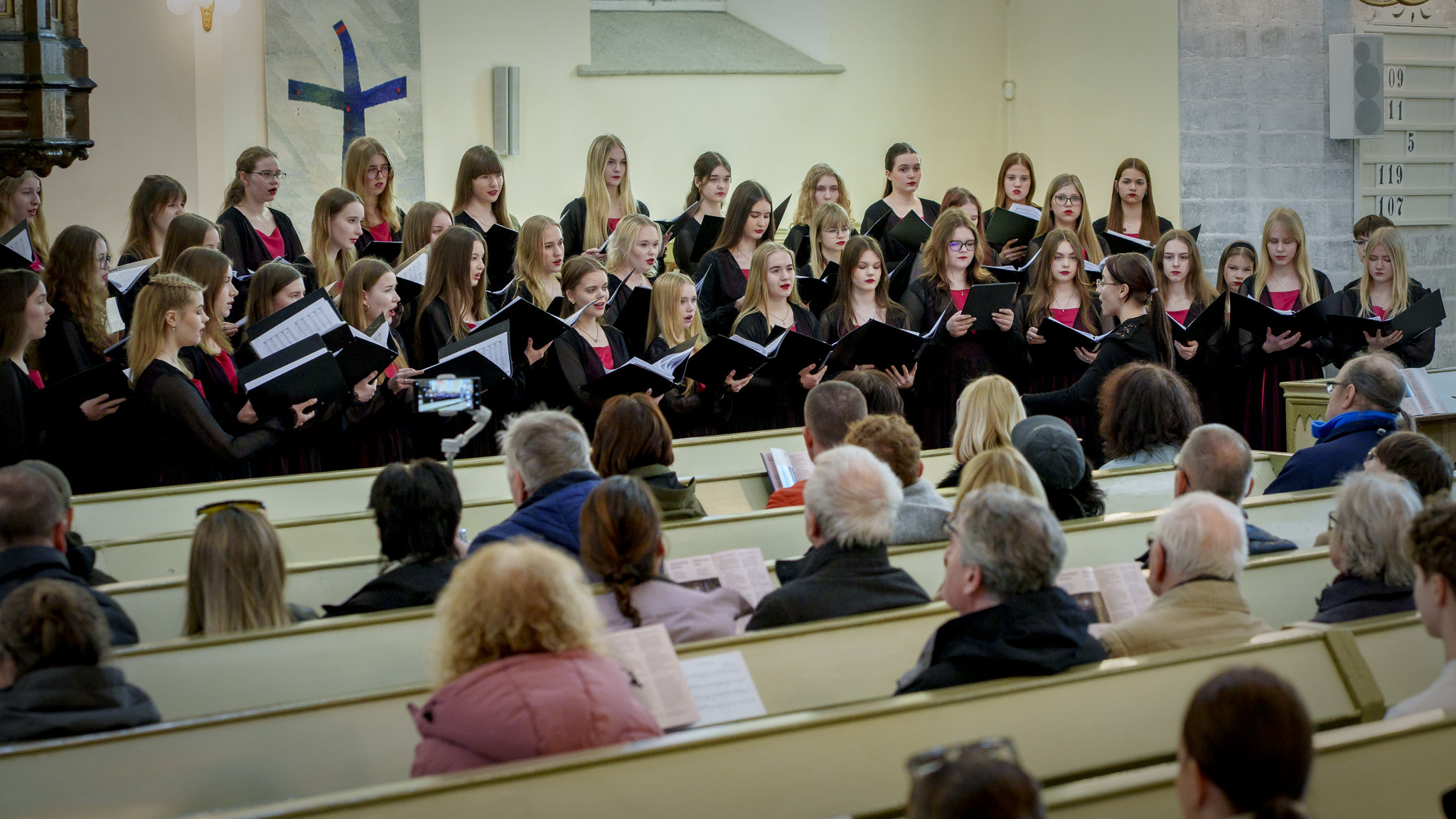
The opening concert at St. John’s Church, featuring the acclaimed girls’ choir Ellerhein, appeared in every way highly conservative. Even the concert attire seemed reminiscent of a time long before the fall of the Berlin Wall, and the opening two choral works by Mart Saar – one dating back to 1910 – sounded like muffled relics.
And yet, I began to doubt my own judgment. As a non-Estonian, I may lack the necessary perspective to grasp the nation-building aspects that may – or may not – be at play here. There may be very good reasons why Estonians wish to be reminded that their professional musical culture predates the Soviet era, especially at a time when Russia’s unpredictability has become another elephant in the room.
One sensed how Estonia, despite its rich and well-established roster of composers, cannot afford to rest on its laurels
Other works in the program activated an older but solid modernity. A couple of pieces by the seemingly ubiquitous Veljo Tormis from around 1970 sounded remarkably fresh and introduced a musical approach that, curiously, kept recurring in many of the works I heard throughout the festival: atonal, static soundscapes meeting small, simple tonal motifs or melodies. In one of Tormis’ works, this took the form of a five-note motif repeated incessantly while cluster chords filled the space.
The concert included two world premieres, both written in 2026. This focus on contemporaneity was a recurring theme throughout the festival. One sensed how Estonia, despite its rich and well-established roster of composers, cannot afford to rest on its laurels but must continually push forward – artistically, upward, outward. Undoubtedly a healthy grounding in reality.
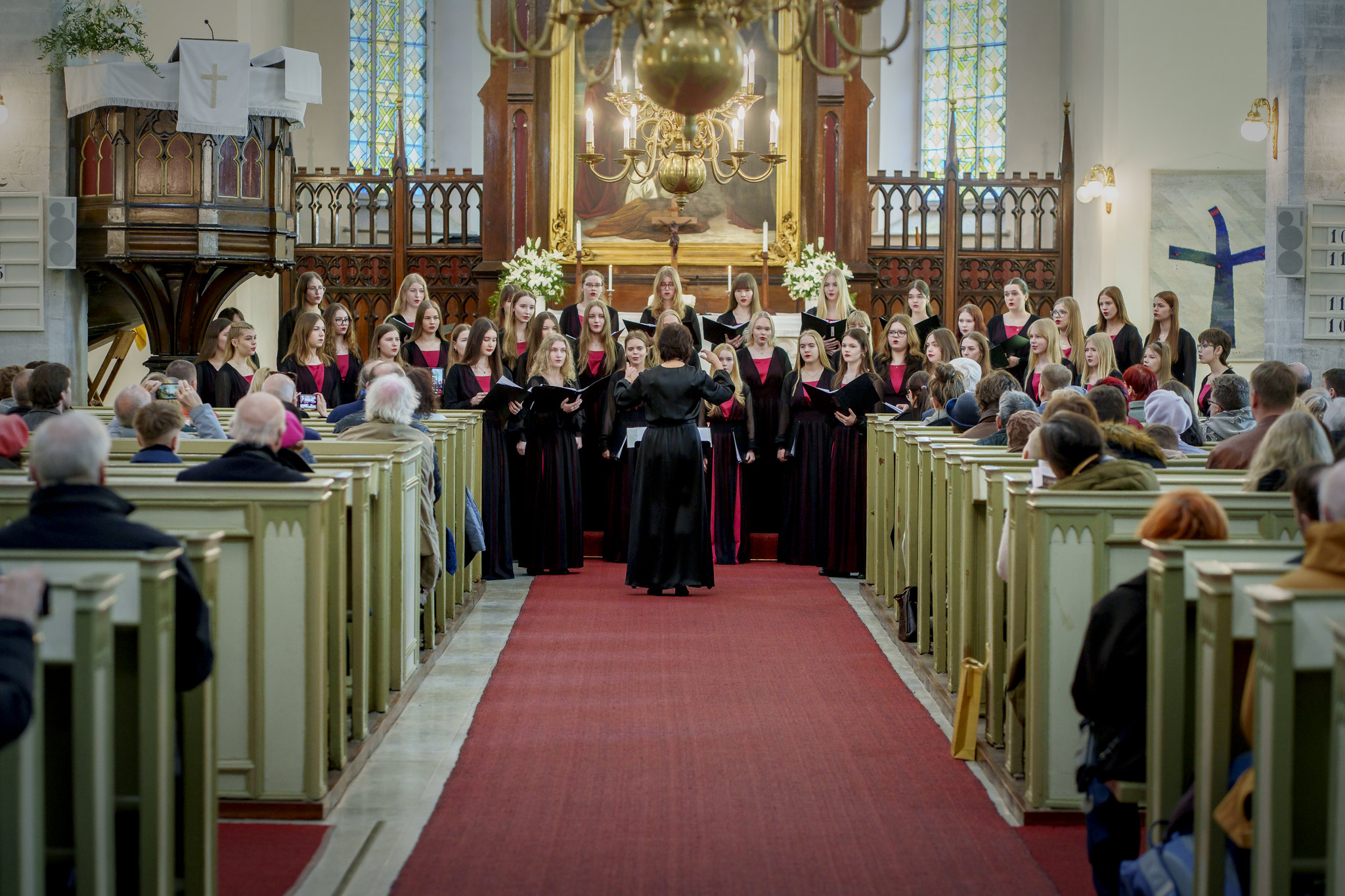
One of these works, Kristo Matson’s Mis oli enne mind, made the room tremble when several choir members began snapping their fingers at random while singing calm, subdued harmonic progressions. It sounded like rain tapping against a window, and the noise element created an acute sense of listening attention.
Pärt himself was also briefly on the program, with a strikingly chosen work: Peace Unto You, Jerusalem (2002), set to a short English-language text from Psalm 122. As the title suggests, it is a prayer for peace in Jerusalem – a city whose very name echoes the Hebrew word shalom.
It is both courageous and appropriate to include such a piece
Given that both Israelis and Palestinians claim the city, the choice of this particular work was highly politically charged, instantly making the concert appear far less conservative. It is both courageous and appropriate to include such a piece – though I almost forgot to listen, as my thoughts drifted to the Palestinian people and their suffering. I was surely not alone in the church. The fate of the Palestinians bears unsettling parallels to the brutal Soviet domination experienced by generations of innocent Estonians.
Against this backdrop, the subsequent peaceful prayer in Urmas Sisask’s Heliseb väljadel felt all the more powerful. Yet this sense was nearly undone by the same composer’s concluding work, Benedicamus Patrem, whose festive deployment of trumpet, percussion, organ, and jubilant choir resulted in such pompous sonorities that it seemed like a curatorial misstep. Even so, it contained a reconciliatory quality that once again turned my thoughts toward our troubled world: Can the desire for peace truly alter conflict? Is hope our only chance?
Three voices in the same darkness
Later that day, the program moved into a raw techno club in an industrial area for the concert Birth of Light. Here, three brand-new works by Liis Jürgens, Maria Rostovtseva, and Astra Irene Susi were presented.
In different combinations, all three involved string ensemble, percussion, boy soprano, and recitation by a male actor, bound together by a highly effective dramaturgy. The works were thus subjected to a shared framework yet emerged as fundamentally different statements – now able to illuminate and perhaps challenge one another.
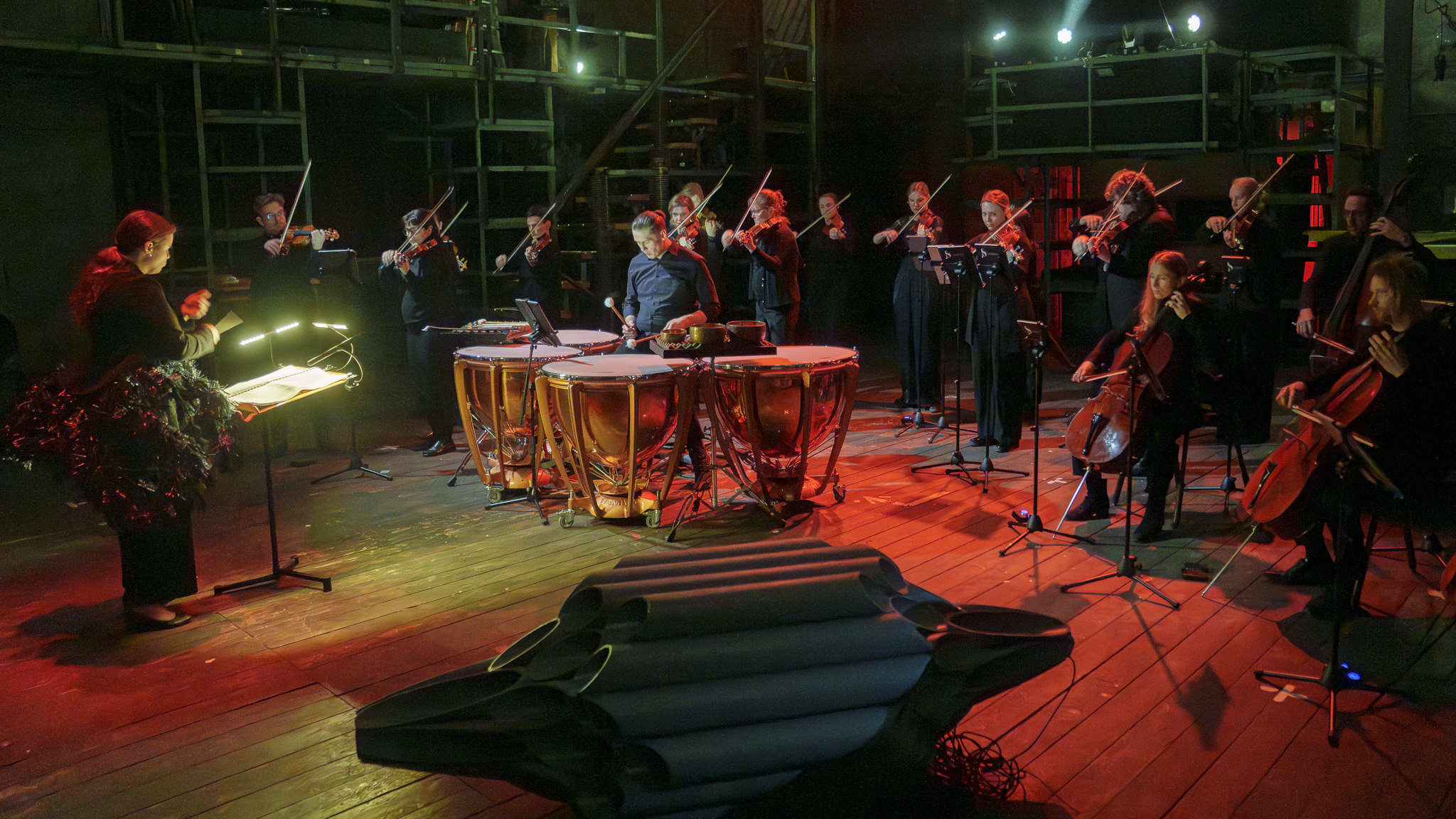
In Whisperer. Sun Temple, Liis Jürgens deliberately allowed the timpani to overpower the strings, placed prominently at the front of the stage. The contrast between the timpani’s monotonous strikes and the expressive strings reminded me of a monotonously shouting individual surrounded by far more nuanced fellow citizens – whom he completely ignores. Once again, my thoughts turned to the global political stage.
At one point, the noise subsided, and the piece ended with a two-note sequence repeated over and over, sung by the male musicians. It sounded like a found tonal fragment – perhaps a couple of notes torn from an Estonian folk song.
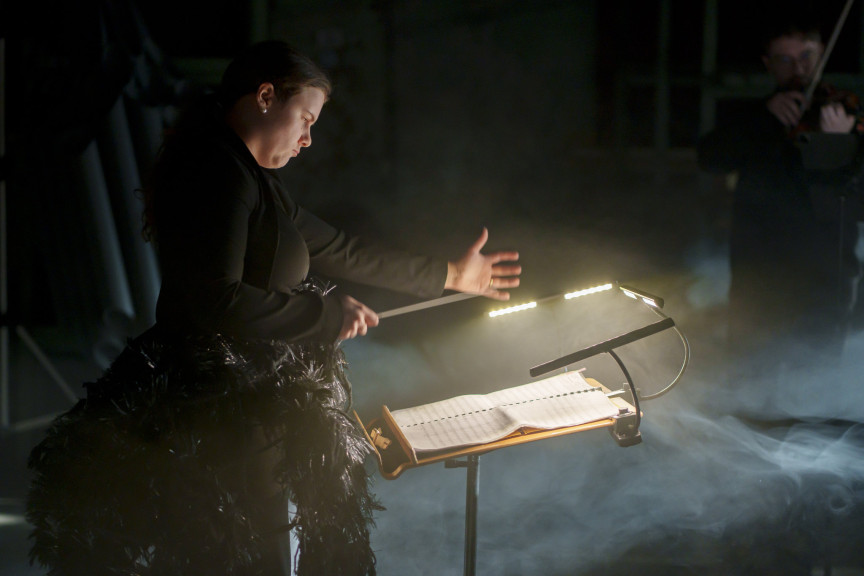
In Maria Rostovtseva’s Golden Egg, the conductor, dressed in a formal gown, sat perched on a contraption one and a half meters above the ground. The strings unfolded in a post-Ligeti – or perhaps rather post-Penderecki – microtonal glissando universe, as unsettling as Penderecki’s early orchestral works have always been.
This created a striking contrast to Astra Irene Susi’s Emergence of Light, which opened with a boy soprano solo before the strings entered. It was elegiac, mournful, and once again unsettling.
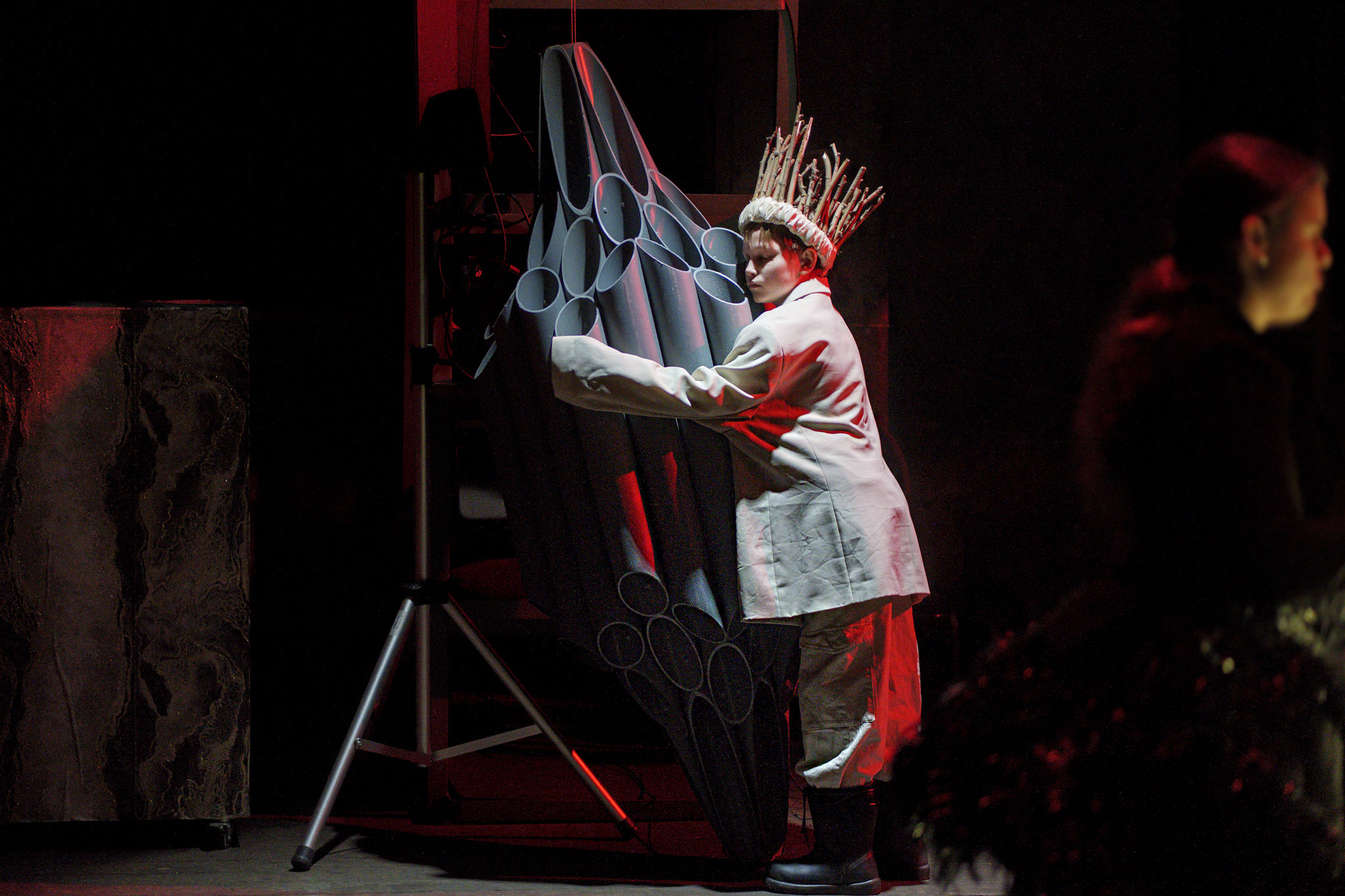
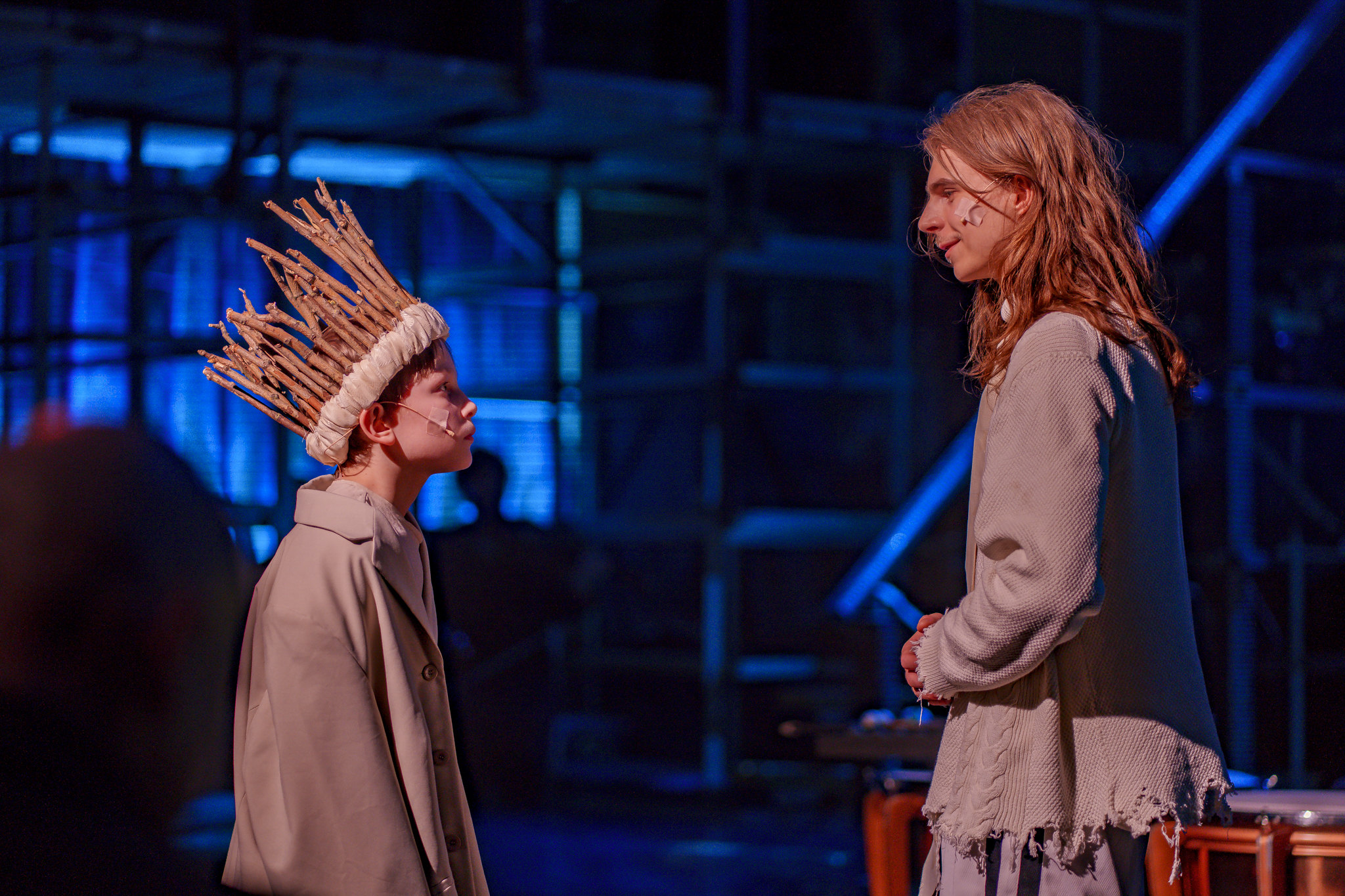
An intriguing stage relationship emerged between the boy and a male actor, as if they were two versions of the same person, perhaps at different points in time. Both were dressed in bright clothes, and the boy resembled a hybrid between Pierrot and Christ with a crown of thorns. The scenography was simple, employing the most minimalist lighting design I have ever seen – yet it was highly convincing.
Both were dressed in bright clothes, and the boy resembled a hybrid between Pierrot and Christ with a crown of thorns
The Old Space and the New Sounds
For the evening concert, I returned to the city center, to Estonia Concert Hall, home of the national symphony orchestra. Although I have visited the hall before, I was struck anew by how old-fashioned and formal it appears. Symbolically, the doors were closed by uniformed ushers several minutes before the concert began. Tradition is clearly upheld here – we were back in a conservative stronghold.
This time, the Estonian National Male Choir, Eesti Rahvusmeeskoor, took the stage, delivering the high level one would expect. Again, newly written music featured prominently, including three works composed this year, among them New York-based Jonas Tarm’s Birds of Ukraine, set to a text about the country’s sorrowful reality and composed with all the gravity and sincerity one could wish for.
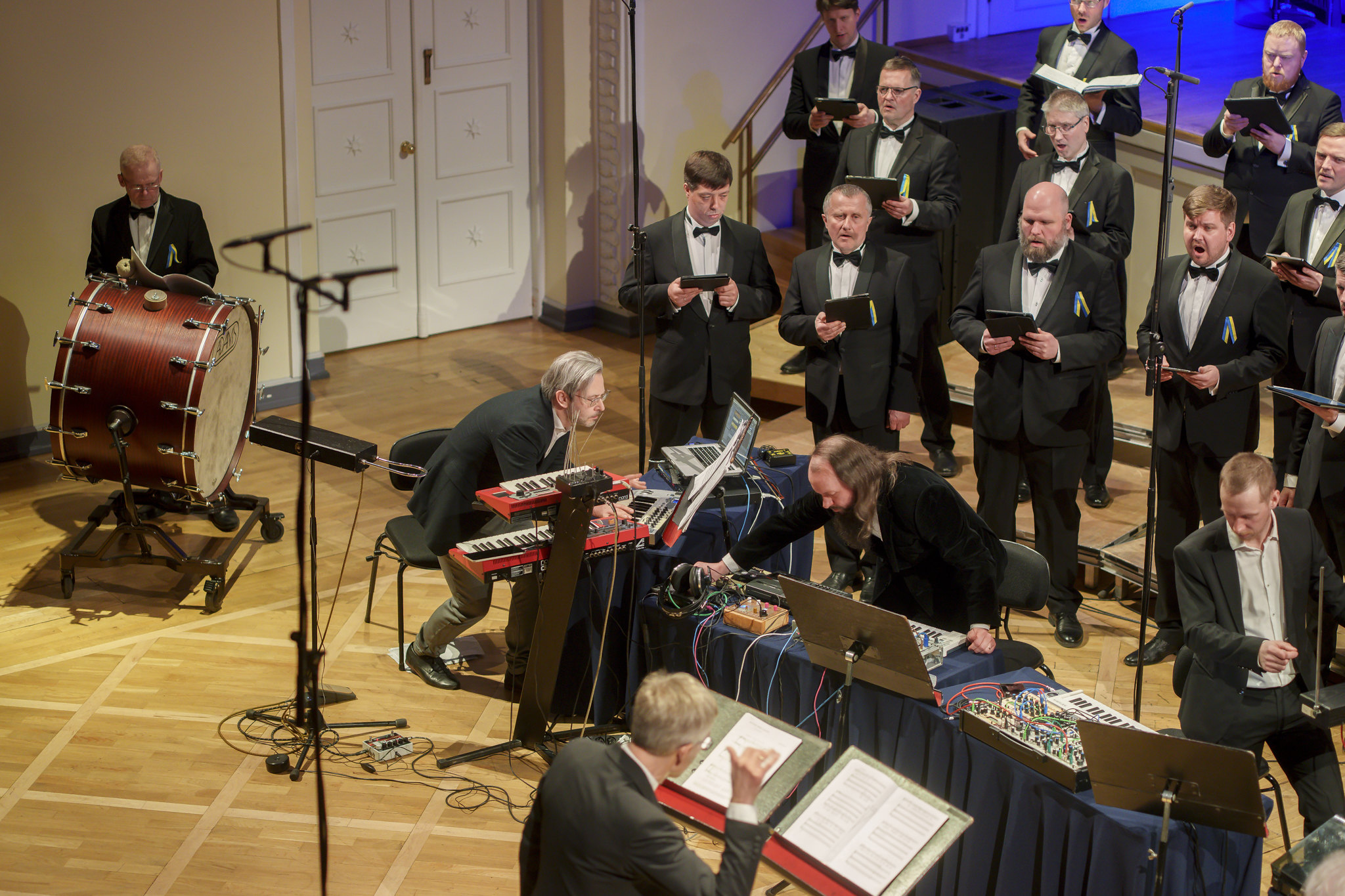
Yet it was in the second half that the concert truly lifted. This came with three more works by Veljo Tormis from the 1970s, performed for choir and electronics with the ensemble EMA, consisting of five electronic musicians whose repertoire includes both Kaija Saariaho and John Cage.
Where EMA’s improvised interludes in the first half had felt forced and unnecessary, everything suddenly fell into place here. Dark synth bass tones blended with shimmering electronic textures and theremins, while the choir led the way. It was evident that the audience – who seemed to know their Tormis – listened with intense concentration. The composer’s dramatic and yearning outbursts, often incorporating folk-like elements, gained an added dimension as the choir’s shouts and exclamations interacted with the unexpected depth of the electronic soundscape.
The world is indeed changing, and perhaps there is hope ahead
A melancholic elation
Across the three concerts, the elephant in the room seemed, after all, less dominant. Each demonstrated how Estonian music is so much more than Pärt, and that the mainstream-oriented sound world associated with his work has not, in fact, inspired subsequent generations to follow in his footsteps – quite the opposite.
The tension between »the established« and »the new«, between »tradition« and »renewal«, between »simplicity« and »complexity« remained intact.
I am left with a sense that a particular kind of melancholic uplift runs like a thread of Ariadne – not only weaving through the day’s concerts as a shared artistic denominator, but also reshaping my broader understanding of Estonian music. The world is indeed changing, and perhaps there is hope ahead.
Estonian Music Days, Tallinn, Estonia, April 11–19
English translation: Andreo Michaelo Mielczarek