






What Happens When the Mainstream Falls Short?
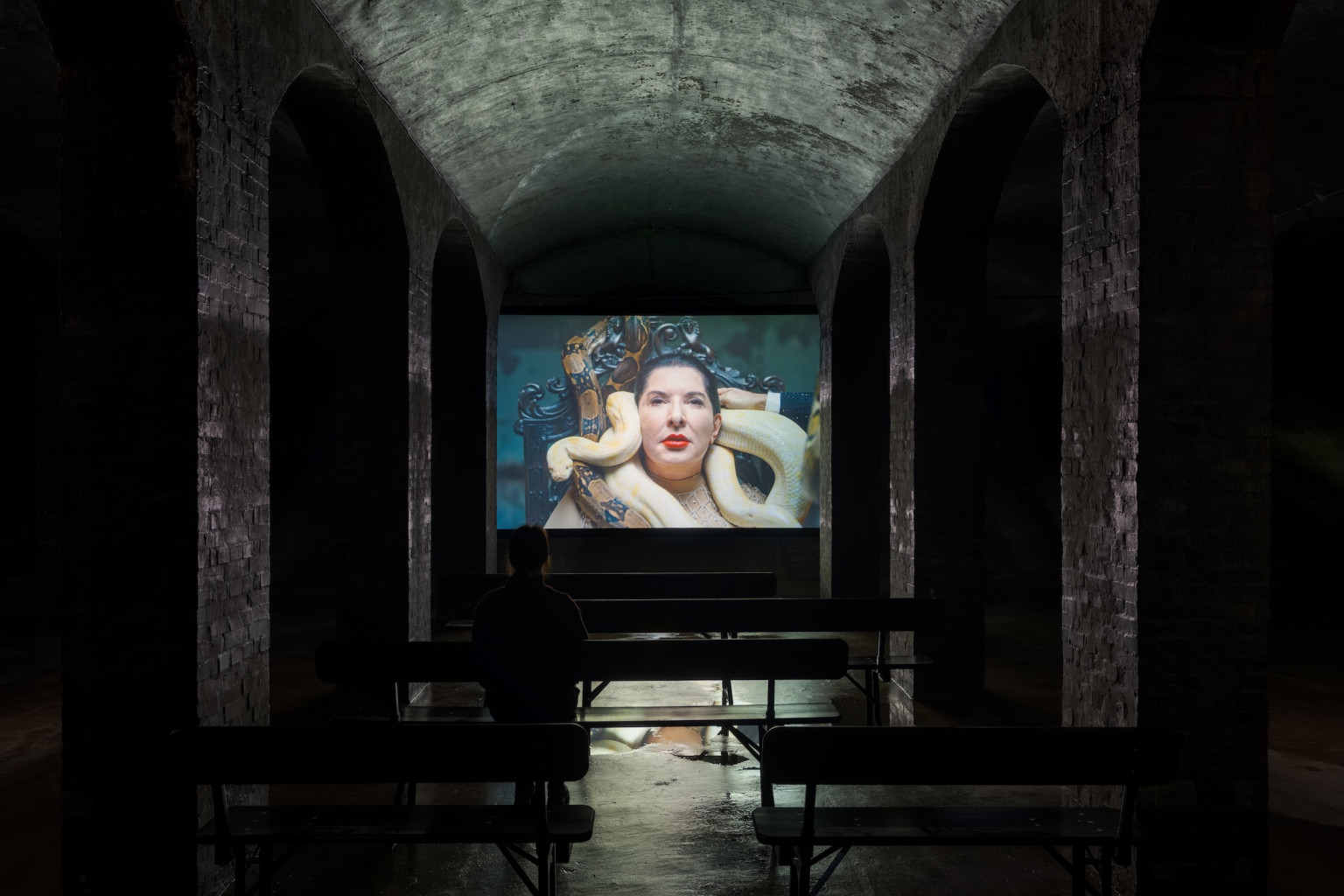
There is simply something about the Cisterns’ grandiose radicality that fits well with the artistic agenda of performance artist Marina Abramović. And it gets even better: despite—or perhaps because of—the work’s pervasive violence, Abramović’s cinematic opera installation Seven Deaths is extraordinarily life-affirming. Therefore: anyone in the capital region who currently finds themselves in a more or less radical life crisis should descend into the depths of the Cisterns beneath the soil of Frederiksberg and spend an hour experiencing what unfolds there. It can only help, I am convinced.
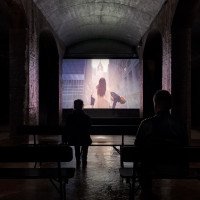
»You give me your time, and I give you seven deaths,« Abramović says on the screen in the instructional video shown at the entrance to the Cisterns. She explains that the deaths in the films are symbolic expressions of the many times we all »die« throughout life when the ground is pulled out from under us. Love, of course. As she puts it: »You fall in love, you lose yourself, you survive – and then you do it all again.«
Seven Deaths cannot avoid being a commentary on global unrest and all the horror and unbearable realities it brings with it
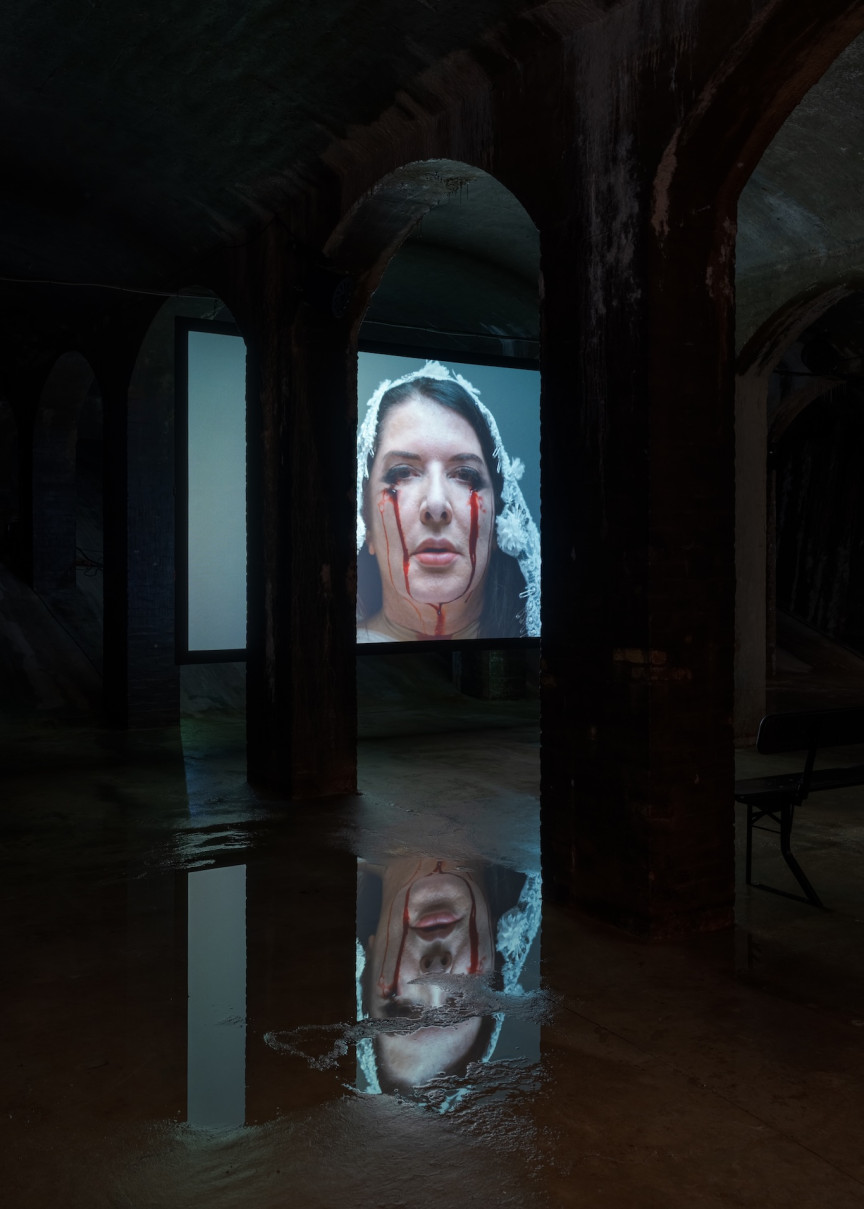
Across seven films, each lasting five to seven minutes, the audience is guided around the wet concrete floor to experience one film at a time, each projected on its own large screen. The films are based on a series of farewell or death scenes from the most famous end of the operatic repertoire, all sung by the legendary Maria Callas, with whom Abramović has felt connected ever since she first heard the world-famous soprano at the age of fourteen. Now the two artists finally meet. As Abramović puts it, Callas is present with her voice, and she herself with her body. Abramović does not mind that arrangement.
Women Always Die Beautifully in Opera
Each of the seven soundtracks has been given its own narrative arc that generally echoes the original contexts of the operas. Along the way Abramović therefore “dies” seven times, which means she is alternately stabbed to death or burned, becomes fatally ill, or throws herself from a high building, and so on. As her companion Abramović has actor Willem Dafoe, who alternately plays murderer, lover, compassionate witness, and so forth.
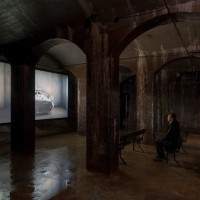
The deaths form a series of symbolic permutations of the suffering and death taking place in the world these years. Seen in that light, Seven Deaths cannot avoid being a commentary on global unrest and all the horror and unbearable realities it brings with it. There is also a feminist dimension in the work, in the form of a reminder of the violence and suffering that women have been subjected to throughout world history. This also applies when male librettists and composers (big surprise: no women have contributed to the music or the texts at all) portray women as those who must bear the burden.
Everything cinematic in Seven Deaths unfolds in slow motion
Maria Callas’s colleague two generations younger, the Australian-American soprano Danielle de Niese, wrote an article in The Guardian in 2018 pointing out that her career – like that of most sopranos – is characterized by the fact that she must always play muses created by men. In other words: female roles shaped by male librettists’ stereotypical visions of women. This was clearly also Callas’s fate. In the selected arias in Seven Deaths, the same pattern appears again and again: jealous men take revenge on women, the public simply cannot tolerate their presence, or they are sacrificed or marginalized for the sake of the greater good. Women, apparently, can be used for and written into anything. And as Abramović remarks in the instructional video, they always die »beautifully and slowly.« What a surprise: it is a patriarchal premise that women’s deaths can always be aestheticized and the work follows that premise with surprising loyalty.
Everything cinematic in Seven Deaths unfolds in slow motion, which convincingly aligns with the soundscape. Because of the unusually long reverberation in the Cisterns, the music sounds stretched, distant, and in a sense dreamlike. The fact that all the arias can be understood as ballads delivered at a slow tempo only strengthens this synergy between sound and moving images.
When the operatic canon becomes a readymade
With all due respect for Abramović’s lifelong fascination with Callas, I was nevertheless surprised by the choice of musical repertoire. Of course, the archetypal and tragic death scenes that fill the older operatic literature provide Abramović with a strong and clear narrative to work from. On the other hand, there is a striking imbalance between her overwhelming radicality as an artist and the mainstream-oriented popular culture to which these arias belong. This applies, for instance, to the very well-known—did someone say overused? – »Habanera« aria from Bizet’s Carmen, as well as the arias from eternally performed operas such as Verdi’s Otello and La Traviata or Puccini’s Tosca.
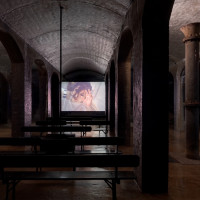
Here perhaps lies the problem. Even though the arias have, in the best avant-garde spirit, been turned into a kind of readymade, they all belong to a mainstream culture that – unlike Abramović’s overarching artistic agenda – is in no way connected to the confrontational, the maladjusted, the abnormal, the marginalized. Rather, they belong to the consolidating, the well-adjusted, the norm-setting, the backward-looking. And the sound of Callas’s somewhat dated recordings from the middle decades of the twentieth century does not connect to a contemporary installation, despite the long reverberation in the Cisterns.
So what could possibly go wrong? I will tell you, dear Marina Abramović
These contradictions grated on my ears throughout the entire performance, and I could not help thinking that this may also have to do with the way music in general is perceived, negotiated, and consumed outside its own domain. Apparently it makes no difference to Abramović that the canonized, conservative operatic repertoire – unlike her own practice – is part of a thoroughly non-controversial mainstream culture. The logic seems to be that Callas is a star, the arias sound pompous and serious and are sung with great emotional intensity, and therefore no one can mistake them for anything other than a powerful musical manifestation. So what could possibly go wrong?
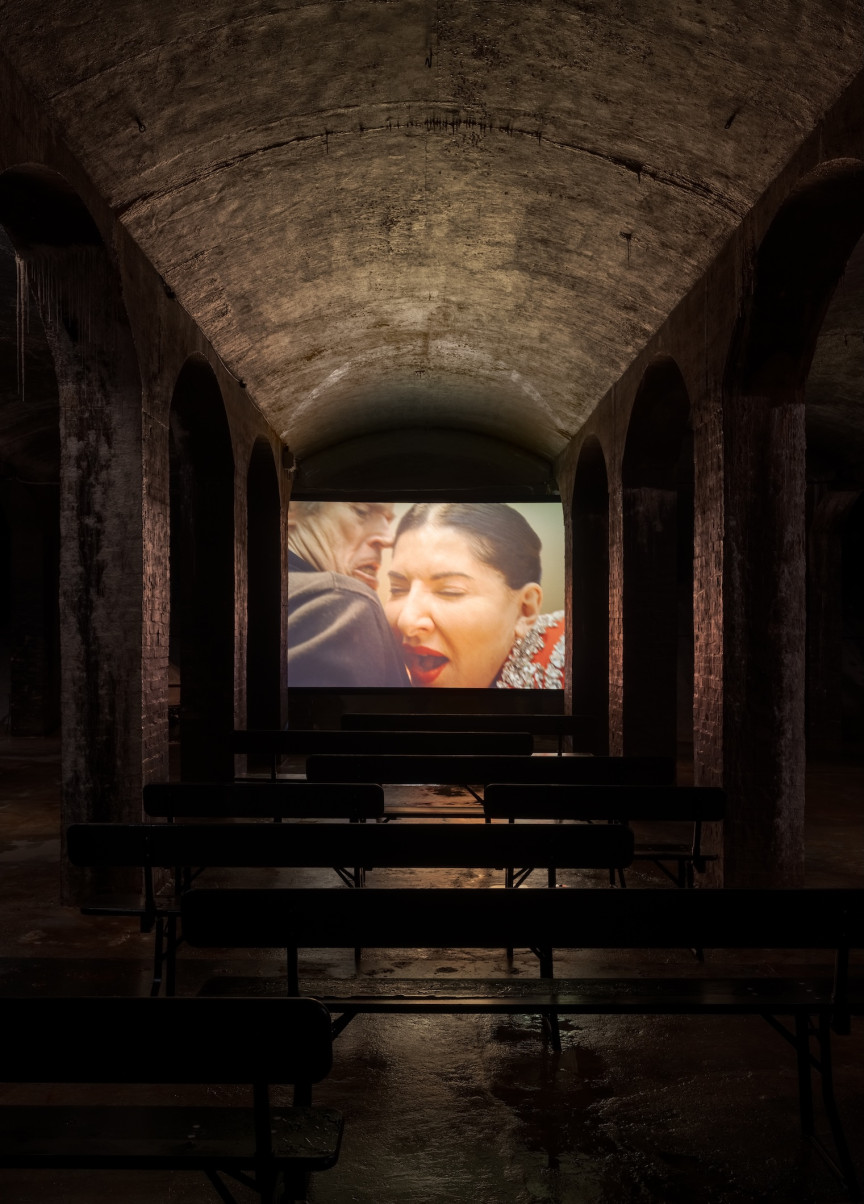
I will tell you, dear Marina Abramović. What can go wrong is that your own radicality – when you smash a glass vase against your own body in one of the films, or in another allow two snakes to coil around your neck – is depressingly neutralized by the sound of the horizon of expectations belonging to normality. And what can go wrong is that your vision of showing people how death, in a symbolic sense, always leads to new life risks itself dying in the sound of opera singing, where the words have no real significance because they are sung operatically and therefore are close to unintelligible; because the long reverberation further weakens textual clarity; and because the words are in Italian and thus ultimately incomprehensible to most listeners.
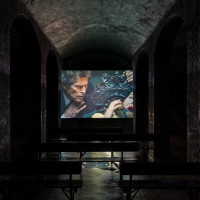
A work that nonetheless points toward life
As an artist who throughout her life has worked with – and in spite of – considerable risks, Abramović must surely be aware of these challenges. Yet I am not entirely convinced. Is she not aware that the arias used are, in fact, part of a distant Italian utopia of »grandeur« and »monumentality«, topped with a decidedly gender-conservative bias? Or has she simply leaned into the widespread but lazy argument that these arias are so monumental, such »great art«, that everything else is excused?
Once again, with all due respect for Abramović’s fascination with Callas: Seven Deaths simply does not resolve this contradiction, and it remains the project’s major artistic problem. Not an »exciting paradox« or an »interesting challenge«. Quite simply a problem.
Descend into the Cisterns. You really have nothing to lose
That said, I still stand by my opening words: despite my objections, Seven Deaths remains a life-affirming work that can be recommended – especially to those of us who, for countless reasons, currently find ourselves in the midst of life crises. To all of you I say: descend into the Cisterns. You really have nothing to lose.
Cisternerne, 14 March – 30 November 2026
English translation: Andreo Michaelo Mielczarek