

in briefrelease
14.01

70 Minutes Confined to a Creaking Construction Site

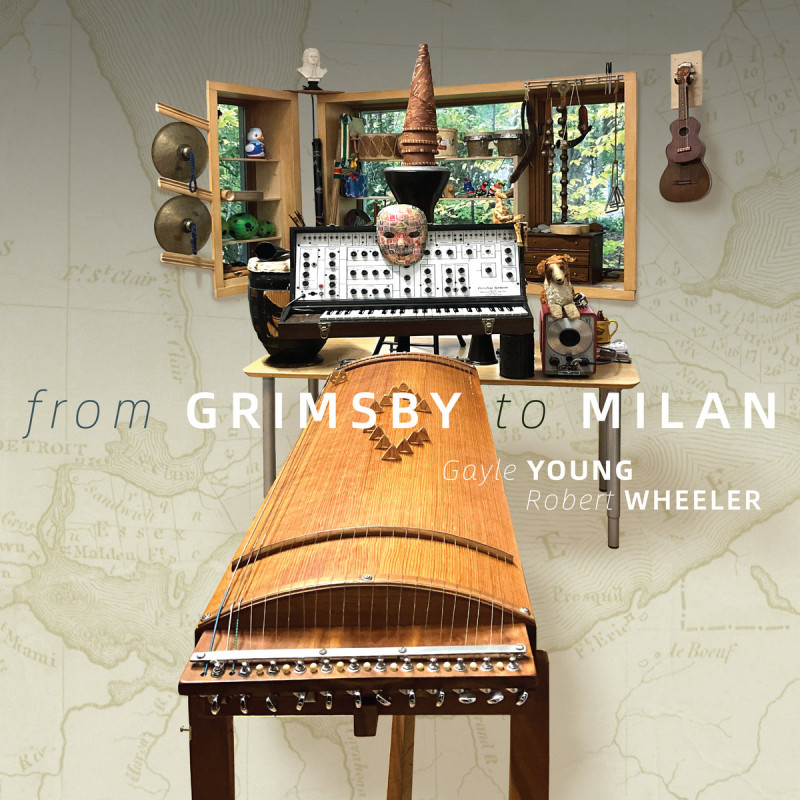
Gayle Young & Robert Wheeler: »From Grimsby to Milan«
© PR
© PR

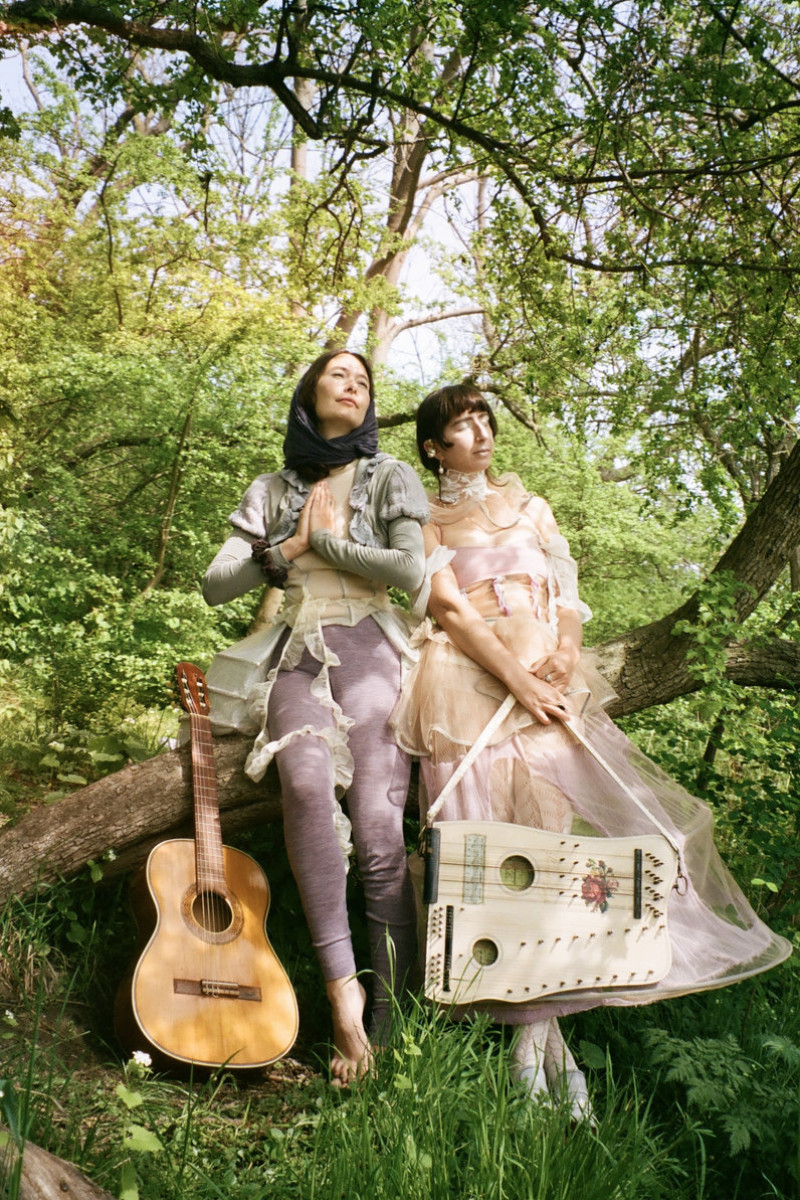
The Amranthen is a peculiar string instrument, invented and built by Canadian instrument maker Gayle Young. It consists of a wooden box fitted with 21 steel strings and three bass strings, and its unique, organic timbre unfolds on From Grimsby to Milan, where Young improvises alongside American musician Robert Wheeler on synthesizer. The recordings from Grant Avenue Studios capture the encounter between the acoustic and the electronic in a loosely shaped, raw musical flow.

Across nearly 70 minutes divided into six parts, the listener is kept in a state of constant uncertainty. The sonic landscape resembles a noisy, dystopian construction site: on »Seaweed Slowly Shifting«, bows are drawn with a saw-like rasp, fingers scratch, machines whirr, and sharp electronic zaps flash like warning lights. Later, bells and pulse-like rhythms enter on »Mariana Trench«, while »Consonant Harmony« slows the pace, settling into a subdued, crackling atmosphere where sparse melodic gestures suggest a momentary lull in the turmoil.

The construction-site metaphor fits well, for the most compelling version of this project would likely be to experience Young’s handmade instruments live, in direct dialogue with Wheeler’s electronics. As an audio recording, however, the project remains closed-off and somewhat insular. And although From Grimsby to Milan contains a wealth of fine detail, the journey – from Grimsby in Canada to Milan in Ohio – ultimately feels long and monotonous, without ever offering the listener the key to unlock its dystopian worksite.

English translation: Andreo Michaelo Mielczarek

in briefrelease
23.04.2024

What a Dial Tone Tells Us About Life

Beachers: »Off the Hook«
© PR
© PR

Crazy about phones? Then listen up. For British artist Beachers spent a day in his London office, and with his smartphone, recorded the sound of a landline waiting for you to dial a number after lifting the receiver. An innocent, yet somewhat insistent sound: Use me, beep-beep-beep-boop, now!

He cut up the recording, panned it around, shifted the pitch here and there, and dabbed it with delays. Turned it into musical material, in other words. And from the effort, Off the Hook grows small tones and harmonies like those from a self-built organ. But the office noises follow along, making the little album feel oddly haunted.

There are white creaks, maybe from a chair. Treble screams like distant, escaped parakeets. Short keystrokes, mysterious silences. After the harmonic organ opening, Beachers lets a deep bass rumble beneath chopped-up beeps. Layers are added, or sudden shifts occur. It’s not meant to be perfectly polished; you’re meant to feel that a human is playing with the digital.

Patiently, small pulses build, maybe even a beat. Listen to the hidden parties and drives of everyday life, the music seems to say—but also: see what we can do to pass the waiting time while forgetting what we’re actually waiting for—someone to pick up, the boss to let us off, death catching up to us.

In the end, only the raw recording is heard. A minute of beeps, boops, and random noise. As if each motif bows to its audience. What a strange release, nostalgically so in its way. And how creative.

in brieflive
09.04.2024

Ballet’s New Power Duo

Josefine Opsahl: »Passengers of Passing Moments« (Koreorama nr. 01)
© Henrik Stenberg
© Henrik Stenberg

Josefine Opsahl herself sits on stage in the Australian-Danish choreographer Tara Schaufuss’s ballet Passengers of Passing Moments, for which Opsahl has composed the music. In fact, she almost steals all the attention from the ten dancers, as it is fascinating to watch the 32-year-old cellist’s theatrical immersion and her very active use of her right leg to control the loop and effects box.

The nearly half-hour ballet score is inspired by Bach, but also conveys a highland-like sense of drama through sampled breathing, stabbing subdivisions, and pronounced reverberation. It begins with delicate, bright major-key tones, but quickly moves into the depths, finding throbbing bass and timpani-like resonance. Emotions rush through every bow stroke.

The theme of the ballet is time. In fleeting moments, the dancers are caught in Opsahl’s small, mechanical loops; later, a dark, melancholic space is established, in which a young woman sinks into a memory. Extended sounds and overtones signal a time put out of joint; a faint wind is heard, a ticking fades in, and suddenly she has dreamed her beloved into being.

The woman moves like a ghost among the other bodies as Opsahl intensifies her playing, shifting between triple and quadruple meter. At one point, it is as if she disappears entirely into the violent temperament of the music; her dramatic flair turns Bach into an Avenger-like hero, and this suits Schaufuss’s focus on the force of emotions remarkably well. It is saturated, direct, and seemingly made for a grippingly intense choreography. A powerful partnership on the grand stage.

© Sebastian Gudmand-Høyer

»Music is a full bodied, raw and physical exchange. It’s an absorption that is overwhelming, that sometimes grants you relief. Music is interactive, and depends on you as a listener.« 

Alexander Tillegreen is a composer and artist who operates both visually, sonically and spatially. He works in a plurality of formats including multichannel sound installations & performances, interactive listening sessions, paintings, prints, light and concerts as well as exhibitions, commissioned works, and releases. In 2023, he presented a cycle of new commissioned sound works for the Darmstädter Internationale Ferienkurse für Neue Musik. Same year, he released his debut album in words on the acclaimed German electronic music label rastermedia. 

Alexander Tillegreen’s work has been the subject of numerous institutional solo and group exhibitions including: A Bruit Secret – Hearing in Art at Museum Tinguely in Basel (2023), O-Overgaden Institute for Contemporary Art in Copenhagen (2022), FuturDome Museum in Milano (2022), Kunstverein Göttingen (2022), Kunstforeningen GL Strand (2023), Museum für Moderne Kunst in Frankfurt (2017), and The National Gallery of Art in Copenhagen (2008). He has presented his music at many festivals and venues including STRØM Festival, Roskilde Festival, and CTM Festival. 

His most recent work investigates the relationship between psychoacoustic sonic phenomena and their potential to reflect and awaken the listener’s own linguistic and cultural embeddedness and co-creative embodied, interaction as a listener. 

He has been conducting artistic research at the Max Planck Institute for Empirical Aesthetics. This research centers on aspects of attention, spatial sound, voice, gender, identity, embodied co-creation, and language perception in relation to the phantom word illusion – a language-based psychoacoustic phenomenon, that triggers the illusory sensation of hearing inner streams of words that are not necessarily acoustically present.

In 2024, Alexander Tillegreen will represent Denmark at the ISCM World New Music Days on the Faroe Islands.

in briefrelease
12.03.2024

Music for Lovers, but Not for Me

Samuel Rohrer: »Music for Lovers« 
© PR
© PR

With Music for Lovers, the Swiss drummer and electronic musician Samuel Rohrer does many things right. The sound design and mix are luxurious, and the album overflows with an abundance of delicious synth sounds. Precisely for that reason, the absence of the most essential ingredient – the songwriting – feels all the more disappointing.

The opening track, »The Parish Bell«, exemplifies how the songwriting fails to unite the otherwise quite strong individual elements into a satisfying whole. Analog drums play interesting patterns, while synths bubble and sparkle – cold as needle points and soft as cotton swabs. Yet nothing really develops, and the track ends up feeling like a snapshot stretched over seven minutes. This is the case for nearly all seven tracks on the release, plus the eighth bonus track. It feels like a soundtrack lacking the listener’s emotional connection to the medium it is meant to underscore. Here the music stands alone, and it often struggles to carry that weight.

There are highlights: Nils Petter Molvær’s ever-compelling trumpet guesting on »The Gift«, the sublimely sounding space-ambient intro to »Celestial Body«, and the motorik drums that emerge halfway through »Schizophonia«, which, as a rare occurrence, tear the music out of its narrow comfort zone. But still, the songwriting falters, and so while it may be music for lovers, it is unfortunately not music for me.

in brieflive
19.02.2024

Cortini – the Electronic John Williams

Alessandro Cortini 
© René Passet
© René Passet

Alessandro Cortini is best known as a member of Nine Inch Nails, and as I discreetly listened in on conversations before the concert, it was clear that several people had shown up because of the connection to the famous band and its noisy, confrontational music – music that is worlds apart from the feather-light ambient universe that characterises most of Cortini’s solo work.

At ALICE, however, we were presented with a very different side of Cortini: Cortini the film composer. The artist was positioned far out at the edge of the stage, where he could tinker with his synthesizers in peace without stealing attention from the film projected onto the back wall of the stage. Contrasting, tactile images slowly sliding into and out of one another. Abstract, amorphous shapes that at times resembled misty memories from the real world: raindrops on a car window, a city seen from above, stars in the night sky; tar, metal shavings, crushed crystal.

Cortini reminded me of a kind of electronic John Williams, enveloping the images in an unusually grand, almost symphonic universe that elevated the black-and-white light forms into hieroglyphs of infinite wisdom. The atmosphere was so sacral and gripping that, with closed eyes, one could easily forget that Cortini was not singing Michelangelo’s paintings from behind the organ in the Sistine Chapel, but instead setting analogue synth tones to what looked like an image of a granite block. Some of the Nine Inch Nails fans, I could hear, were slightly confused by the emotionally charged, almost romantic aesthetic, but I myself truly admired Cortini for his uncompromising maximalism. There was no affected distance or feigned coolness – only pure, unadulterated musical beauty.