


No Easy Points for Malmö’s New Free Festival
It is undeniably exciting: an entirely new festival dedicated to music and sound art right on Copenhagen’s doorstep, in the heart of Malmö, to be precise. Compact and tightly curated – and with free admission! It feels remarkably generous.
I attended the second and final evening of the festival’s inaugural edition, and sensed a particular mixture of anticipation and curiosity among an audience who, in a sense, had already been given the whole experience for free, without having to reach for their wallets.
Compact and tightly curated – and with free admission! It feels remarkably generous
The evening’s programme unfolded on and around the stage at Inkonst, a relatively small venue, and the diversity of expression, approach and use of technology among the five acts was striking. This diversity proved to be one of the festival’s great strengths. Throughout the evening, the performances were consistently compelling, but also demanded considerable mental engagement and concentration from the audience.
When Light Becomes Part of the Music
Let me focus on three of the acts: the Swedish avant-garde jazz trio Freq. Expedition, the Danish percussion duo Sistro Duo and the Icelandic new media artist Sól Ey.
Freq. Expedition brought together electric guitar, trombone and percussion/vibraphone in an intriguing space between stasis and forward motion. With great consistency, the trio focused on a series of predominantly monophonic passages, in which unison trombone met unison guitar, alongside unison vibraphone played with a bow. The result was a refreshing transparency in the soundscape and, consequently, in the musical expression.
It struck me along the way how thoroughly the concept of the cluster has prevailed in avant-garde culture, with its usually complex combinations of notes sounding simultaneously. Through their monophonic approach, the trio articulated a quiet, non-polemical counterforce to all this, reminding us that although humanity gained an extraordinary amount when the concept of polyphony first emerged, perhaps we also lost something along the way.
It was like witnessing a scenario in which a cloud belt of stillness, the size of Jupiter, created small pockets of insight
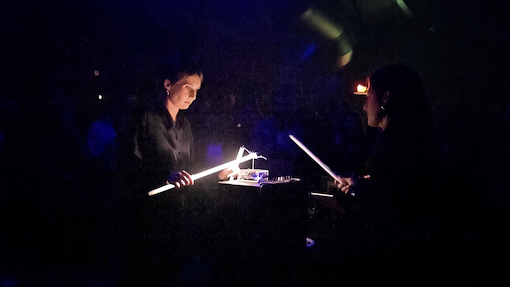
In three works by Sól Ey herself and the Danish composer Mads Emil Dreyer, Sistro Duo demonstrated just how blurred the boundaries between music and sound art can become. In one of the pieces, the encounter between sound-producing objects and instruments, and the performers’ movements as they touched them with mallets, generated cascades of flashes of light, accompanied by the soothing hum of synthetic sound.
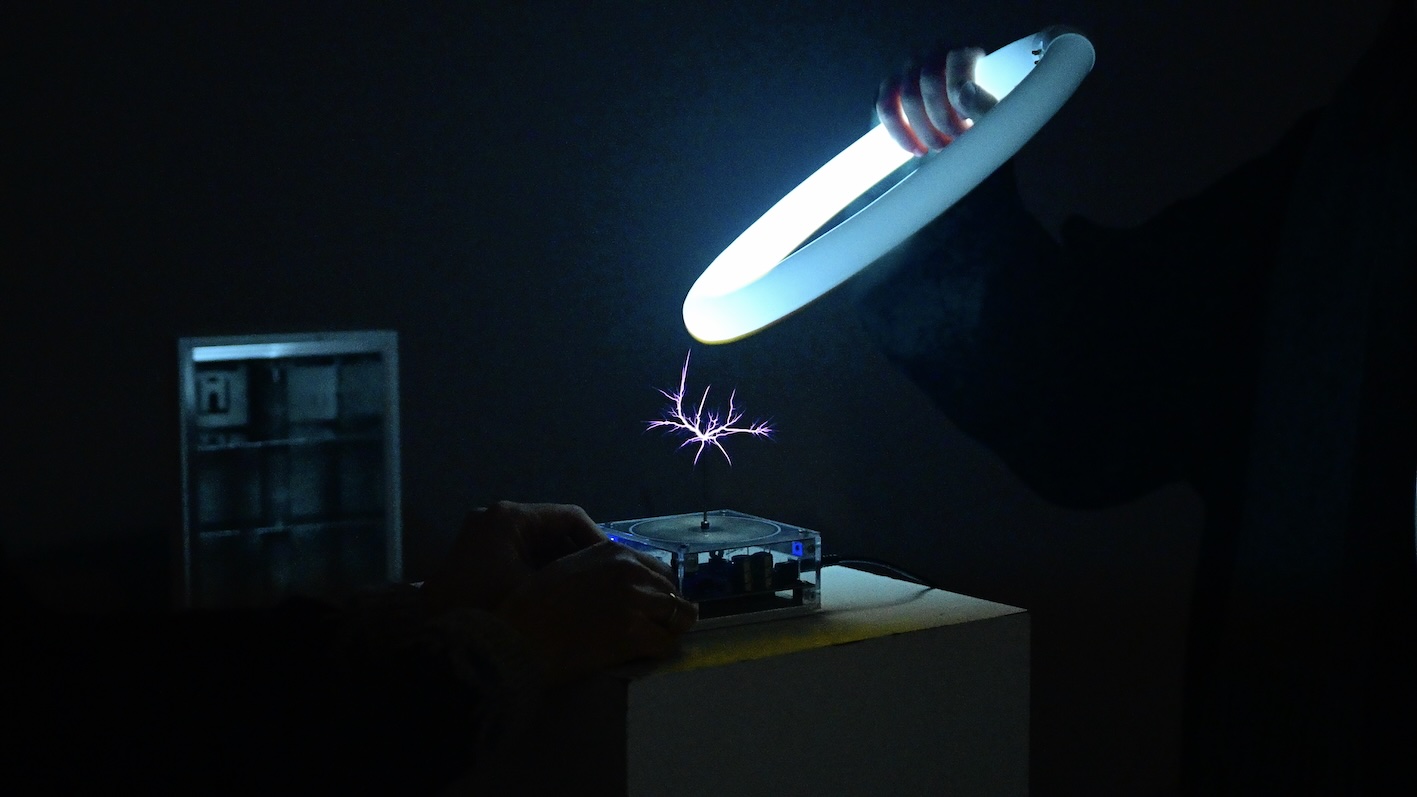
It was like witnessing a scenario in which a cloud belt of stillness, the size of Jupiter, created small pockets of insight, presence and clarity. The piece lasted 15–20 minutes, but something in me wished it had gone on for several hours. Had it done so, however, the duo would not have had time to perform Dreyer’s ethereal, beautifully resonant work for sound and light, in which each key on an electronic keyboard was connected to a light bulb that illuminated whenever the key was pressed. That, too, was a work I would not have wanted to miss.
I was actually a little frightened by the thoughts that came into my head as the performance unfolded
An Angel Amid the Noise
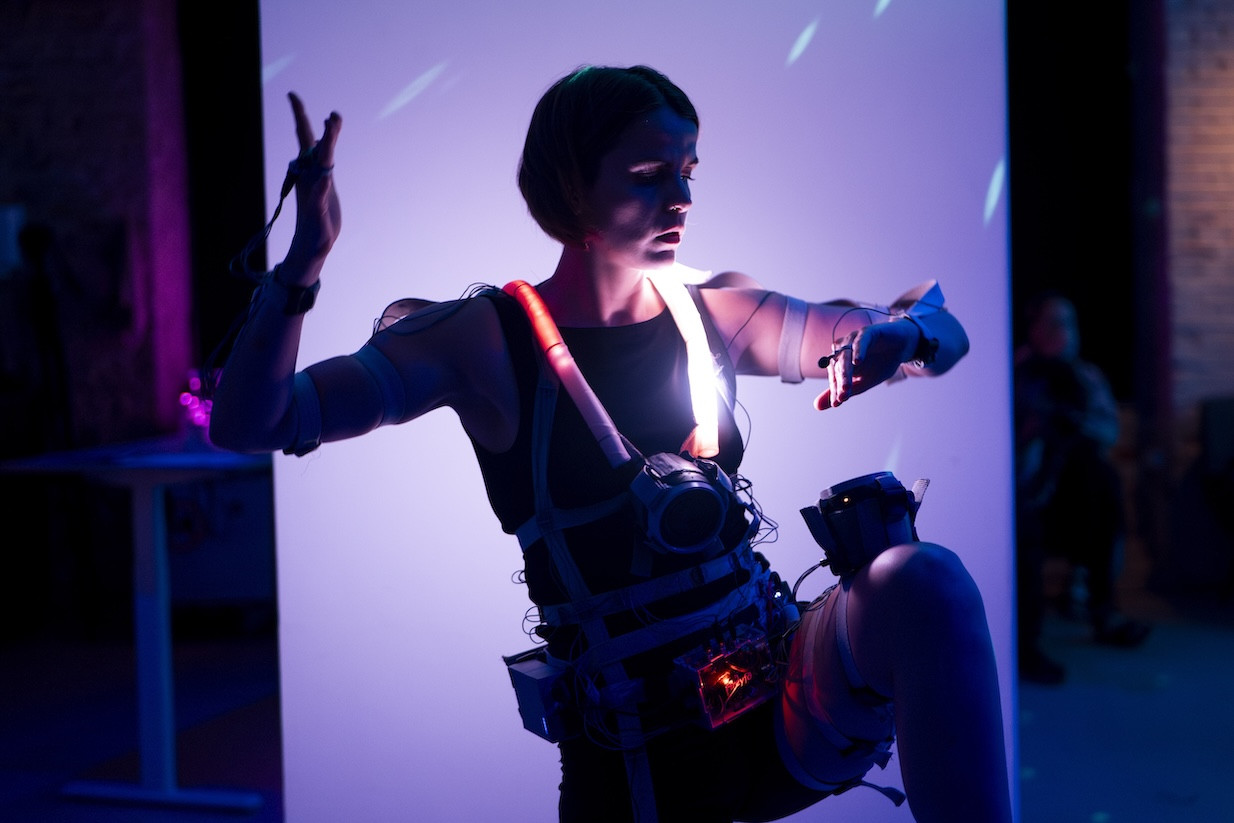
The evening’s concert programme concluded with Sól Ey’s deeply affecting solo performance, which brought sound, light and movement together as one. Suddenly, without warning, she appeared among the audience, moving calmly through the crowd in a suit equipped with microphones and loudspeakers. Together, they generated a feedback-driven noise landscape, complemented by shifting orange and white light from LEDs also attached to her body.
The noise was controlled through the coordination of bodily movements, and it was fascinating to follow how the three elements – sound, light and movement – interacted, conditioned and complemented one another. It was hardly surprising that the audience gathered around her whenever she stopped at different points in the concert space.
I was actually a little frightened by the thoughts that came into my head as the performance unfolded. I genuinely experienced it as though an angel had voluntarily descended to earth, allowing herself to be burned alive to atone for humanity’s stupidity and thoughtlessness. An angel who, for the sake of humankind, destroyed herself right before my eyes in one ultimate attempt to kick-start the world and set it back on its feet. An angel acting for us as well as on our behalf.
A little later, once I had managed to gather my thoughts again, I realised that, in moments of genuine attentiveness, art can assume limitless possibilities. Even on a Friday night in a small venue in a major city. It was that feeling I carried home with me.
Miss Clock Speaks Again
As a festival, Tekno also extended into other parts of the city, including Malmö Konsthall, Folkets Park and the Inter Arts Center. The latter is located next to Inkonst, and there I had the opportunity to experience Swedish visual artist Anna Lundh’s sound installation Miss Clock (Into the Groove), presented in a dark room equipped with a loudspeaker system. The work used samples from the Swedish version of the speaking clock – the telephone service people could call in the pre-digital era to find out the exact time.
The work did more than demonstrate how older sound technologies from a long-vanished world can open up cracks of nostalgia, loss and loneliness in the modern listener when confronted with them. It also showed how an older technology can be retrospectively transformed by more recent thinking about the performative nature of gender.
Both as a festival and as an event, the very first edition of Tekno thus made a convincing start
The sound of the work is, after all, that of a woman’s voice inexorably announcing a series of times, or fragments of them: »Tyva … tyva … tyva … otta … otta …« and so on. The woman behind this voice performed her gender through the work she carried out when she originally recorded the time announcements. It stood as a statement of how deeply intertwined the technologies of society and its constructions of gender really are.
Both as a festival and as an event, the very first edition of Tekno thus made a convincing start. I look forward to following its development.
The inaugural edition of Tekno – Music, Sound, Technology took place in Malmö, Sweden, 12–14 November 2026.
English translation: Andreo Michaelo Mielczarek