



Listening as worlding
Abstract
At the core of this paper lies a method for designing concerts in civic spaces, developed as an attuning-method that emerges from the intersection of the concepts sonic citizenship and artistic citizenship. The article investigates how this method reflects central questions in both discourses and demonstrates how the exchange of practices across these fields can foster a new mode of listening towards places and communities. Drawing on a student’s concert project, the article demonstrates how the design of concerts may serve as laboratories for listening, thereby enhancing the socially transformative power of communities. With a strong focus on practical implementation, this article develops a concrete method for practicing sonic citizenship through the lens of classical performances.
Introduction
This article introduces a new method of concert design that is inspired by two dominant discourses: sonic citizenship and artistic citizenship (1). It is based on the initial question of how the way of listening as a practitioner within places of everyday life might change and foster a heightened awareness of sounds, places, and communities. As a cellist, I am involved in performing classical concerts and creating new concert formats. The introduced method aims at creating a concert setting in a non-concert space by taking seriously the site’s spatial, sonic, and material characteristics. This approach was practically explored in a concert realized at a playground in Cologne.
The authors Højlund, Vandsø, and Breinbjerg advocate for “methods that put the body, listening, place, and exploration into play, so to speak – both in relation to analyzing soundscapes and in relation to setting the framework for an active sonic citizenship through attunement” (Højlund, Vandsø and Breinbjerg, 2024). The reciprocal interplay between every day and artistic sonic practices, central to my method presented here, aligns closely with Højlunds and others transdisciplinary search for approaches that foster attunement, heighten awareness, and enhance potentials for social transformation.
Sonic citizenship refers to the idea that social and political life is enacted not solely through speech or legal status, but also through practices of listening, sound-making, and the communal shaping of acoustic spaces. Although the specific term "sonic citizenship" emerged only recently, its underlying concepts appear across intersecting discussions within sound studies literature. The concept of listening, in particular, opens up fruitful intersections between the narrow discourse of sonic citizenship and the broader of sound studies: on acoustic communication (e.g. Truax, 2016), on listening publics (e.g. Lacey, 2023; LaBelle, 2018), on feminist studies in sound (e.g. Voegelin, 2020), on feminist listening practices (e.g. Buyken and Losleben, 2024), on care-ful listening (e.g. Voegelin and Wright, 2022) and on listening and emplacement (e.g. Barron and Losleben, 2025). In a later section, I draw on these theoretically grounded strands to situate practitioners' listening within civic spaces, as proposed in my method.
Højlund, Vandsø, and Breinbjerg (2024) define citizenship as two-folded: as a sensory experience that can build or counteract a sense of belonging to a collective and as an “ideological and political” force that limits or opens up ways of nationhood (Højlund, Vandsø and Breinbjerg, 2024). Three levels are differentiated on which individuals and communities negotiate belonging or exclusion in the sonic: micro-social, meso-social, and macro-social practices. All examples, though in different ways, highlight how processes of sonic attunement dynamically and continuously change and develop. While sonic citizenship primarily concerns the analysis of practices of attunement, it is equally marked by a strong interest in developing tools for translating these insights into concrete social and political realities. The recent flourish of the concept is linked to the post-pandemic scholarship in and on sound. Marie Højlund and others analyse sonic citizenship in Danish communal singing events during the COVID-19 pandemic, demonstrating how sound functions as both social glue and marker of exclusion (Højlund, Vandsø and Breinbjerg, 2024).
The concept of artistic citizenship has gained prominence as a way to describe how artistic practices move beyond purely aesthetic concerns to engage questions of ethics, social responsibility, and transformation. The discourse highlights the role of the arts as vehicles for democratic participation, community formation, and social transformation (Elliott, Silverman and Bowman, 2016). I understand artistic citizenship as an umbrella term, merging music mediation, music education, performance studies, and concert design (Uhde, 2024 and 2018). According to Folkert Uhde concert design involves the re-thinking of concert content and processes as a response to changing social conditions. It involves questioning traditional concert forms and replacing them with innovative formats that reshape the musical experience to be new and contemporary for the audience. Key points include deliberate dramaturgy, the participative and often immersive involvement of the audience, as well as the targeted design of music, space, and atmosphere to enable new listening experiences and artistic perspectives (Uhde, 2024 and 2018).
My approach concerns the practical dimension of designing a concert space and how listening and sounding connect with places of everyday life. This paper avoids binary thinking between music and sound, or between everyday sounds or artistic sounds, nor does it aim to contribute to ontological debates surrounding their nature, recognizing that such investigations would exceed the scope of this study. The direction pursued here follows Marcel Cobussen and Michael Bull’s argument that sound possesses its own specific possibilities for agency (Bull and Cobussen, 2021, p. 5). This idea also has methodological implications, informing how the sonic is researched and how these approaches shape understandings of music’s role in concert design, particularly through the focus on sonic materiality and situatedness. With this in mind, the article deviates from the still very Euro-American concept of classical concerts, which typically presupposes a fixed idea of what counts as music and primarily addresses white, able-bodied humans, both on stage and in the audience.
As introduced in the article’s title, the concept of worlding holds central importance here, encapsulating the quality that the proposed attuning method contributes to. Worlding broadly describes the shift from perceiving the world as pre-given to viewing it as an ongoing process of making and constituting (e. g. Anderson and Harrison, 2010, p. 8). Perspectives from new materialism and feminist studies articulate the active, continuous co-creation of worlds through intertwined material interactions – humans and non-humans collaborating to produce realities rather than merely inhabiting a pre-existing one (Palmer and Hunter, 2018). By centering the sounding materials of the playground, this framework underscores the sonic agency of non-human elements.
The question I raise is three-fold: Firstly, how is the artistic-led attuning method developed, how does it work and what are the key elements of it? Secondly, how does it mirror and affect the discourses of sonic and artistic citizenship? Thirdly, how does the introduced artistic-led attuning-method enable a common worlding by interweaving sounds of the instruments, of the materials, of the humans, and of the non-humans with each other?
The article proceeds as follows: First, I will introduce the method, how it was developed, how it was realized within a concrete example, and how it can be applied beyond this specific setting by pinning down to three key elements: attentiveness, exploration, and imagination. Secondly, I will critically examine how the method interweaves the fields of sonic and artistic citizenship and how it develops further ideas of listening. Thirdly, I will sum up the offered strands by widening the perspective on the idea of listening as worlding.
1. The Method: Laboratories for Listening through Concert Design
1.1. Auto-ethnographical Grounding
As a classical cellist and scholar of sound and music, I often encounter a recurring source of irritation in concerts: the moment the performance begins, a rigid divide seems to emerge between those who listen and those who produce sound. In many concerts, this strict separation has left me as a performer dissatisfied, especially because I could not grasp the engagement of the audience, the way they were affected by the music and how the music related to their everyday lives.
With the attempt to transform the dualistic space of the concert, our ensemble, as many others, began to design performances outside the conventional settings of concert halls and churches( 2). We presented concerts in schools and kindergartens, at waterworks and waste incineration plants, in marketplaces, and on public streets. By displacing music from its expected architectural and spatial frameworks, we sought to situate concert practices within everyday environments and in closer proximity to the people inhabiting them. This reorientation involved the development of new programs, experiments with performer positioning, with other arts, performances in the dark, and other related strategies. These approaches opened up new experiential dimensions. Most notably, we as performers experienced an intensified sense of connection with audiences – particularly when spatial proximity or participatory elements, such as shared singing or movement, were introduced. In the following sections, I will frame these experiences within the conceptual framework of artistic citizenship and concert design.
Through my engagement with the concept of sonic citizenship, the expectations I hold for my concert practice have further evolved. This engagement raised questions such as: What are the sonic qualities of a concert space before the first note is played – particularly in places embedded in civic and public life? How do those who inhabit these spaces – living, working, playing, or learning within them – become sonically attuned to one another? In what ways are such environments already constituted and affected by sound prior to the music? And how does the music I play and the way I play relate to that? It was in response to these inquiries that a concert with students of the Cologne University of Music and Dance was developed, to which I will return in a later section.
While preparing this article, the guiding questions grew more precise: What happens when everyday spaces are temporarily transformed into concert venues, as often occurs in music education, outreach, or mediation projects as I will refer to more precisely later? How do the existing sonic communities of a street, a kindergarten, or a marketplace respond to and intertwine with the music and its performers? In what ways do everyday sounds – the past, the recent, and the yet-to-come, with their memories in our bodies and their affective traces they leave – interlace with what is being played? Or do they, perhaps, remain separate altogether?
This auto-ethnographical introduction is grounded in the evolving process of artistic exploration as a cellist who seeks to engage with social and political issues through performing. It serves as the starting point for this article, which critically examines the conceptual dimensions and underlying ideas of sonic citizenship – which I situate for this moment primarily in the context of everyday sonic practices – and artistic citizenship – which is linked more closely to artistic sonic practices. That these concepts are interwoven is central to the discussion. Yet, how this interconnectedness is constituted, especially regarding their capacity to enable another way of attuning to places, communities, and environments, is the question this paper seeks to address.
The following example of a student’s concert, ‘playground-concert,’ is used to illustrate how the integration of both visions – sonic and artistic citizenship – lead to transformative modes of listening.
1.2. The Example: Playground Concert
The playground concert was initially developed within a seminar at the Cologne University of Music and Dance under the direction of my colleague Prof. Dr. Corinna Vogel (3). It was then reflected in one of my own seminars on the topic of sonic citizenship. In this article, it serves as an example to underline how listening within places of everyday life can be enriched through an artistic-led perspective. The focus of the following discussion is on the musicians and their approach to the playground and its sounds. The children’s perspective will not be addressed here but will form part of a subsequent research project.
The concert project was grounded in the idea of creating a performance for children in relation to, and situated within, a space of everyday familiarity: the playground. Its point of departure was a sonic exploration of this site across different times of day – ranging from the morning hours, when children were still asleep or in kindergarten, to the sonic qualities of late morning and afternoon, when children and families animated the space, and into the evening, when other groups appropriated the site or it returned to stillness. The students’ group used sound walking (Westerkamp, 1974; Losleben, 2023) and sound journaling (Truax 2016, p. 4) as methods, which involved self-documentation of sonic experiences using their own smartphones. It helped them to focus their attention on the everyday sonic experiences, sharpened their listening skills, and they got familiar with the place by realizing how the sonic constitutes the place, the way people negotiate themselves, and in this specific place, how children play and use the playground equipment.
After the sonic exploration followed experiments with the playground equipment: How is the equipment being used sonically? Which techniques in using them can be developed beyond the practices based on the children’s playing behaviour?
Afterward, the seminar group listened to the recordings of the sound journaling and developed improvisations on those sounds such as the squeaking of the swing. Through singing, noisemaking, and moving an artistic exploration of the swing and the other playground equipment developed, based on the sonic experiments on the playground. These improvisations served to enlarge the sonic materiality, both through imitating and reflecting the sonic structure of the playground. Besides the swing (“Schaukel”) also a seesaw (“Wippe”), a slide (“Rutsche”), a climbing frame (“Klettergerüst”), a sandpit (“Sandkasten”) existed.
Then, a choreographic sketch emerged [see figure 1], which was also based on the children’s movements and playing behaviour.
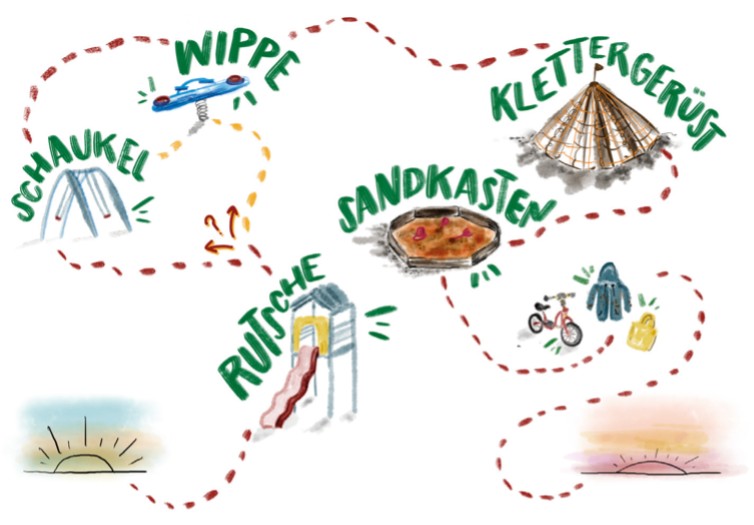
Afterward, followed a dramaturgical idea for the concert, by imagining a child, who wakes up in the morning, is active during the day, needs to get ready, leaves the playground and goes to sleep at night. The aim was to implement a narrative level into the program, which also reflects the temporality and situatedness of the playground sounds depending on the time of the day.
Only in a last step the students’ group decided which piece of music could reflect the specific sonic explorations and the way the materials, the bodies, and the sounds interacted with each other [see figure 2]. The selection of musical pieces based on various decision parameters: sound markers (Stockhausen), bodily movements (Maierhof), Expanding cohort of children using the seesaw (Riley), the children’s different positions on the climbing frame (Skempton), the used material and instruments (Jotter), the social interactions shaped in the composition (Leroux).
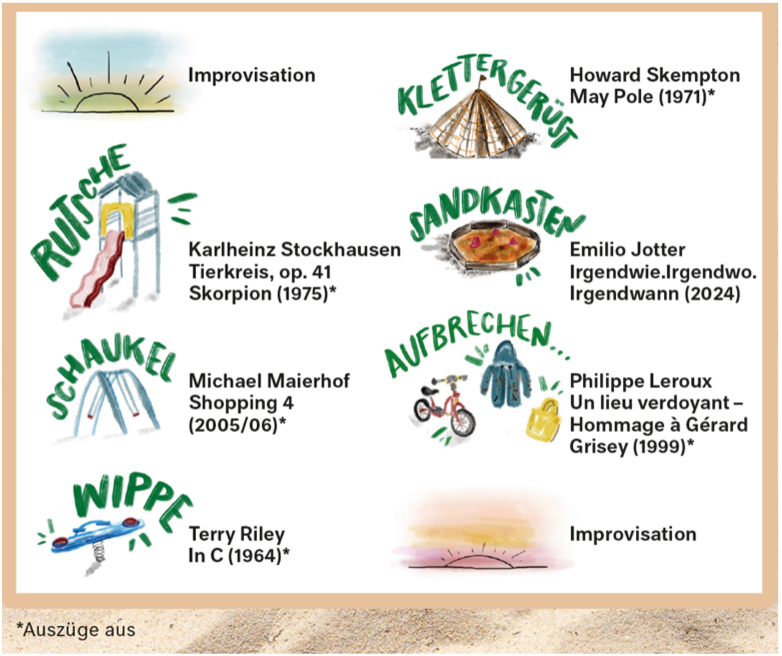
During the performance the students and the children formed together a performer-audience-collective. The actual pieces of music were performed after improvisations with the specific playground equipment combined with the instruments. Therefore, the borders of making sounds with the material on the playground and performing sounds based on musical works blurred. They interwove with each other, especially because the whole nexus of a musical work as an isolated and aesthetic artwork, as it is usually evident in classical concerts, did not exist.
The students explored the sounds of the playground equipment, e.g., the squeaking of the swing, as more than a mechanical by-product of use, but as a sonic quality of embodied intra-action, inscribing bodily presence into the sonic playground. Its rhythmic, metallic resonance formed part of the ecology of relations at the site, mediating between materiality and movement, absence, and presence. In this sense, the squeaking did not simply accompany play but constituted a relational sound event, foregrounding the entanglement of bodies, materials, and environment.
1.3 Artistic-led Attuning Method
Building on these practical insights, the “artistic-led attuning method” was developed as a framework for creating concerts in civic spaces. It emphasizes three key qualities – attentiveness, exploration, and imagination – that are characteristic for its application. Although there is some sense of journey through the three elements, they primarily operate as a framework of values rather than a linear order.
Attentiveness
For the method, attentiveness means to engage sonically with a place and its humans and non-humans in a focused mood. It requires openness and the habit of responsibility for sharing sonic relations. To listen and to be sonically present also means to share a sense of intimacy and fragility. The artist-students, who listened within the playground, were engaged themselves. They weren’t passive observers, which made them develop a shared sense of being involved with the sounds, with the children, their emotions, their ideas and playing habits.
In Folkert Uhde’s concept of concert design attentiveness is an aim which is achieved through intentionally designed spatial, dramaturgical, or multi-sensual settings, and involves intentional slowing down and specific settings of lights and seats (Uhde and Gögel, 2024).
Within my methodological framework, attentiveness is not a goal met by concert design, but it rather constitutes the fundamental mode of sonic engagement with a place. I propose that such attentive listening reflects both a specific artistic opportunity and a domain of expertise, one in which artists are continuously trained and actively engaged.
Exploration
As described above, within improvising with the playground equipment and within performing the music the different sonic agencies (the material, the instruments, the humans, the non-humans etc.) explored each other in a mutually co-constitutive way. This engagement extends beyond mere analogy structures between music and sound based on melodic, rhythmic, or formal similarities. It does not, for instance, assume that the squeaking of the seesaw is reflected within the melodic structure of a particular piece of music.
The ways in which the musicians collaborate with the playground equipment – either by ‘playing’ it directly or reflecting its sounds through their instruments – articulate a bodily mode of engagement. The bodily movements become sonic events and vice versa. It is an exploring-in-the-making that focuses on how meaning, intention, and emotional experience change in the interplay of body and sound. These bodily-sonic explorations intertwine the sonic materialities of both the playground and the musical pieces. Through this, the playground’s conventional function is transformed – or, rather, brought into focus in a novel way: as a co‑constitutive collaborator in a sonic event. Furthermore, sounding and listening emerge as inherently embodied processes that themselves generate new sonic explorations.
Barry Truax’s idea of a continuum offers a framework for the idea of sonic explorations. Truax describes the relationship between sound and music as a continuum, where musical, speech, and environmental sounds function as parts of a broader communication system (Truax, 2016). Rather than treating music and sound as separate categories, he frames both as forms of organized sound capable of carrying meaning within particular social and environmental contexts. While in his work the notion of continuum is grounded in soundscape composition, I appropriate this concept as a framework to theorize the new mode of listening within concert design.
Imagination
By transferring the sonic experiences of a civic place like the playground into a piece of music, another “sonic world” is offered (Voegelin, 2021). A world which engages other forms of embodiment and other ways of engaging with the place. Listening to the artistic sounds of the musical pieces offers the possibility to raise awareness for the architecture of the place, its size, and materiality (Voegelin, 2021). After Voegelin, imaginative listening produces dynamic sonic life-worlds that coexist with and transform the real world, emphasising the contingent, fluid, and plural nature of sonic experience. The artistic-led method enforces this way of imaginative listening, because the music gives an additional structure to the sounds.
In the context of soundscape composition Barry Truax defines imagination as a process of engaging the listener by re-creating events, emotions, and cultural memory through sound. Truax situates the potential of soundscape compositions in the realm of electroacoustic compositions. In my method, it is not a matter of an electroacoustic set-up. It is about the potential to enlarge imagination and how Truax calls is “dreaming” (Truax, 2016) through the artistic engagement and through interweaving other sonic agencies like instruments and musical pieces into the place.
2. Listening in and beyond the field of Sonic Citizenship
This section brings together the theoretical foundation on which this practically tested method is built and how the method addresses tensions, supports, or strengthens specific questions in these research fields. The question which is central for me is, how listening is conceptualized within the discourse of sonic citizenship and in how far the introduced method reflects possibilities to develop further the idea of what listening does.
In a first step, this chapter synthesizes listening concepts articulated within the discourse of sonic citizenship, and subsequently delineates listening epistemologies that extend beyond this specific field, and how these can develop further the way of attuning to places and communities.
2.1. Listening within the Field of Sonic Citizenship
Sonic citizenship posits that the enactment of social and political life extends beyond speech or legal status to include practices of listening, sound production, and the communal configuration of acoustic environments. Listening then describes the medium through which individuals relate to a collective or an environment sonically, e.g., by receiving neighbourhood-noise, by regulating their behaviour through attuning to the environment or by negotiating belonging or exclusion in the sonic. To summarize in the language of Annette Vandsø, a listener is: “A citizen who responds to given circumstances, for instance, through strategies for listening, protesting, or on more subconscious levels, attuning themselves to the messy and fragile sonic environment that surrounds them.” (Vandsø, 2023, p. 8).
Out of the literature on listening in sonic citizenship, e.g., on communal listening (Phelan, 2018), on transliminal listening (Andrisani, 2017) the attunement approach (Højlund, Vandsø and Breinbjerg, 2024; Højlund et al., 2021) provides a detailed ontology on how listening in sonic citizenship is enacted.
As a critical re-framing of Schafer’s soundscape approach and his idea of tuning the world to the human ear, the attuning approach redefines listening as a situated, embodied, and dynamic practice of adjustment between the listener and their sonic surroundings: “In contrast, the attuning approach works through a relationship between the listener and the sonic environment, and thus with a distinctly situated perspective” (Højlund, Vandsø and Breinbjerg, 2024). Rather than treating listening as a passive sound perception, listening within the idea of attunement is understood as a process of ongoing sensitivity and responsiveness to the temporal, spatial, and social layers within a soundscape. The listener not only receives sound but aligns their bodily rhythms, attention, and emotional states with the shifting atmospheres around them. By cultivating this mode of engagement in the process of listening, the attuning approach points at the capacity to reshape sonic environments and fostering new forms of sonic participation and citizenship.
Højlund, Kirkegaard, Kristensen, and Riis (2021, p. 433) focus on the attunement approach as a methodology to describe how strongly the sonic controls or acts within the “atmospheres of everyday life”. In the project of Sandra Lori Petersen, listening is conceptualized as a spatial relation between neighbours living in apartments on top of the other. Petersen (2021) reflects on the domestic-personal sphere and describes listening as “bulging spheres”, a spatial metaphor which closely aligns with the attunement model of Højlund and others (2024).
To conclude, it can be noted that listening is understood as a relational, situated, and embodied practice. As a central point of reference, Schafer’s one-dimensional reaction model (tuning) is further developed toward a reciprocal relation within sound (attuning).
2.2. Listening beyond the Field of Sonic Citizenship
While the explicit phrase “sonic citizenship” is relatively recent, its ideas can be traced through several overlapping debates on listening epistemologies in the broader sound studies discourse.
Sound studies scholar Nina Sun Eidsheim focusses on sound as a vibrational and multisensorial practice. Sound does not appear as something registered in solitary auditory perception, but as a vibratory, sensuous event (Eidsheim, 2015). Eidsheim’s umbrella term “the thick event of music” (ibid., 160) encompasses the “tactile, spatial, physical, material, and vibrational sensations” (ibid., 8) and provides the multi-layered and inter-material framework for situating the practitioner’s listening within civic places.
Salomé Voegelin urges us to privilege “listening in” rather than “listening to,” acknowledging the singular, contingent character of auditory experience and the forms of knowing it enables. Voegelins concept “sonic sensibility” underscores the idea that through or better in listening a new way of imagination can develop. Together with Mark Peter Wrights she brings this capacity of imagination into the realm of social life. Grounded in the larger workshop series “Points of Listening”, a programme of experiential listening strategies in and around London, their approach shifts focus away from what is known or how invisible sounds shape the world toward listening as a distinct mode of being and experiencing. “Participative sonic knowledge” embodies the relational, entangled, and contingent potential of sound as a medium of collective action and an alternate form of communal existence. This, they suggest, leads to a different way of knowing – one that envisions a polyphonic community through sound (Voegelin and Wright, 2022, p. 36).
Marcel Cobussen (2022) and Kevin Toksöz Fairbairn (2022) situate the sonic within feminist new materialist thinking. This approach foregrounds the intra-active, co-constitutive nature of listening, challenging narrowly anthropocentric and disembodied models in favor of a relational understanding informed by feminist new materialist theory. In Buyken and Losleben’s approach (2024) listening is reconceptualized as an embodied, multisensorial, and entangled practice, wherein material, spatial, and social agencies co-emerge through acts of sonic engagement. Together with Katrin Losleben we propose a perspective on sounding and listening as processes of becoming-with sounds, bodies, and materials. Translating Barad’s theoretical insights into musical practice, we argue that listening is an entangled, intra-active process in which humans, instruments, sounds, and spaces co-emerge and co-constitute meaning through their intra-active engagements, what we term “becoming-with”.
Situated within the discourse of climate change, sonic geographies, feminist and place studies, Elizabeth Barron and Katrin Losleben analyse the importance of sound for understanding places. They argue that listening “reveals things to the senses about a place that are not available to the other senses; to constitute place without sound is thus to miss an entire dimension of that place.” (Barron and Losleben, 2025, p. 201). Listening, in their account, operates as a narrative and sensory modality through which collective emotion, practices of care, and relational place-making intersect, generating alternative frameworks for comprehending a place and those who dwell within it.
These approaches explicate the ways in which listening is understood as part of a becoming-with a place, becoming-with a community. What becomes evident is the co-constitutive and intra-active quality of listening and how listening is inextricably entangled with place.
The introduced method reflects this transition from a relational mode of listening to one that is co-constitutive with humans, places, materials, and other agencies. The way how the sonic agencies at the playground entangle with each other comes to the fore. This is not merely a matter of relating but of coming-into-being. By situating listening within these thoughts on listening epistemologies in sound studies discourse, I argue that the potential of attunement with places and communities can be significantly expanded.
3. Listening as worlding
Both, sonic citizenship and artistic citizenship are grounded in the premise that sonic practices – such as listening, sound-making, playing, or performing – affect the realm of social life. But, I ask, how is this reached? What role does listening play? How, then, is listening conceptualized to enable social transformation?
The field of artistic citizenship seeks to create encounters between people from diverse biographical, social, religious, or cultural backgrounds – individuals whose paths might otherwise never intersect. This is pursued through a wide range of musical practices and specific artistic formats and leads to the re-conceptualisation of concert formats. Although concepts and strategies, e.g., like those of audience engagement, try to be as inclusive as possible, to what extent are these concerts open to different modes of listening and sounding? Do they create a framework for diversity? Even with participatory and educational elements, they constitute Western-influenced sonic spaces designed for musical-aesthetic events. Does it remain as Bowmann (2016, p. 77) reflects: “[…], no concept of artistic practice or artistic citizenship can be infinitely inclusive?”
Through bringing the two fields of artistic and sonic citizenship together the question of how social transformation can be achieved becomes evident. Therefore, I distinguish between two kinds of community, which are both infused by sound, and both hold the potential to unfold a socially transformative force in the sense of citizenship.
In the first case (see figure 3) agency is empowered by conferring an explicitly artistic form to an assembled gathering. This applies to concerts, also participatory concerts, or community-based performances. Here, it is the form itself (see the blue line in figure 3), e.g., the intentionally designed spatial, dramaturgical, or multi-sensual setting, that generates the social force (see the yellow arrows), which can in turn influence broader social and political realms.
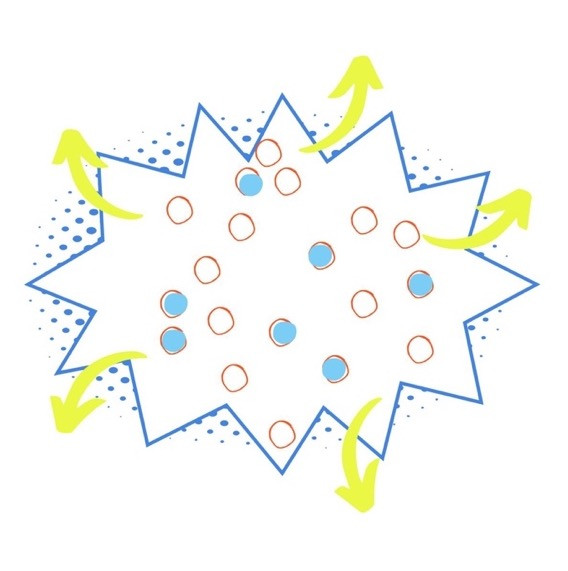
Figure 4 illustrates another pathway for socially transformative force. Agency arises in sonic interactions (note the blue-line network), like those on a playground, co-emerging in the everyday sounds of humans, spaces, and non-humans rather than added externally. In the acts of listening and being heard, the community constitutes – and empowers – itself (see the yellow spiral).
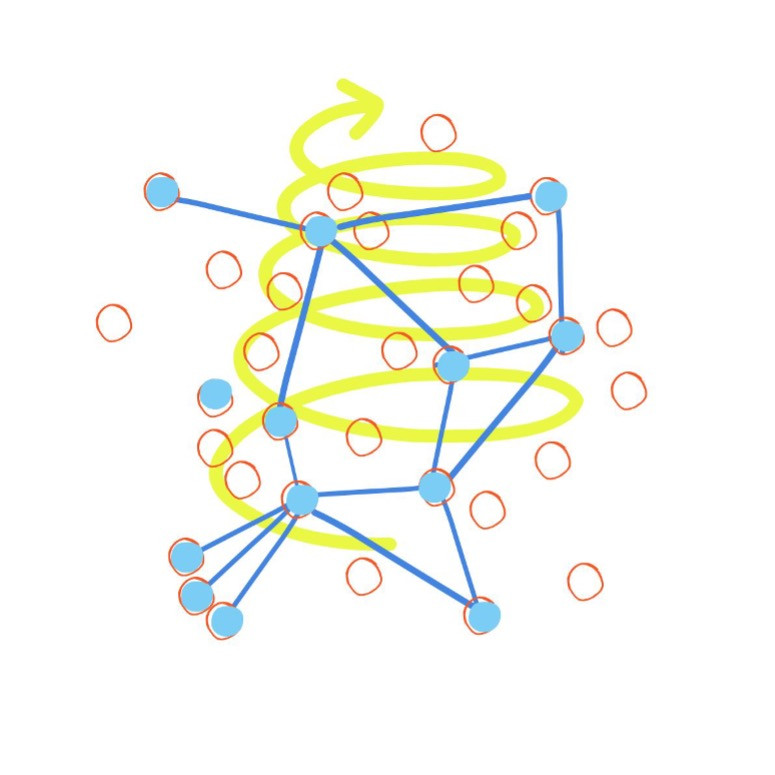
Following this thought, sonic experience is never isolated, but always an entangled “worlding” (Haraway, 2016, p. 13) co-produced through intra-material relations. Recapitulating Brandon LaBelle (2018), the potentialities of sonic “worlding” lie in the power of becoming-together in difference, and in forming community through shared yet divergent acoustic experiences – a process always open, situated, and politically consequential.
Wendy Harcourt introduces worlding in that way: “I use the term worlding […] to describe how we create and experience different interconnected worlds – past, present and futures – human and non-human worlds, material and spiritual worlds with different practices, cultures, and natures connecting them” (Harcourt, 2019, p. 156). She conceptualizes worlding as active practices of art, commoning, and hope-making that cultivate interconnected human-nonhuman worlds. Worlding, to phrase it differently, “is informed by our turning of attention to a certain experience, place or encounter and our active engagement with the materiality and context in which events and interactions occur” (Palmer and Hunter, 2018).
The artistic-led attuning method exactly points at that question, how social transformation can emerge in different settings, such as in everyday sonic practices or in artistic sonic practices like in concerts. It aims at overcoming the exclusive form of how people gather in concert by implementing the music into the everyday sounds and sonic relation in a space of everyday life.
By implementing artistic sonic practices, such as improvisations and compositions, into the realm of a civic place – as it has been developed within the method – another sonic world emerges. This is enacted by the musicians’ bodies, their instruments, and their cultures and histories belonging to them. Together with these sonic agencies the place becomes different, and the listening as worlding becomes different. Because it is enriched through artistic qualities such as attentiveness, exploration, and imagination.
As a performer I then have the possibility to actively engage within the sonic relations of those who inhabit spaces, living, working, playing, or learning within them. My artistic sonic world co-emerges with the already rich sonically worlds around me. Therefore, the idea of this research, does not lie in bringing classical music to people far from the concert hall, but rather in creating a new perception of places within society through an artistic attentiveness to place.
- 1
I thank Katrin Losleben for the critical, constructive, and inspiring discussions that preceded the writing of this article. I am grateful to Jasmin Odendahl for our collaboration and for creating the two illustrations (figure 3 and 4).
- 2
Please follow the projects of the Cölner Barockorchester here: www.coelnerbarockorchester.de
- 3
I am deeply grateful for the exchange with Prof. Dr. Corinna Vogel in the context of this project and for the opportunity to engage with the concert as a material part of my research. My gratitude also extends to master’s student Klara Kohl, who shared important background information with me during my class.
Keywords
Bibliography
Anderson, B. and Harrison, P. (2010) (eds) Taking – Place: Non-Representational Theories and Geography. Farnham: Ashgate.
Andrisani, V. (2017) Inventing Havana in Thin Air: Sound, Space, and the Making of Sonic Citizenship (Doctoral dissertation). Vancouver: Simon Fraser University.
Barad, K. (2008) Meeting the Universe Halfway. Quantum Physics and the Entanglement of Matter and Meaning. Durham, NC: Duke University Press.
Buyken, E. & Losleben, K. (2024) "How do Cellists and Sounds Become with Each other? Exploring the Entanglements of Artistic Research and Agential Realism". In Music & Practice, 11/2024.
Barron, E. and Losleben, K. (2025) "Emplacing Watery Encounters: Listening, Care, and Embodied Knowledge for Sustainable Climate Futures". In Progress in Environmental Geography, 4(2).
Bowman, W.D. (2016) "Artistry, ethics, and citizenship". In D. Elliott, M. Silverman, and W. D. Bowman (eds.) Artistic citizenship: Artistry, social responsibility, and ethical praxis. New York: Oxford University Press, pp. 59–80.
Cobussen, M. (2022) Engaging with Everyday Sounds. Cambridge: Open Book.
Eidsheim, N.S. (2015) Sensing Sound. Singing and Listening as Vibrational Practice, Durham/London: Duke University Press.
Elliott, D. J., Silverman, M. and Bowman, W. D. (2016) Artistic citizenship: Artistry, social responsibility, and ethical praxis. New York: Oxford University Press.
Fairbairn, KT. (2022) dis/cord: Thinking Sound through Agential Realism. Brooklyn: punctum.
Haraway, D. (2016) Staying with the Trouble: Making Kin in the Chthulucene, Durham and London: Duke University Press.
Harcourt, W. (2019) "Feminist political ecology practices of worlding: art, commoning and the politics of hope in the classroom". In International Journal of the Commons, 13(1), pp. 153–174.
Højlund, M., Vandsø, M., and Breinbjerg, M. (2024) "Sonic Citizenship: About the Messy and Fragile Negotiations With and Through Sound". In Journal of Sound Studies 26. Available at: www.researchcatalogue.net/view/3032038/3032039
Højlund, M., Kirkegaard, J.R., Kristensen, M. S. and Riis, M. (2021) "The Overheard: An Attuning Approach to Sound Art and Design in Public Spaces". In M. Bull and M. Cobussen (eds.) The Bloomsbury Handbook of Sonic Methodologies. New York: Bloomsbury Academic.
LaBelle, B. (2018) Sonic Agency. Sound and Emergent Forms of Resistance. Cambridge, MA: Goldsmiths Press.
Lacey, K. (2023) "The Labour of Listening in Troubled Times". In Journal of Sonic Studies 24. Available at: www.researchcatalogue.net/view/1932647/1932646
Losleben, K. (2023) Soundwalking & Soundsitting. A Manual for the Conductors. Available at: https://issuu.com/arcticauditories/docs/arctic_auditories_soundwalk_booklet_eng_flipbook#google_vignette (Accessed September 29th 2025)
Palmer, H. and Hunter, V. (2018) "Worlding". Available at: www.newmaterialism.eu/almanac/w/worlding.html (Accessed September 29th 2025).
Petersen, S. L. (2021) "Sonic Relations as Bulging Spheres". In Journal of Sonic Studies, 22. Available at: www.researchcatalogue.net/view/1406993/1406994
Phelan, H. (2018) Sonic Citizenship-Right and rites of belonging in Ireland, in Making Congregational Music Local Christian Communities Worldwide. London: Routledge.
Truax, B. (2016) Music, Soundscape and Acoustic Sustainability. Available at: www.sfu.ca/~truax/Sustainability.pdf (Accessed September 29th 2025).
Uhde, F. (2018) "Konzertdesign: Form Follows Function". In M. Tröndle (ed.) Das Konzert II, Bielefeld: transcript, pp. 121–148.
Uhde, F. and Gögel, H.J. (2024) "Strategies of Proximity. Breaking away from the Standard Classical Concert". In N. Smith, P. Peters and K. Molina (eds.) Classical Music Futures: Practices of Innovation. Cambridge: Open Book Publishers.
Voegelin, S. (2020) Uncurating Sound: Knowledge with Voice and Hands. New York: Bloomsbury.
Voegelin, S. (2021) Sonic Possible Worlds, Revised Edition. Hearing the Continuum of Sound. New York: Bloomsbury Academic.
Voegelin, S. and Wright, M.P. (2022) "Points of Listening: Reflections on the Participatory and Polyphonic Potential of Communal Sonic Practices". In The Polish Journal of Aesthetics 64 (1), pp. 19–36.
Vandsø, A. (2023) "Rereading 4’33 as Sonic Citizenship. On the conceptual framework for urban sounds". In Parby, J. I. (ed.): Conference Proceedings: Sound, Language and the Making of Urban Space, August 24-25, Copenhagen. University of Copenhagen and Museum of Copenhagen.
Westerkamp, H. (1974) "Soundwalking". In Sound Heritage, III (4), Victoria, B.C.