



Sonic solidarity
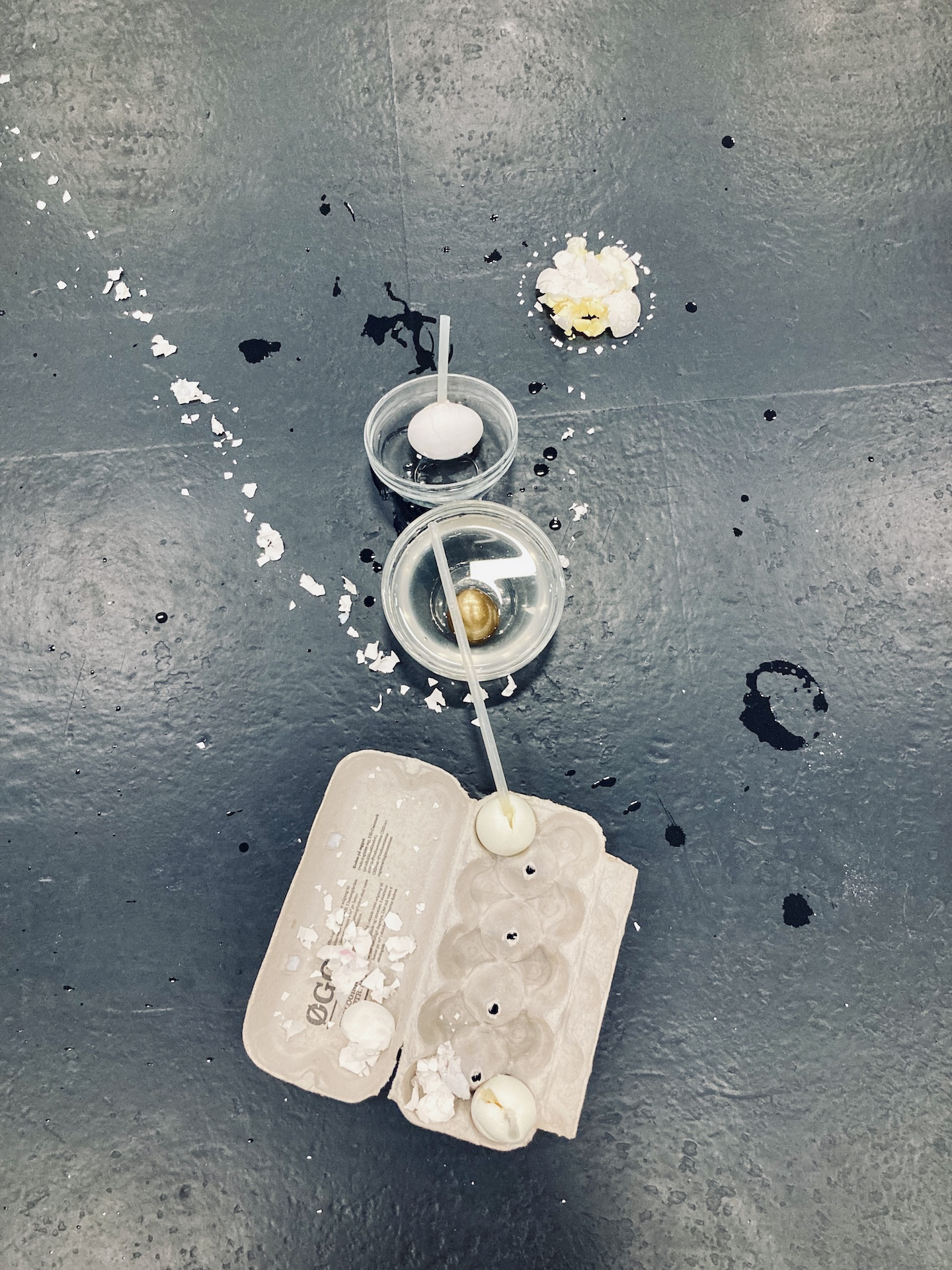

Abstract
This audio paper examines how sonic solidarity is formed within a separatist community of women who have undergone fertility treatment, as explored through the project Listening Choir (2024–2025). Through monthly gatherings, participants come together to share experiences of hope, disappointment, shame, desperation, anger, and grief. The choir’s listening practice is grounded in feminist thought (Sara Ahmed, Donna Haraway, Silvia Federici) and the principles of Deep Listening. Within this framework, the women come to experience their voices as autobiographical instruments (Carson 2025, 21), while exploring how vocal practice enables them to stretch, transform, and reimagine themselves (LaBelle 2014, 5).
The sound material analyzed in this paper was recorded during the Listening Choir sessions and consists of vocal exercises in which the women express mutual support by sounding together and joining free tones. An additional recording is an experimental, rhythmically structured composition based on the many medications taken during fertility treatment. The resulting cacophony, interwoven with moments of tonal harmony, forms a sonic image of the solidarity that characterizes the soundings of the Listening Choir.
The Listening Choir function as a separatist group (Gaonkar & Schmidt 2024) inspired by consciousness raising groups from the 1970s, seeking a shared practice capable of offering relief and healing. A further aim has been to reclaim – through the body, voicing, and listening – the potential and power of bodies subjected to intense hormonal and interventional treatments, particularly in the abdominal region. As Silvia Federici writes, “Our bodies have reasons that we need to learn, rediscover, reinvent. We need to listen to their language as the path to our health and healing …” (2020, 123).
Audio paper
Recordings, research and speak: Tanja Diers
Mix and editing: Mads Brauer
Keywords
Bibliography
Ahmed, Sara (2024) “Feminist Ears”. In Bodies of Sound. Ed. Revell, I. & Shin, S. (pp 276-295). Silver Press. Bell & Bain Ltd., Glasgow.
Carson, Anne (2025) The Gender of Sound. UK: Spiral House.
Diers, Tanja (2025) “You Cannot Kill My Nature If I am Already a Cyborg”. In Matter #4 (pp. 45-53), Teaterhögskolan Malmö.
Federici, Silvia (2020) Beyond the Periphery of the Skin: Rethinking, Remaking, and Reclaiming the Body in Contemporary Capitalism. Oakland, CA: PM Press
Gaonkar, A. M., & Schmidt, C. U. (2024) “Separatistiske fællesskaber af racialiserede kunst- og kulturarbejdere i Norden”. In A. Ogundipe, & A. Danielsen (red.), Fellesskap, konflikt og politikk: Spenninger i kunst- og kulturfeltet (p. 87-130). Fagbokforlaget.
Hanisch, C. (1970) “The Personal Is Political.” In Notes from the Second Year: Women’s Liberation, Radical Feminism, Shulamith Firestone and Anne Koedt (eds.). Accessed June 13, 2025. https://ufdc.ufl.edu/AA00048258/00001/images.
Hanisch, C. (2006) “Introduction.” Accessed June 13, 2025. https://www.carolhanisch.org/CHwritings/PIP.html
Haraway, D. (2016) A Cyborg Manifesto: Science, Technology and Social-Feminism in the Late Twentieth Century. University of Minnesota Press.
LaBelle, B. (2014) Lexicon of The Mouth – Poetics and Politics of Voice and the Oral Imaginary. Bloomsbury Publishing.
LaBelle, B. (2018) Sonic Agency – Sound and Emergent Forms of Resistance. Goldsmiths Press. 2018.
LaBelle, B. (2025) Poetics of Listening – Inner Life, Social Transformation and Planetary Practices. New York/London/Dublin: Bloomsbury Publishing Inc.
Oliveros, P. (2021) Breaking the Silence (1998). Copenhagen: Passive/Aggressive.
Oliveros, P. (2022) Quantum Listening. London: TJ Books Limited. Terra Ignota.