



Out of Utopias and Down to Earth
When, trying to get home, you attempt to squeeze yourself onto an already overcrowded train together with a wall of utterly exhausted festivalgoers who, over the course of a week, have had every last veneer of civilisation peeled off them, you learn the hard way that Roskilde Festival’s dream of a loving and inclusive community has a habit of colliding with a much harsher reality. And yet even here, you can still feel your heart warm when a group of young people on that packed train share, via a recording on their phone, their delight at seeing Birthe Kjær appear on stage during Tobias Rahim’s concert in the early hours of Friday morning.
There is still room here to dream grandly, vulnerably and openly, but the dream is also confronted by the noise of a concrete and conflict-ridden world
You cannot live inside the dream, but »the dream paints reality,« as Rahim himself has written – and it is a line that speaks directly to the phenomenon of Roskilde Festival in 2026. There is still room here to dream grandly, vulnerably and openly, but the dream is also confronted by the noise of a concrete and conflict-ridden world.

Much has been written about the long-awaited new Orange Stage. Based on the few concerts I heard there myself this year, it looks much like the old one from the audience’s perspective and thus does not outwardly change the festival experience all that much. Bigger changes have taken place elsewhere on the festival grounds, where the stages Apollo and Avalon have been retired in favour of Fauna and Lagoon. The names speak for themselves: the festival is moving away from the older stages’ allusions to the world of mythology and towards something more grounded and tangible – a connection to, and a commitment to, nature. The change comes at the same time as the festival moves away from the theme of Utopia, which has served as a kind of framework for the past three years. Fittingly, the legendary British grindcore band Napalm Death deliver one of the festival’s most brutal highlights on Thursday. Utopia Banished is the title of one of their classic albums from 1992, and their Roskilde set likewise becomes a pummelling ritual, urging us to throw ourselves out of the softness of utopia and into the grinding mosh pit of reality.
Even the architects of utopia need to get some real earth under their fingernails – and at Roskilde Festival, they do
In a very different musical register, Swedish pop star Zara Larsson, this year’s closing headliner on Orange Stage, delivers a summery pop extravaganza whose radiant musical palette may look like a utopia, but which also preaches a message that now and then you have to allow yourself to be ugly in order to arrive at true beauty. Even the architects of utopia need to get some real earth under their fingernails – and at Roskilde Festival, they do.
Bodily turbulence and musical jet lag
In very concrete ways, several of the musicians at the festival are affected by an overheated reality. From the stage, French artist Oklou talks about having come directly from an extreme heatwave in her home country to a raw, cold and windy Friday evening at Roskilde Festival – and about how hard it has been to adjust.
If this is what she sounds like on a bad day, I hardly dare imagine what she sounds like on a good one
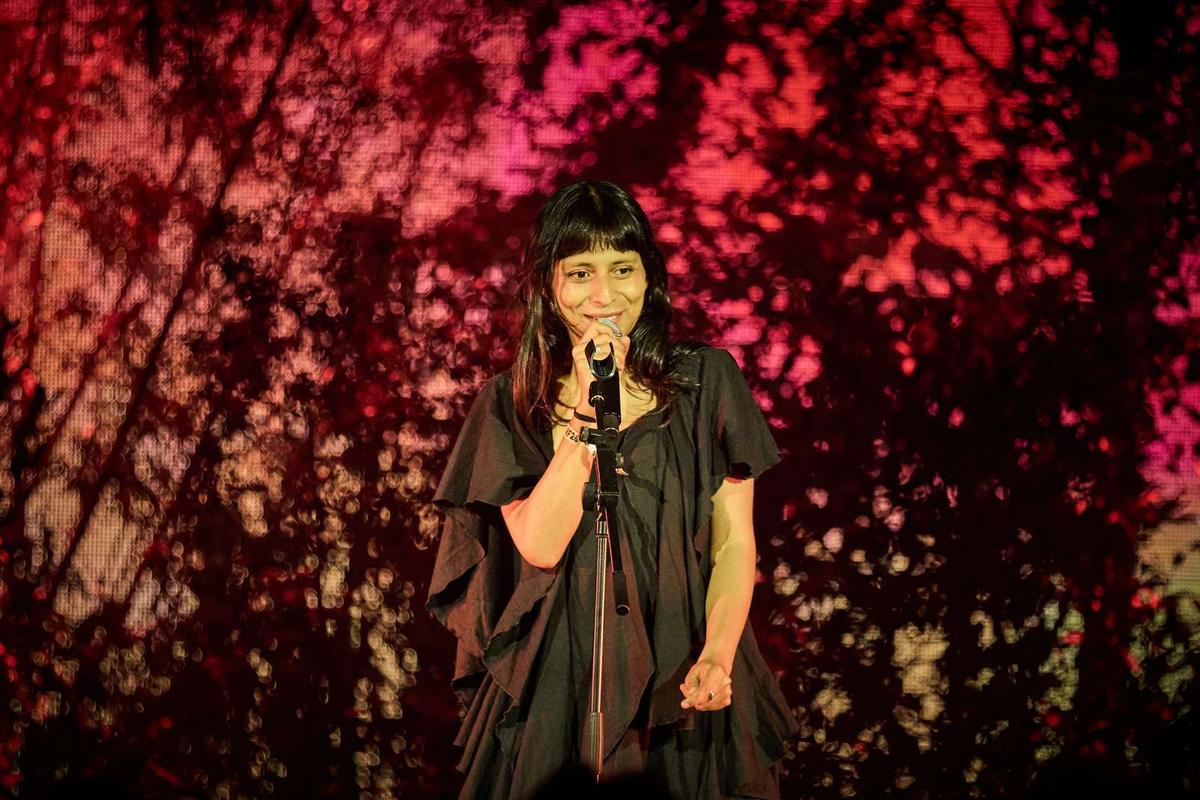
The heatwave has also lodged itself directly in the musical body of Mexican musician and trans activist Luisa Almaguer, who apologises for the way days of wild temperature swings and air conditioning have hit her like the flu and affected her central instrument: her voice. That said, if this is what she sounds like on a bad day, I hardly dare imagine what she sounds like on a good one, because she still delivers one of the strongest vocal performances of the festival with her deep, melancholic voice. At the same time, she dishes out some tough love to the audience, saying that she loves us, but that precisely for that reason she needs to shake us awake and urge us to take responsibility – both in relation to the hatred and violence being poured over trans people around the world, and in relation to the apocalyptic state of the world itself. “Trans people have been here since the beginning of time, and we will be here until the end of the world … which is, in a way, now,” she adds darkly.
We have to prepare ourselves for extreme contrasts, and Roskilde Festival remains a good school in that regard. Where else can you move directly from Almaguer’s grim prophecies and painful experiences to Addison Rae’s hyper-energetic sugar rush of a pop show, and then on again to Los Thuthanaka’s psychedelic meltdowns, obsessive rhythms and tripped-out guitar figures that sound as if krautrock had been born in the Andes?
We have to prepare ourselves for extreme contrasts, and Roskilde Festival remains a good school in that regard
If one can speak of a kind of musical jet lag – the sensation that arises when you are abruptly shifted from one musical zone to another – then Roskilde Festival is surely where you find it. It can certainly become too much, but the turbulence it creates also has a way of making you receptive and raw-skinned in ways you rarely become at ordinary concerts. And to my mind, that is one of the crucial points of festivals like Roskilde.
Perhaps for that very reason, it also feels like a shock when, on Thursday evening, I let myself be shaken by Uncle Acid & The Deadbeats’ heavy psychedelic and occult rock, only for the concert suddenly to be interrupted for »reasons we are not yet able to disclose,« as a Roskilde Festival representative announces from the stage. The next day, we learn that the cancellation was due to adverse weather conditions that meant sound from the Lagoon tent was interfering with the headlining Gorillaz concert on Orange Stage. No doubt that was true, but can it really be right that one band and its fans should be thrown under the bus for the sake of another concert at a festival otherwise nourished by the narrative that what happens on the smaller stages is at least as important to the festival’s DNA?
Roskilde Festival, too, contains a powerful elite capable of dictating the terms of the community
Of course, we know very well that behind the festival’s utopian ideals of solidarity there is also plenty of arm-wrestling with heavyweight agencies, but it still feels like a loss of innocence when you are hit so directly by the sense that Roskilde Festival, too, contains a powerful elite capable of dictating the terms of the community.
Deep listening and liberating dance
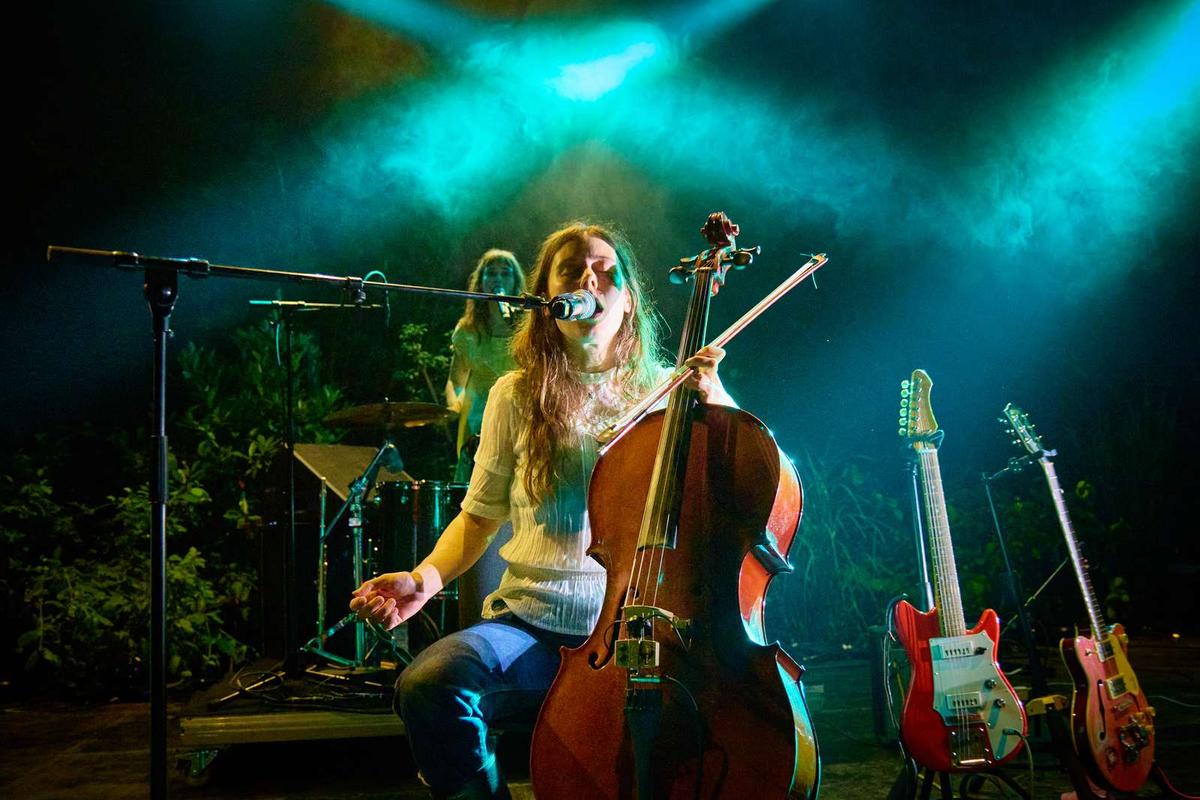
Fortunately, there are still plenty of oases for experimental music at the festival, where the Slovenian trio Širom deliver one of the weekend’s strongest concerts with their endlessly imaginative universe and arsenal of sound objects, ranging from traditional instruments such as hurdy-gurdy and banjo to a roll of tape. Few bands are as capable as this trio of creating a musical space that is at once meditative and constantly surprising.
Listening is a skill that must be trained, and Širom’s concert is an exceptionally fine training camp. The British band The New Eves also inspire enthusiasm at Gloria with their skewed yet charming blend of folk music, post-punk and witch-like cabaret, while electronic musician Blawan delivers sublime experimental techno in the dark on Friday night.
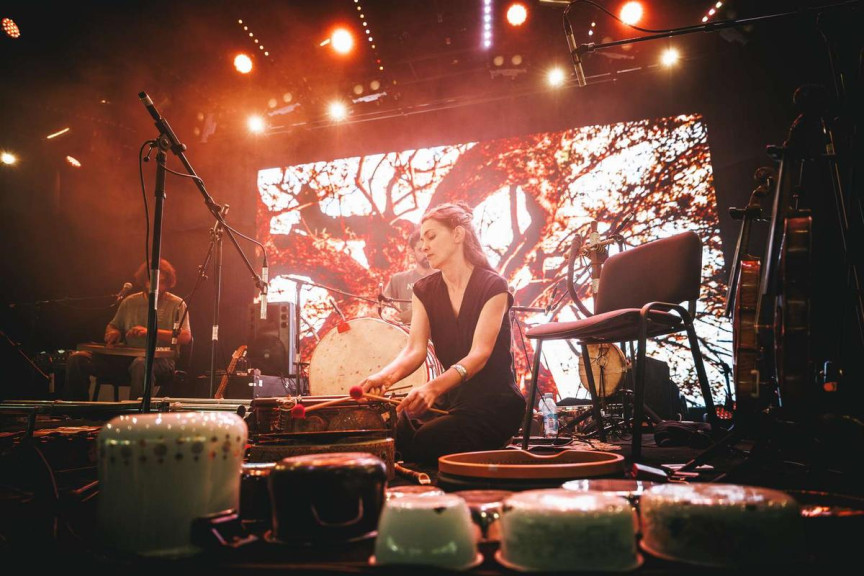
More generally, this year’s Roskilde Festival excels at throwing great dance parties, but the festival also demonstrates the diversity of musical spaces in which dance can unfold – and that dance itself can be an act of resistance in a world on fire. For in dance, too, a utopian search for freedom and community collides with a physical, sweaty sense of presence. The erotic liberation is dialled up when Swedish artist Cobrah (who also reveals from the stage that she is half Danish) transforms Lagoon, together with her two dancers, into a dark nightclub filled with BDSM-inspired moods and club-oriented electronic pop that goes straight to the body.
For in dance, too, a utopian search for freedom and community collides with a physical, sweaty sense of presence
On the same stage, American singer Rochelle Jordan provides a dazzling and danceable finale to the festival with a tight concert that is practically a tour de force through several eras of hedonistic nightclub atmosphere, synthesising classic disco and hard house music. Finally, the female collective Pili Pili Girls from Tanzania deserve special mention for delivering the festival’s most fun dance party, complete with loose-limbed exuberance, colourful costumes, twerking and lightning-fast singeli beats on Platform.
Flower children and biblical B-sides
Roskilde Festival is always balancing between staying true to the hippie ideals on which it was founded – and which are still frequently signalled by peace signs on the giant screens around the festival – and looking towards new horizons instead of sinking into nostalgia. In magical fashion, The Savage Rose manage to strike that balance with a lively and finely played concert that radiates hippie spirit without averting its gaze from the horrors of our own time. There is hardly anyone like Annisette when it comes to speaking of human beings as fragile flowers in life’s wild field without tipping into kitsch, and no one who with equal authority and indignation can sing the peace hymn »Kringsat av fiender« with its closing line, »We will take care of beauty, of warmth / as if we were carrying a child gently in our arms,« and make both young and old fight back tears together. And while the band does carry beauty carefully forward, they also begin their concert with a blazing version of Bob Dylan’s »Masters of War«, where blooming utopias feel very far away in bitter lines such as »And I hope that you die / And your death’ll come soon.«
Travelling by way of the hippie era all the way back to the time of King Solomon and then straight into a dancing present
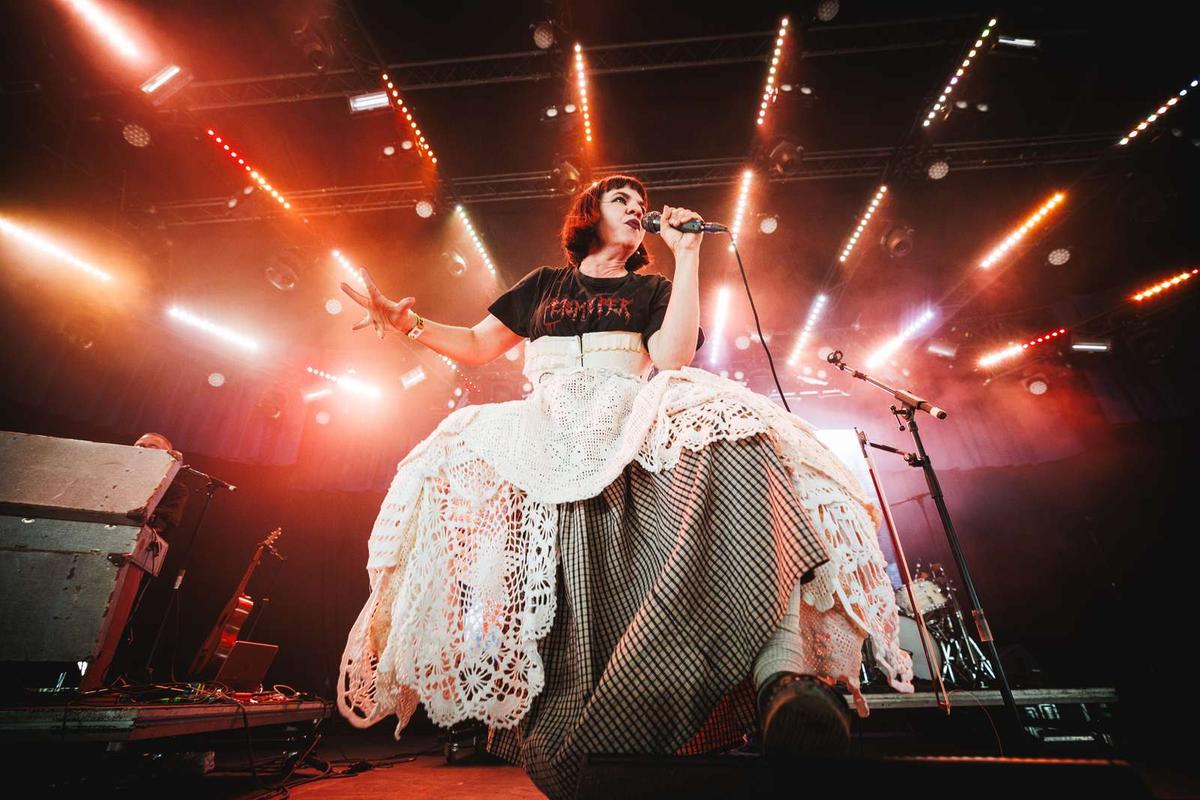
Sometimes you have to look back in order to look ahead, and while Danish politicians at Christiansborg are busy talking about spiritual rearmament and Christian values, the progressive Swedish folk musician Sara Parkman reaches back to texts from the apocrypha of the Old Testament – »a kind of B-sides to the Old Testament,« as Parkman cheekily puts it – in order to deliver a glowing defence of the necessity of art as something that transcends the divisions of nationalism and human pettiness that otherwise separate us. That, too, can induce cultural jet lag: travelling by way of the hippie era all the way back to the time of King Solomon and then straight into a dancing present.